Not everybody is as excited about the upcoming Eurovision Song Contest as we are in my house. Do not mistake this competition for a ‘song contest’, because it isn’t. The truth is that the Eurovision is a thinly-veiled politically motivated popularity contest – in fact, you will pick up more about European history and geography in those two hours than most people have after 13 years in school. Trust me.
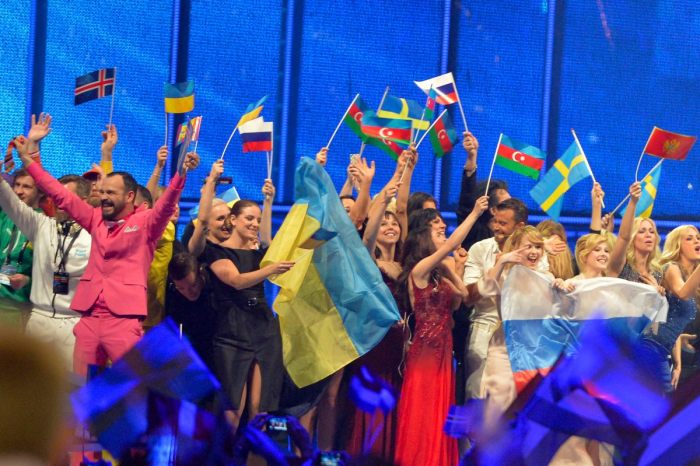
Photo: Andres Putting (EBU)
To convince you, here’s my ultimate guide to the Eurovision Song Contest – I am sure my Australian readers will be grateful for this advice as they will be taking part in it for the first time this Saturday. As for everybody else: relax, Australia is not technically in Europe, not is another finalist, Azerbaijan. No need to completely revise your geographical knowledge. And no, I have absolutely no idea why they are taking part, either. It’s just one of these idiosyncrasies that make this competition what it is. The contest involves participants from 49 countries, most of them actually European ones. Each country gets one song in which they will perform first in two semi-finals, and then 27 of them will go on to the finals (some countries qualify automatically. Again, don’t ask). Afterwards each of the participating countries gets to vote for their favourite song, which is then revealed, country by country, in the truly nerve-wrecking finale, which is what the whole thing is really all about: this is the time you can really p••• off your neighbours, wind up old enemies, and pay back those insults you sustained in the aftermath of World War 2 or any other given conflict. This is not to say that the songs and performances themselves don’t matter, they are just not the most important part of the whole show. On a very basic ‘performance’ level, you can easily spot a potential winner by watching out for the following signs:
- costume changes: anyone ripping off clothes mid-song, preferably to reveal sexy, tight-fitting undergarments, stands already a good chance to come into the top five.
- fireworks: again, as long as they are part of the performance and not a backstage accident, you’re on to a potential winner.
- funny language and weird instruments: anything ‘ethnic’ goes against the basic laws of Anglo-American pop music, which states that it has to be in English and sound exactly like everyone else. In the Eurovision, this law is suspended: ethnic stuff warms the hearts of those countries who do not fully subscribe to the aforementioned Anglo-American pop. And warmed hearts translates into votes.
- One or more key changes: admittedly, this seems a rather random factor, but a song that unashamedly becomes higher and higher in the course of the performance will invariably win points. The more the merrier, even if it leaves you squealing at the end. You can always distract your audience with some fireworks or costume changes.
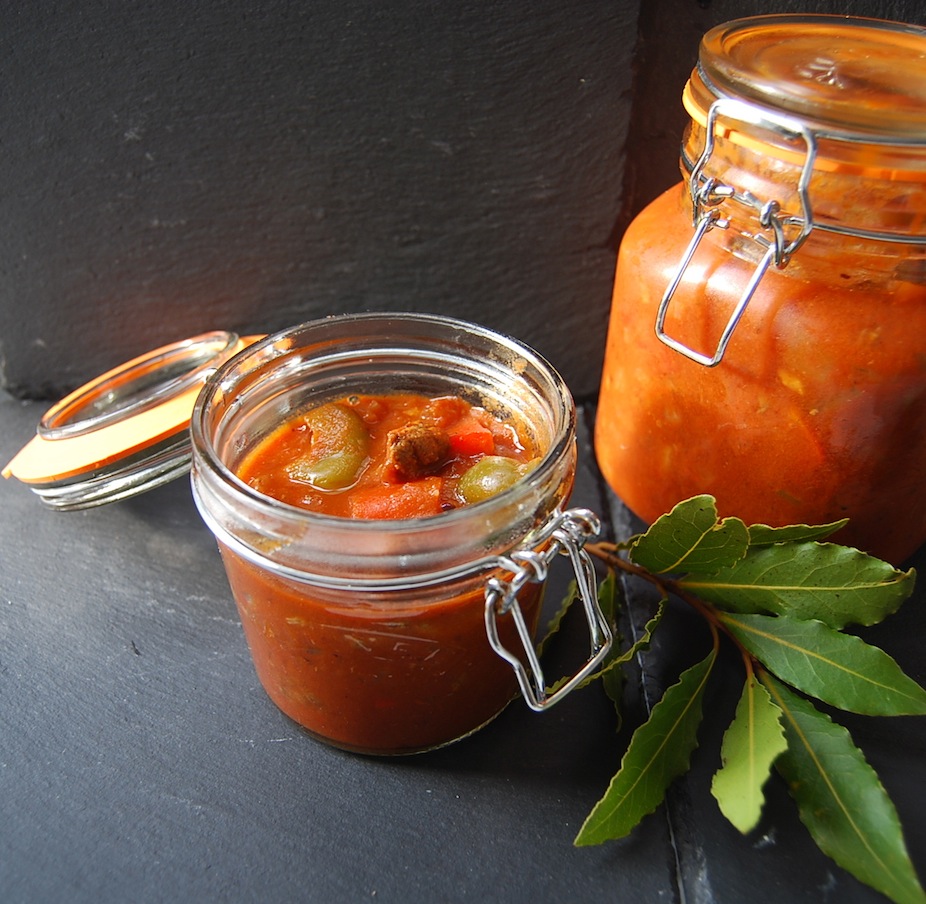
These factors play their part when, after what feels like several hours of singing, the actual voting process begins. And if you thought the singing part was long, I promise you the voting bit is even longer: one by one a representative of each country will crack a lame joke which is subsequently lost in translation, followed by the reading out of the points they have given to each of the participating countries. Sounds boring? It in’t, at least not if you have a map of Europe in front of you, and a smattering of European history. Sweden? Will always give its top prizes to either Norway, Denmark or Finland, regardless of costume and key changes. Greece? Zero points for Turkey: despite its proximity and the fact that the occupation of Greece by the Ottoman Empire ended in 1824, the resentment has not ceased. Turkey, on the other hand, gets a large number of votes from Germany (immigration patterns play a role here), as well as from Bosnia-Herzegowina, whose people use this occasion to express their solidarity with their fellow Muslims. France never gets any votes: for a start they insist on singing in French (even the votes have to be read out in French!), and also they are often perceived as rather arrogant, as are the Brits. Nul points, zero points from most countries for both. Neither will Austria ever concede any points to its neighbour Germany, partly because of anti-Prussian resentment and partly, well, you’ve seen Sound of Music. Ireland, on the other hand, is generally seen as cuddly and unthreatening, which is a much more convincing explanation for their many wins, really, than the quality of their songs. As you can see, it’s not just about the music. It’s about bonding. And how better to celebrate the European spirit by pairing delicious dishes from two countries that, although not directly bordering on each other, still share some of their history? Poland (number 18 in tomorrow night’s running order) and Hungary (number 22) speak very different languages, but were ruled by the same empires (Poland by Prussia and the Austro-Hungarian Empire, the latter over many centuries part and parcel of the latter) and were both annexed by the Soviet Union, subsequently spending a few years behind the Iron Curtain. Meat stews have been on the menus of both countries, but it is the Hungarian goulash that has fired up the European imagination, making it one of the country’s most famous exports. 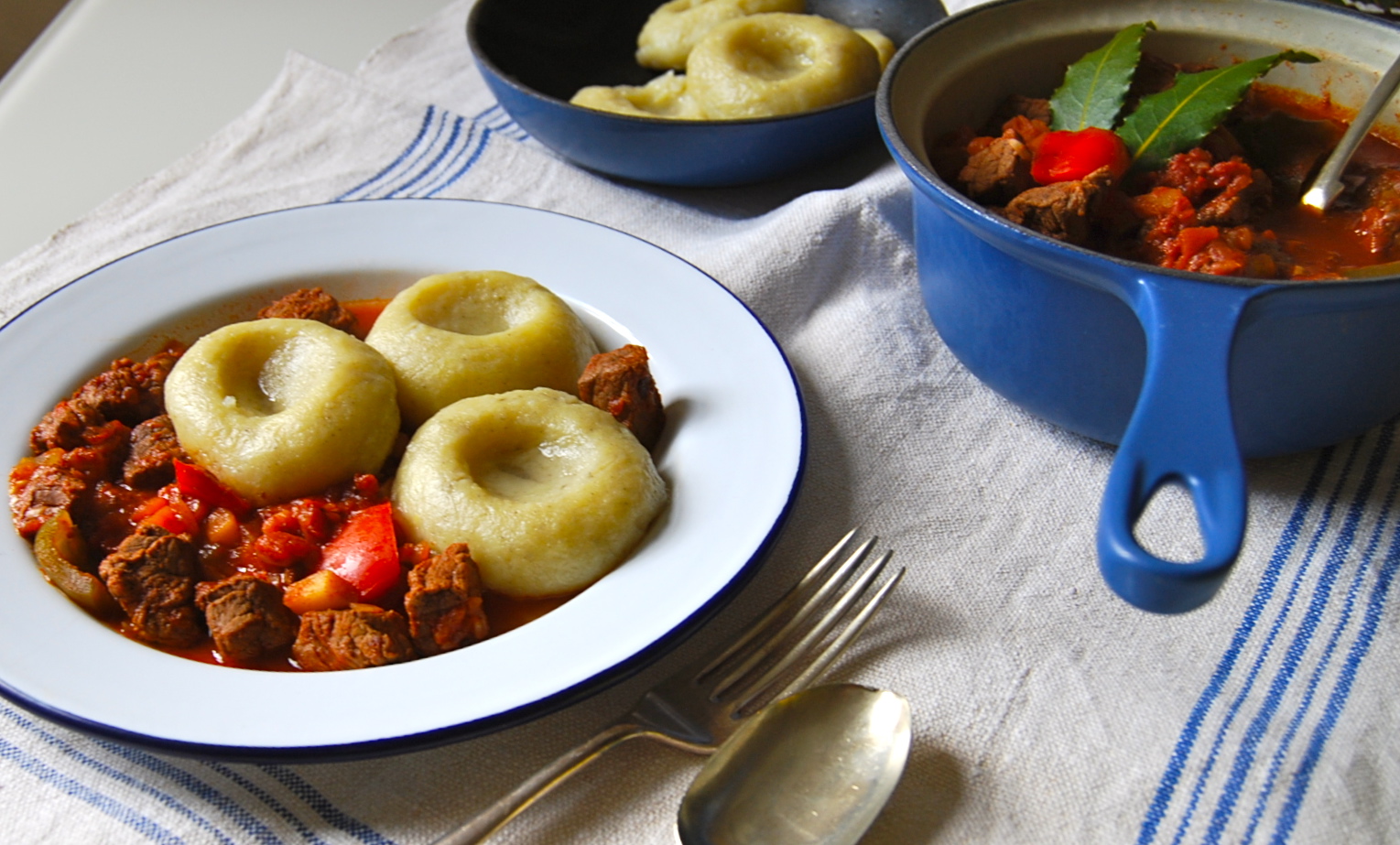 Goulash is a real one-pot-wonder. And ‘fired up’ has to be taken literally, as it gets its kick from the liberal application of all sorts of peppers and paprika: I used a mix of bell peppers, for colour and texture, as well as sweet paprika and smoked paprika. In addition to ketchup (not a traditional Hungarian ingredient, but perfect for balancing out the acidity of tinned tomatoes) I always use some dark cocoa powder, which gives the dish a wonderful depth. What goes for the songs also goes for the cooking: feel free to experiment! As with most stews, their long simmering times mean bigger portions: it’s not a meal for two, you might think. I’d argue the opposite: make a large batch of it and either freeze some of it, or even preserve it in jam jars or similar – I brought a large Kilner jar full of the stuff along to our recent camping trip in Hayling Island: poured steaming hot into sterilised jars, you can easily store it in the fridge for up to a month, or transport it for a couple of hours in the car, as we did. Simply warm it up again and serve with rice or bread for a quick and warming dish.
 As part of my ‘Eurofusion meal I have teamed it up with dumplings – and not any dumplings, but delicious Silesian potato dumplings. Kluski śląskie (don’t ask me how to pronounce it!) are like the big brother of gnocchi: the size of a pingpong ball, they are given their distinct shape by pressing your thumb into the surface, this flattening the dumpling and creating the perfect shape to mop up gravy or a stew. The trick to these beauties is to get hold of potato starch or potato flour, which is not something I had come across in our local supermarket. Thus, armed with its Polish name, mąka ziemniaczana, I went to our local Eastern European shop. True to the spirit of the Eurovision, the lovely Lithuanian shop assistant (number 7 in the show) took one look at my note (needless to say, I didn’t even attempt to say it, to avoid confusion) and went off to get me a bag, which turned out to be a produce of Latvia (number 19, just after Poland) .
 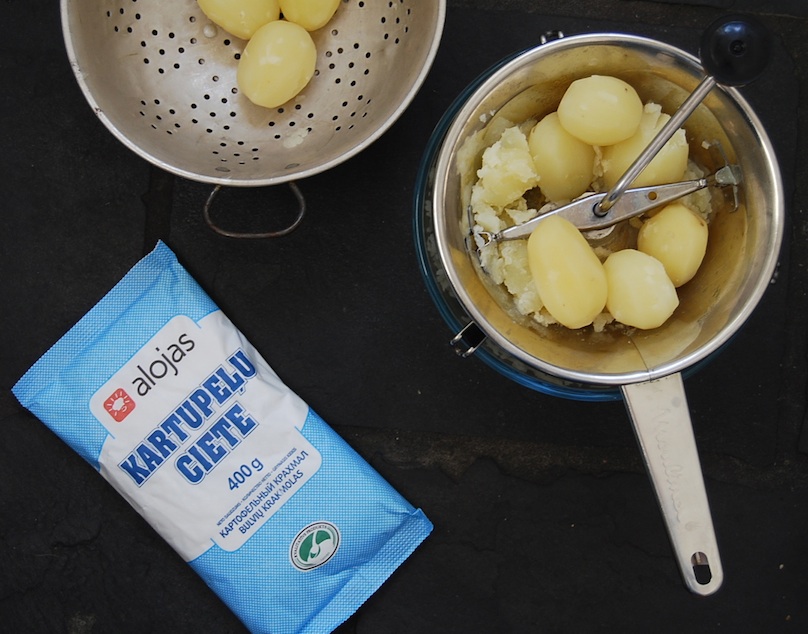 As for the potatoes, get firm ones and adjust the starch according to their firmness: if you get it right, you will create incredibly light and fluffy little dumplings. For a beautifully illustrated ‘rule of thumb’, head over to Magda‘s blog, whose photographs of the dumplings are simply stunning. Like gnocchi, there is an element of a gamble: too much flour and they end up like golf balls; too little and you’ll be serving mashed potatoes …
Silesian Potato Dumplings (serves 8)
- 1 kg firm potatoes, peeled and boiled
- 100-140g potato starch or potato flour
- 1 egg
- 1 tbs salt
Ideally using a ricer or a vegetable moulin, mash your boiled potatoes very finely. Add the egg and salt, as well as around 100g of the potato flour and begin mixing the dough. You want it to be not too sticky and easy to roll into golfball-sized dumplings, so you might have to adjust the potato starch. Once you get a nice firm dough roll them into balls and press your thumb into the centre to get the typical sauce-embracing shape. Place the dumplings on a floured surface; you can prepare them the day before and leave them overnight in the fridge, or cook them straightaway.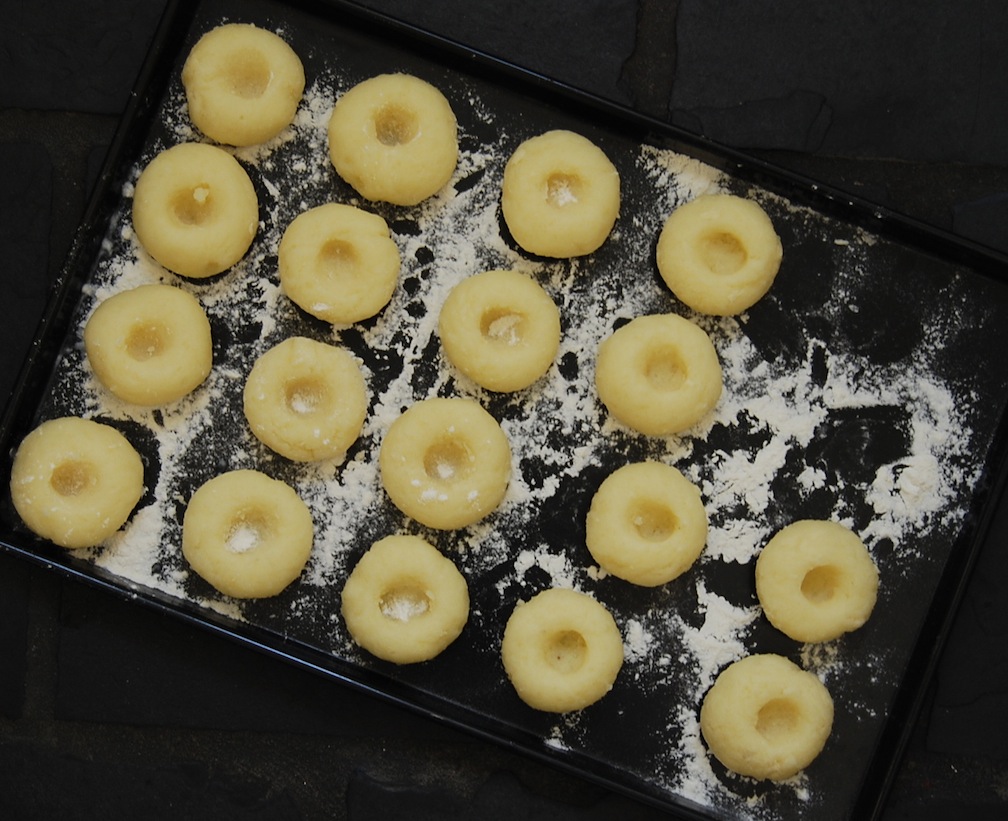 Simply bring a large pot of water to boil, add some salt and dump the dumplings into the boiling water.Once they rise to the top, which takes around 2 or 3 minutes, they’re done. Serve with any stews or even mushroom sauce, for a vegetarian treat. Alternatively, to celebrate the Eurovision Song Contest or for a delicious Eurofusion meal, serve them with my beef goulash.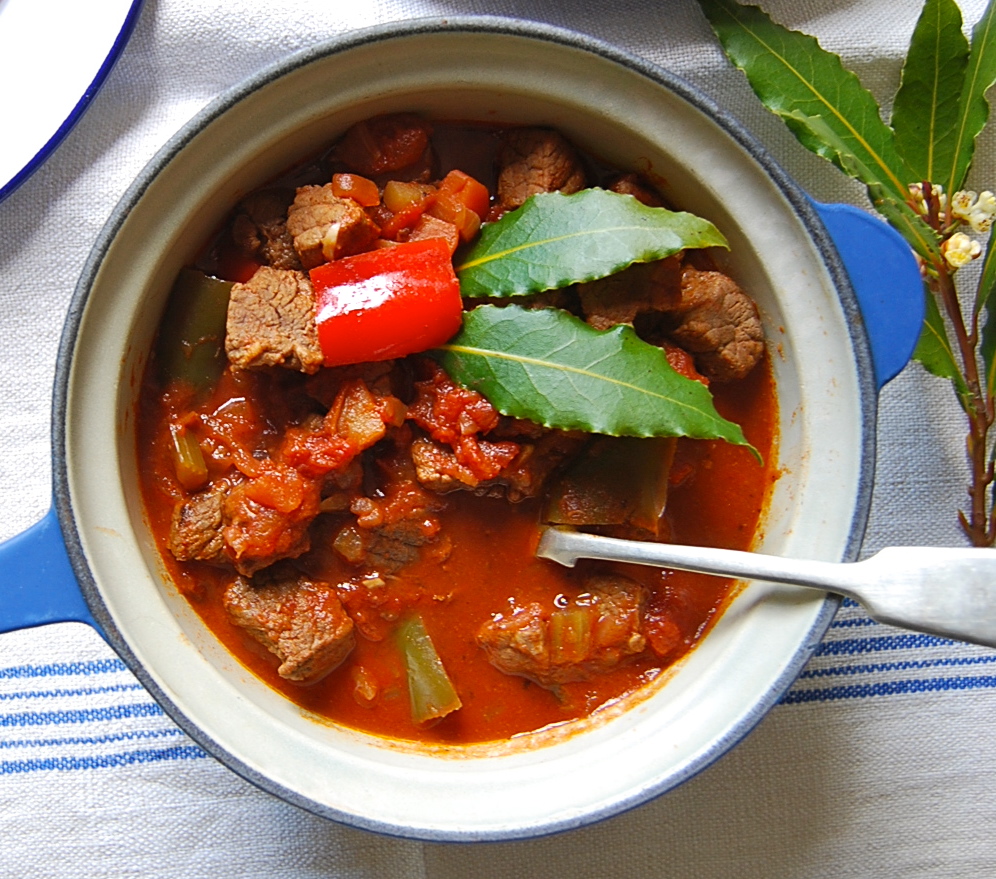
Beef Goulash (serves 8)
- 1 kg beef (topside), cut to 2-3 cm / 3/4 in cubes
- 2 onions, diced
- 2 tbs lard (or vegetable oil …)
- 1 tsp sweet paprika
- 1 tsp smoked ‘picante’ paprika
- 1 bay leaf
- a pinch of caraway seeds
- 1 tin chopped tomatoes
- 500ml vegetable or beef stock
- 1 tbs ketchup
- 2 tsp cocoa powder
- salt, pepper
- 2 bell peppers, ideally red and green
Begin by sautéing the chopped onions with the lard in a large casserole dish or Dutch oven until they become translucent. Add the meat in portions, making sure the meat is browned from all sides before removing it from the pot and frying the next batch. Throw it all back into the pot, add the paprika, bay leaf and caraway seeds and stir it all for about a minute before adding the stock and the remaining ingredients except for the peppers. Cover and bring to boil, then simmer it at a medium temperature for about an hour – just enough time to get on with your dumplings! Core and cut the peppers into 2-3 cm / 3/4/ in cubes and add them to the stew; add water if necessary: you don’t want it all to be covered but the consistency should be that of a stew. Simmer it for another 30 minutes, season and serve.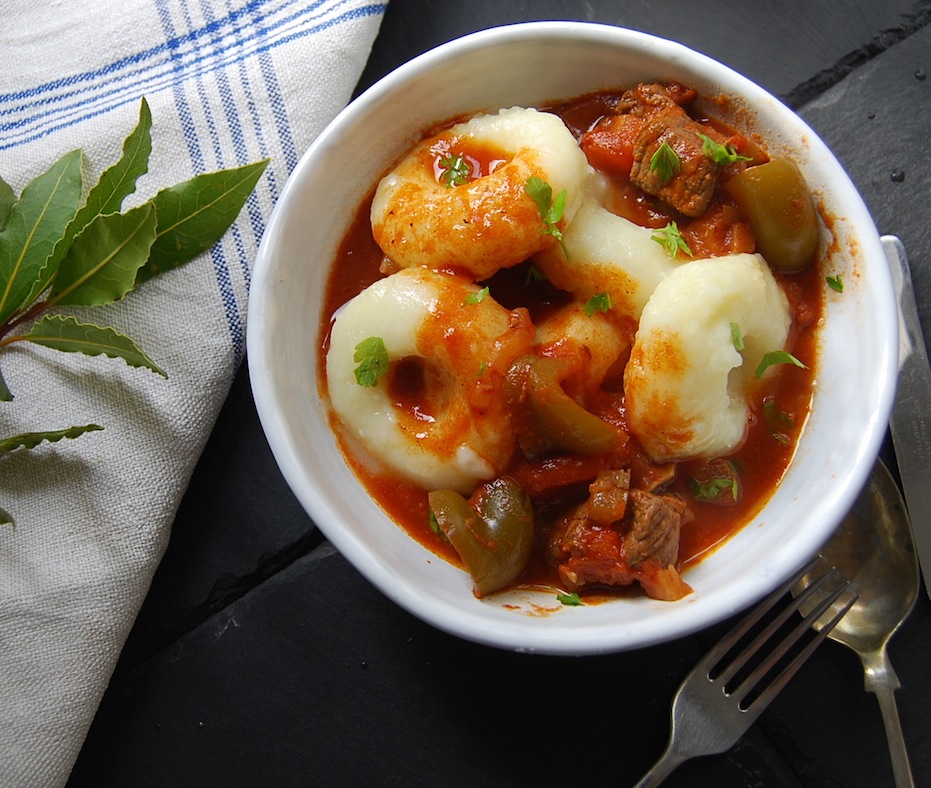 I’ll be bringing this dish – or. rather, these two dishes – to Angie’s weekly Fiesta Friday party, where I’ll be trying to proselytise her co-hosts, Juju @ cookingwithauntjuju and Amanda @ The Chunky Chef, as well as the other guests to the merits of watching this event. And how about you guys? Are you ready for the Eurovision? Maps – tick. History books – tick. Checklist to count up points – tick. Well done. I’ll leave you with last year’s winning entry, Conchita Wurst’s ‘Rise Like a Phoenix’, for Austria. And no, the beard is a statement, not a traditional Austrian women’s accessory.


 Ginger&Bread
What a fantastic run down of Saturday night’s importance! Rooting for Serbia! Watched the Semi-Finals online. I love the staging and the quirkiness of the performances. Will have to try your dumpling recipe too.
LikeLike
It’s looking like such a brilliant night! We’ll be watching it in Germany, though, which means that the presenters are ever so slightly biased (unlike the BBC, where they are just too embarrassed …)
LikeLike
I’ve never really got the whole Eurovision thing. I know people who go mad for it, and I’ve always assumed they were a bit crazy…!!! 😉 ha ha! I don’t mean you of course…..;)
I think we enter it in the UK fully in the knowledge we will never get many points, but we enter into the spirit of the fun that it creates, and we have great commentators on the programme – they’re the best bit for me 🙂
Enjoy your evening and your fabulous hearty meal xx
LikeLiked by 1 person
Absolutely! I absolutely adored Terry Wogan, his deadpan one-liners are a stuff of legend! There’s a few countries I will never ever be able to watch again without thinking of his comments … Not too sure about poor old Graham, though. I sometimes feel he lacks the political nous and jumps to superficial conclusions based on the quality of the performance. I mean, seriously?!
LikeLiked by 1 person
Ha ha! You really are into it aren’t you??? 😉
Enjoy!
LikeLiked by 1 person
Love this Eurovision post! I never really watched it before but want to this year because of the hype.
On another note, are those Le Creuset pots in your pics? I’m a Le Creuset fanatic! 😉
LikeLike
It is! A very old cocotte, where you can use the lid as a frying pan. Perfect for small tortillas! Oh, and do watch it with a map. It makes the songs almost bearable 😉
LikeLike
I’ll look (or rather not look) at this contest in a new light after reading your post…. silesian = schlesisch?
Dumplings and me are not friends…. I ended with potatoe soup last time I tried.
LikeLike
I’ve had this problem with gnocchi, and it’s either too little flour/potato flour, or you boil them for too long. Do give dumplings another chance, especially those from Schlesien – they’re so worth it!
LikeLike
Those dumplings look delicious Eurovision usually means curry in this house might give these ago instead!
LikeLike
Go for it – perhaps India will take part next year, which would justify your choice 😉
Tonight’s curry night in our house!
LikeLike
When I saw the word “dumplings” I knew the recipe had to be Ginger’s. I still have a recipe or two that I still want to make. Thanks for sharing with all the gang at Fiesta Friday 🙂
LikeLike
You’re welcome – looking forward to you dumpling off your recipes! 😉
LikeLike
???
LikeLike
Sorry – there’s two Things I can’t resist: a good Dumpling and a Bad Pun …
LikeLiked by 1 person
I grew up eating goulash and it is a one pot wonder! I’ve never made dumplings like this and they look amazing. I think they would be wonderful with your mushroom sauce too!
LikeLiked by 1 person
They are delicious, and so versatile!
LikeLiked by 1 person
This is something new to me – sounds interesting. …
LikeLike
Is that the food or the show? I’d try the food first … 😉
LikeLiked by 1 person
Yummmmm dumplings! They look fantastic. I remembered Eurovisions when I lived in England, we’d cozy up and watch it all excited. We never hear of the contest here in the USA, but I always listen to the BBC News each night, and they did talk about it coming up. I was floored when I saw last year’s winner tonight 🙂 Enjoy the contest!
LikeLike
It was great – despite the shocking nul points for Germany 😉
LikeLike
Brilliant post – the take Eurovision quite seriously in Spain, bt don’t seem to quite “get” that they’ll never win as they are in the “wrong” part of Europe! Great recipes, enjoy the evening!
LikeLike
Thanks for the lowdown G. I love a good EV and a good goulash… Great work 😜. Still not sure what’s up with the beard chick though…
LikeLiked by 1 person
I’m so glad you’re also confused by the sausage girl 😉
LikeLiked by 1 person
I love kluski slaskie! especially with gulasz 🙂
LikeLike
Me too – but then I love any dumpling, really 😉
LikeLiked by 1 person
I couldn’t watch Eurovision this year, I missed Conchita!
LikeLike
She is just brilliant – especially as an ambassador for LGTB and for tolerance in general!
LikeLike
First off, this goulash looks absolutely amazing! So hearty and filling and perfect for these oddly chilly days we’ve been having for late spring. Secondly, I am trying to understand this show you describe, as we don’t get it over here in the U.S., but it sounds fascinating. I’ll try to see if I could maybe catch some of it on YouTube or something.
LikeLike
Just avoid the actual music bit – it might be a step too far 😉
LikeLiked by 1 person
Oh Ginger, what a fab combination! I just came across an old German cookbook (put together by families of settlers here) I had forgotten I had and have dumplings on the mind anyway! And now this! I enjoyed (and laughed) during your explanation of this show, even though we don’t have it here!
LikeLike
You have no idea what you’re missing out on! It’s like a Bollywood version of World War 3 😉
LikeLiked by 1 person
lol! Sounds fabulously campy!
LikeLiked by 1 person
What a great post! Really enjoyed reading it!
LikeLike
Thanks! I take it you did your duty as a subject and voted for your country?!
LikeLiked by 1 person
Of course you must vote if you are lucky enough to live somewhere where you can right?
LikeLike
Absolutely – long gone the days when the voting was done for you 😉
LikeLiked by 1 person
Umm possibly not for the UK though!! 😉✌️
LikeLike
With that choice? Why not 😉
LikeLike
I instantly knew this was your recipe before I hovered over it and saw the link address! Awesome!
LikeLike
Ha ha, so you’re telling me I’m predictable?! 😉
LikeLike
No but I know your style!
LikeLiked by 1 person
I’m so bad with tv shows…. but I’m very good at eating dumplings!!! They look fabulous with goulash!
LikeLike
Thanks, Margherita! And I know how you feel about TV … I just have no patience with it and forget what I’m watching!
LikeLike
Pingback: Five Senses Friday no. 63 | No Apathy Allowed
Those dumplings look super neat. I’ve never seen that shape before. I’d try checking out the kosher section of a major grocer for the potato starch. I stock up around Passover to make sure I have it around.
LikeLike
Pingback: Steamed Apple – Self-Preservation for Beginners | Ginger&Bread