Lebkuchen, a sweet spiced bread, have been popular in Germany since the Middle Ages – in fact, specific Lebkuchen bakers were mentioned as early as 1239 in a document in the city of Ulm, documenting the popularity of the breads. Lebkuchen are the product of an increasingly successful international trade in the period: the introduction of spices from the East added to the existing honey-sweetened breads – hence the alternative name Pfefferkuchen, ‘spice cake’, as well as the English ‘gingerbread’.
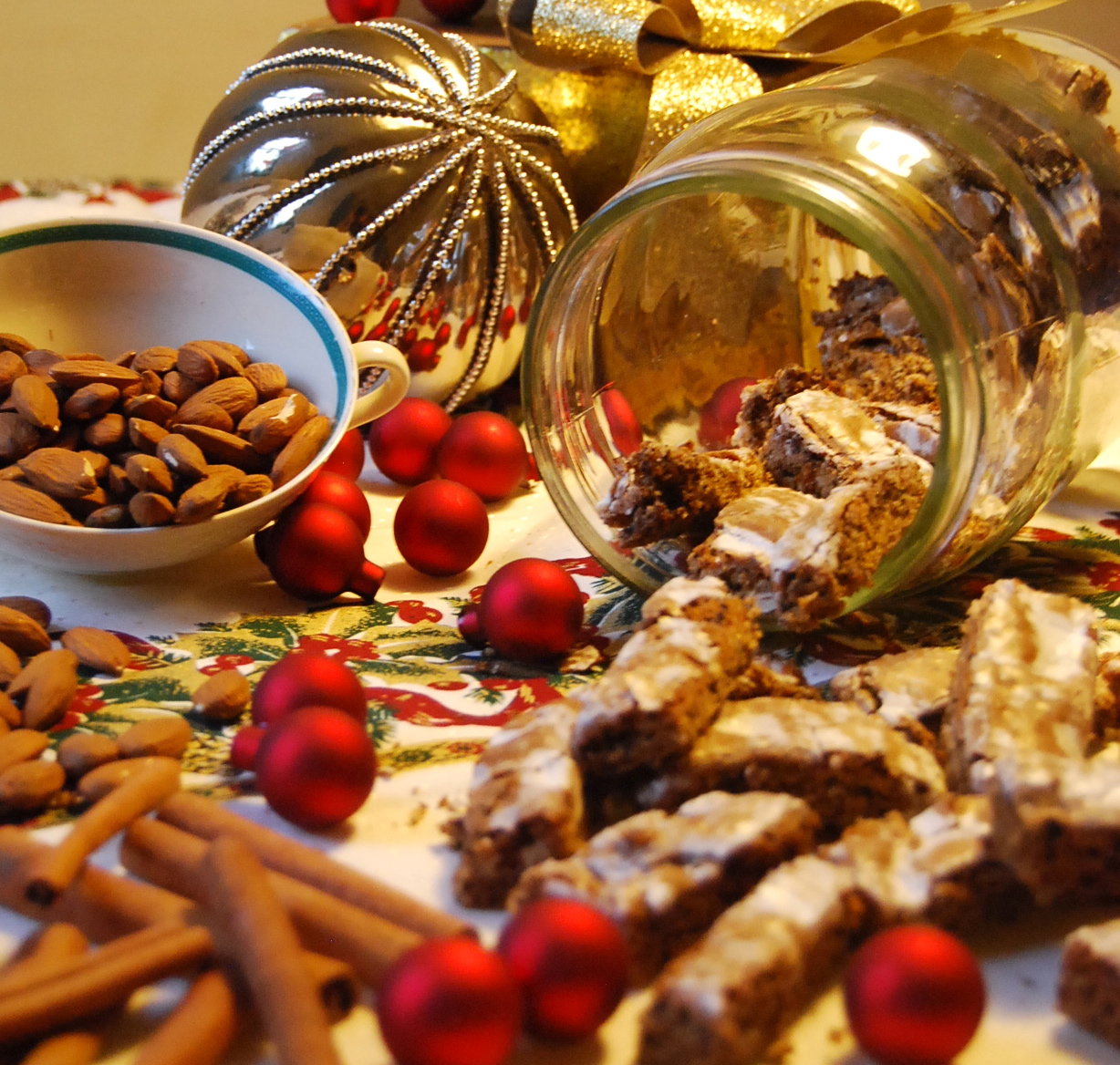
Photograph: Helwyn Jones
Basler Leckerli are a type of Lebkuchen that originated in the Swiss city of Basel, on the river Rhine. Despite conflicting stories about their origin, they have been around for at least since the 16th Century, which makes them a Swiss, rather than German bread. Although Basel, originally a Roman settlement, had been German for centuries, it joined the Swiss Confederation in 1501 and has since be Swiss. This explains perhaps why so many of our traditional dishes are part of the shared experience of our neighbours: Prague, for example, now the capital of the Czech Republic, was part of the Holy Roman Empire as well as of the German-speaking Austro-Hungarian Empire before becoming the capital of first Czechoslovakia and then the Czech Republic; founded in 1348, its Charles university is actually the oldest German university and Franz Kafka, one of the most influential German writers of the 20th Century, was born and bred in Prague. Similarly Strasbourg and the Alsace was German as often as it was French, changing hands every time the two nation went to war with each other. No wonder we eat each other’s food as if it was our own!
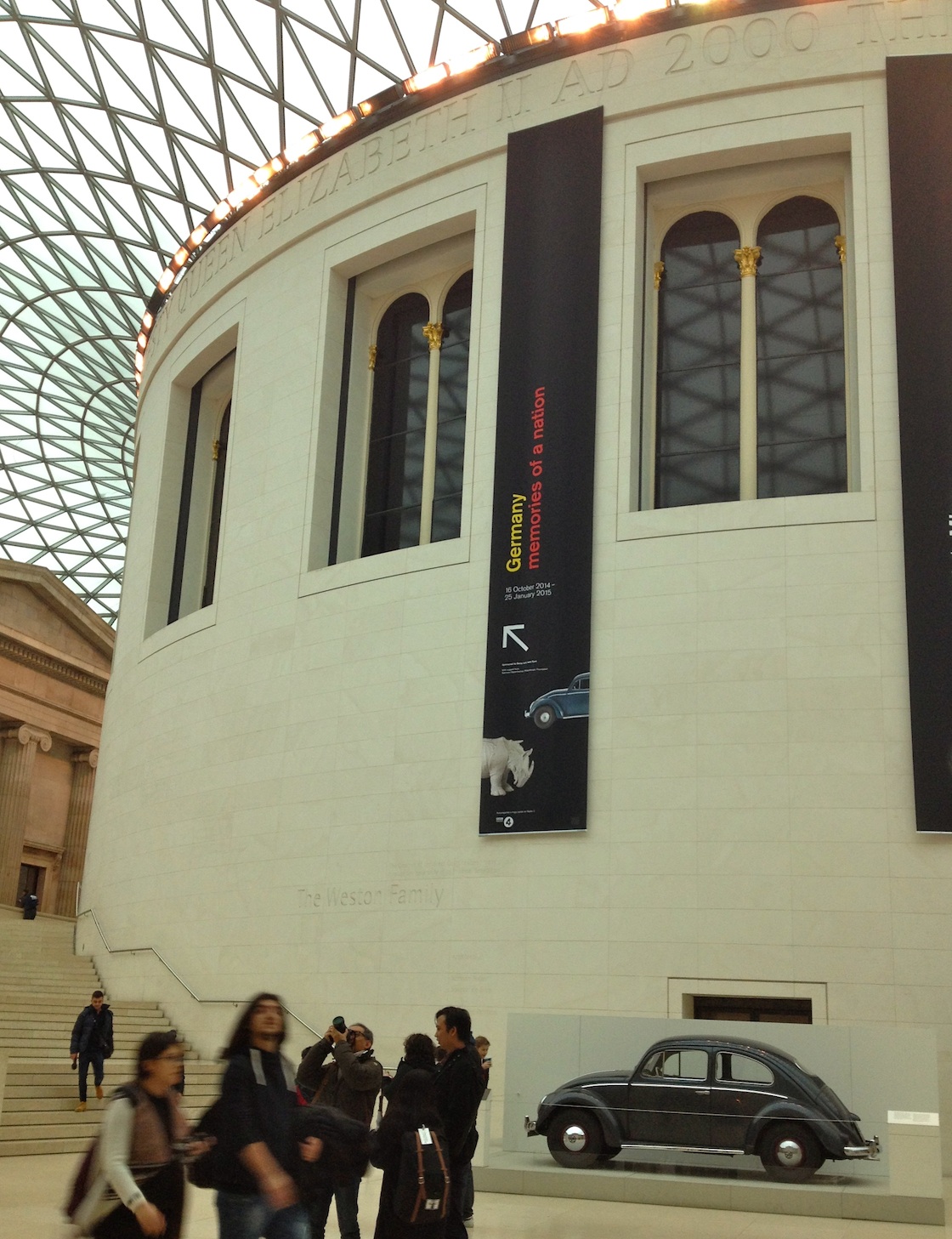
The other day, we went to see the exhibition ‘Germany: Memories of a Nation‘ in the British Museum.It was a fascinating display of artefacts, ranging from medieval art via Luther’s Bible translation all the way to the fall of the Berlin wall and beyond. I particularly enjoyed the detailed treatment of the medieval period, which explained the shifting boundaries of what only gradually developed into the unified ‘Germany’ in the wake of World War I: until then, there had only been temporary confederations in form of the Holy Roman Empire, formed by Charlemagne in the 800s, and the similarly loosely-connected German empire under the Prussians in the 20th Century. This lack of a unified history was illustrated by a map of medieval Germany, on which a variety of different coins from the period were attached, a selection of the over 200 different regional coins that were used at the time – side-by-side with a map of Britain, on which one single coin highlighted the fact that Britain had been a much more homogenous construct.
Incidentally, Basler Leckerli were not part of my childhood Christmas; a friend of mine introduced me to them only last year, but I cannot imagine another Advent without them: soft but crunchy, sweet and spicy, they are Christmas in a neat little square. ‘Leckerli’ means small and delicious, and they do exactly what it says on the tin.
Basler Leckerli (makes 50)
- 2 eggs
- 2 tbs apple juice
- 250g caster sugar
- 70g honey
- 1/2 tsp ground cloves
- 2 tsp ground cinnamon
- 2 cl rum
- 70g dark chocolate, grated
- 1 tso baking powder
- 250g plain flour
- 100g whole almonds
- 40g mixed peel
- 150g icing sugar
- 2 tbs water
Line a large baking tray (like the one you would use to roast a turkey in) with baking parchment and preheat your oven to 200C.
Chop the almonds rather coarsely: they will provide the crunch of the final cookie.
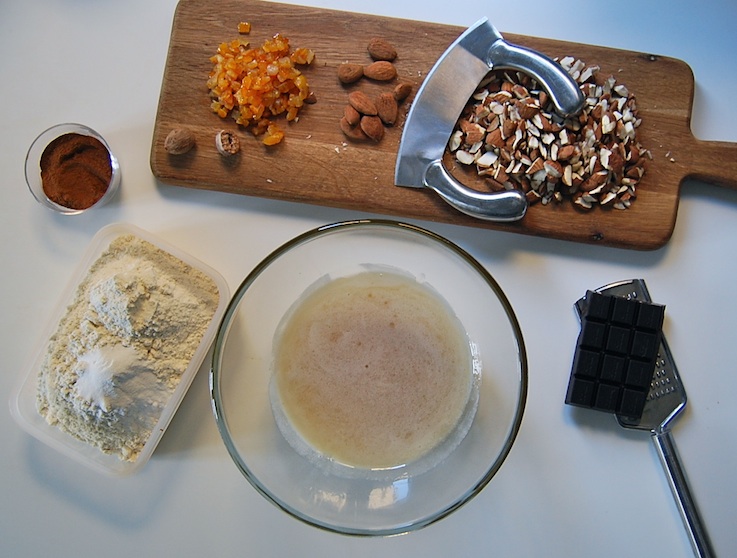
Beat the eggs and apple juice until light and creamy; add the sugar in small portions and beat to incorporate it fully before adding the next portion. Gradually add the honey, spices, chocolate, the flour and baking powder and finally the almonds and the mixed peel.
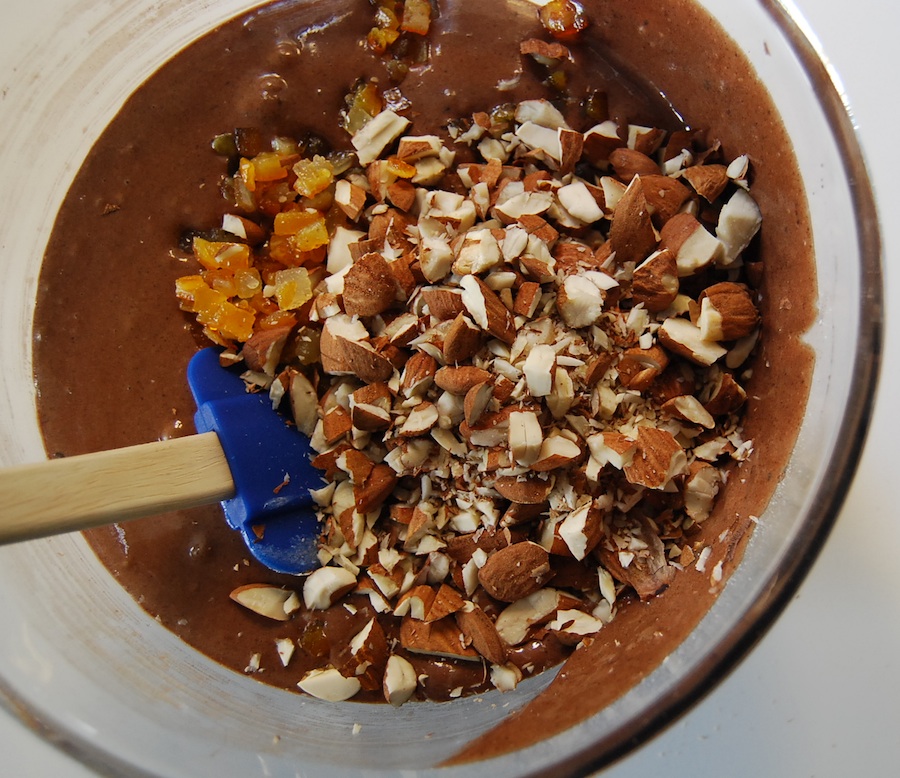
Pour the dough into the cake tin and level it, using a spatula. Bake for15-20 minutes.
When you removed the bread from the oven, mix the icing sugar with the water until smooth. Immediately glaze the bread with the icing and leave it to soak for 10-15 minutes.
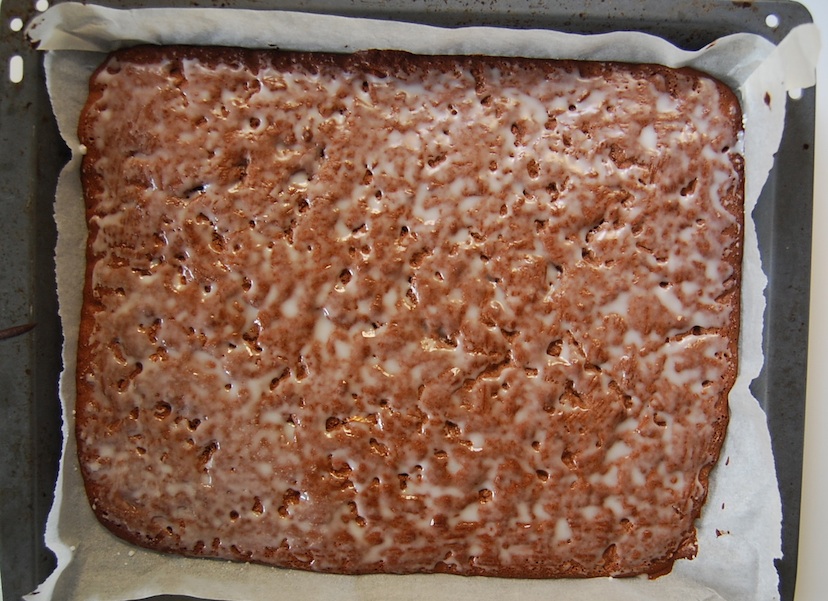
Remove the bread from the tin and cut it into 4cm / 2 in squares or rectangles of a similar size.
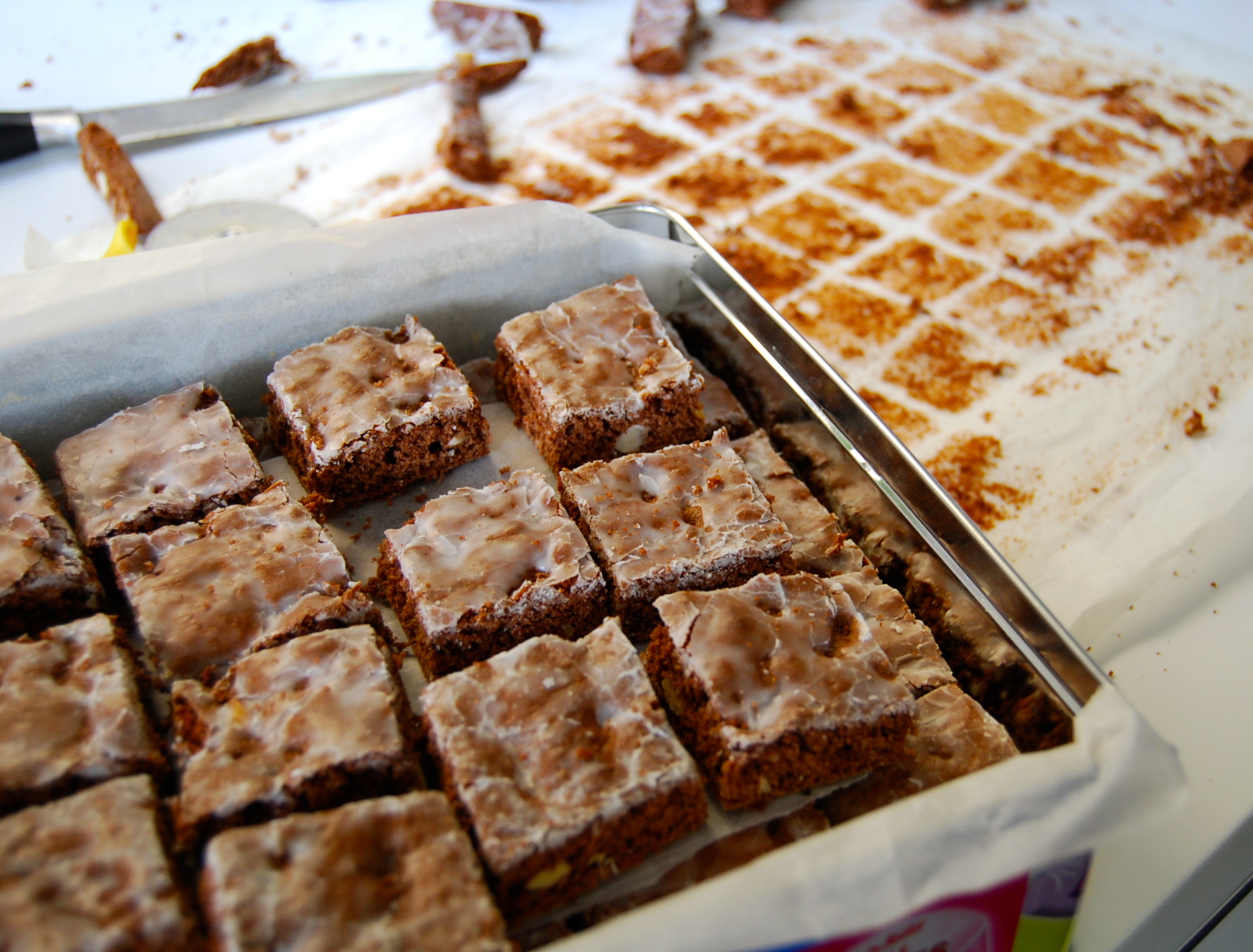
As with the cinnamon stars, the Ausstecherle or the Springerle, the Leckerli will stay fresh for up to a month if kept in a tin.
Do you have a recipe that made your day or year? Basler Leckerli were certainly my greatest discovery of the last 12 months!


 Ginger&Bread
Funnily enough, I have mentioned you and your gingerbread over on this month’s BritMum’s Foodie Round up (http://www.britmums.com/2014/12/christmas-foodie-round-2014/) apologies for adding the link here, but I couldn’t find how to contact you directly! Emma 🙂
LikeLiked by 1 person
Thank you! I think my email is on the ‘about’ page? You are too kind – I might even forgive you the fact that you are surrounded by German Christmas foods 😉
LikeLike
Oh my gosh, Ginger… you’ve been baking up a storm lately! This is another drool worthy offering. 🙂 Delicious… I’m weak when it comes to anything lightly iced!
LikeLiked by 1 person
I am the same – it’s the combination of sweet and sour, icing sugar and lemon juice! I’m not too keen on the shop-bought variety, it lacks the kick.
LikeLiked by 1 person
I agree, the number of cakes and cookies you made recently worries me Ginger! I definitely wouldn’t be able to fit into my pants after all this!! 😀 these cookies look too yummy! Have mercy!
LikeLike
I recently gave in and bought a pair of leggins. It helps that I share my house with a swarm of locusts, disguised as boyfriend, children and mother-in-law. 😉
LikeLiked by 1 person
No way! A pair of leggins?! So clever of you. Probably I should have done the same a long time ago insteaf of torturing myself with this running and swimming ihhihiii
LikeLike
I follow Churchill’s advice for a long life: ‘no sports’. 😉
LikeLiked by 1 person
He was right damn it!
LikeLiked by 1 person
I am learning so much from your blogvent baking! Lecker, indeed! (and I love it when new finds get adopted into our Christmas traditions.)
LikeLike
It’s great to be able to share and exchange, whether on the web or for real 😉 I’m glad you’re enjoying our Advent!
LikeLike
Your gingerbread looks delicious! So warm and comforting. It would be great to take to our parties!
LikeLike
It is lovely, quite spicy, which would make it lovely with coffee. Store it in a decorative tin and the party is all yours!
LikeLiked by 1 person
Yum! I am definitely going to give this a try, my boyfriend would inhale the lot!
LikeLike
They are amazing, the spices give you a real kick!
LikeLiked by 1 person
I like things that pack a bit of a punch 🙂
LikeLike