 St Martin’s, or Martinmas, is particularly popular with German children: in kindergardens, infant schools and at home we make paper lanterns to use for the processions that take place on the evening of November 11. This is followed by a family dinner revolving around a roast goose, which is the point where adults start enjoying it, too. Although I am – like many of my countrymen and -women – not a practising Christian, certain feast days are so ingrained into our lives that I could not imagine a life without the traditions and foods that come with them. Martinmas is one of these celebrations, and as it marks the beginning of my favourite time of the year, Advent, I would like to invite you to celebrate the day with us. Before we get to the fun bit, food, we have to make lanterns. We made ours this year a weak earlier than usual, simply because my friend C the arts teacher came to visit, and who better to supervise the madness of children doing crafts than the expert:
 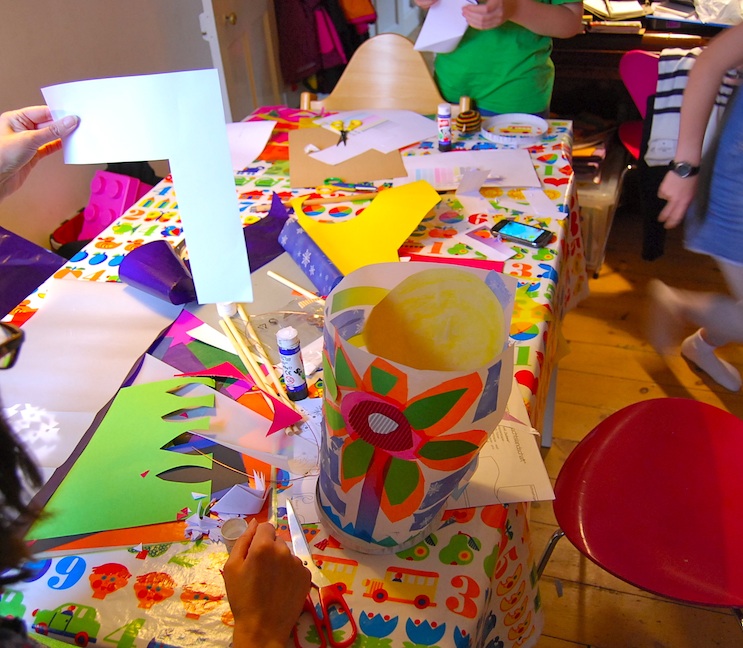 How I do admire those immaculately styled homes you see in magazines or on other people’s blogs! Our own style seems to be heavily influenced by the Notting Hill Carnival and by some unspecific war-zone. But after many tantrums and tears, the finished lanterns looked quite magnificent in the evening breeze:
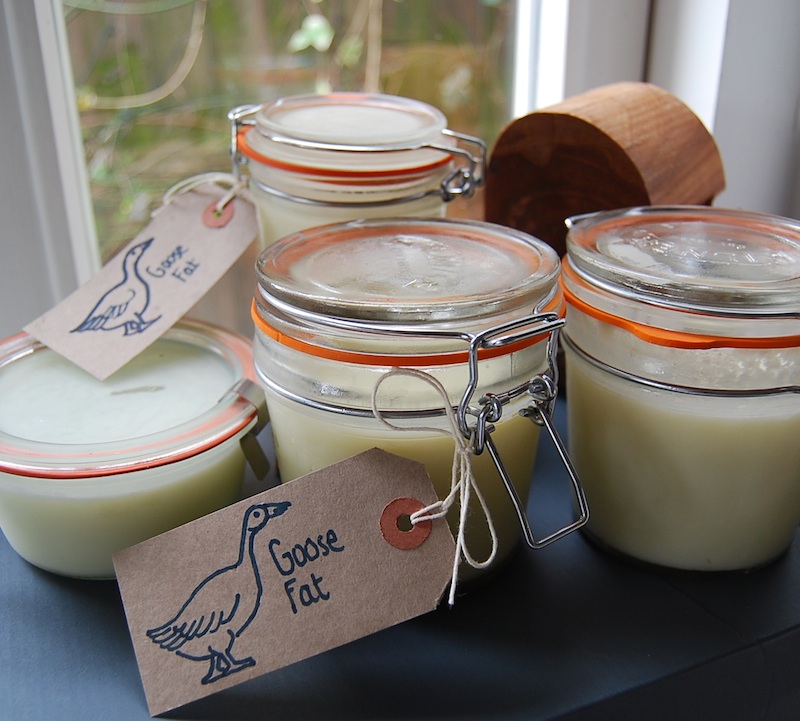
  St Martin was a Roman soldier who, according to the legend, cut his cloak into two to give half of it to a beggar who was suffering in the freezing temperatures. That night Martin had a dream in which he saw Jesus wearing the piece of the cloak he had given to the beggar, and when he woke up the cloak had been restored. Martin later became bishop and even saint, and he is revered as the patron saint of beggars, as well as a patron of children. The tradition to eat a goose has several explanations: according to the legend, St Martin was hiding in a stable to escape from the messengers of the church, who wanted to elect him as bishop; a flock of geese gave him away. But more likely the feast of St Martin, which marks the end of the autumn harvest and the beginning of the period of fasting leading up to Christmas, can be seen as a thanksgiving feast before the fasting period leading up to Christmas. Geese have by this this point reached a decent weight and make for an excellent feast! Goose is the traditional Christmas dish in many European countries, including Germany. In Britain and the United States, however, the traditional Christmas goose has been replaced by turkey: not only is it a bigger bird, it is much less fatty than a goose. In fact, half of the work involved in preparing a roast goose involves getting rid of the fat, which oozes out of every pore. It’s incredible. Fortunately, goose fat is a delicacy in itself, and our dinner today yielded almost a pint of pure goose fat, which we might – or might not – give away as Christmas presents for foodie friends, who will use it to give their roast potatoes and vegetables an extra oomph.
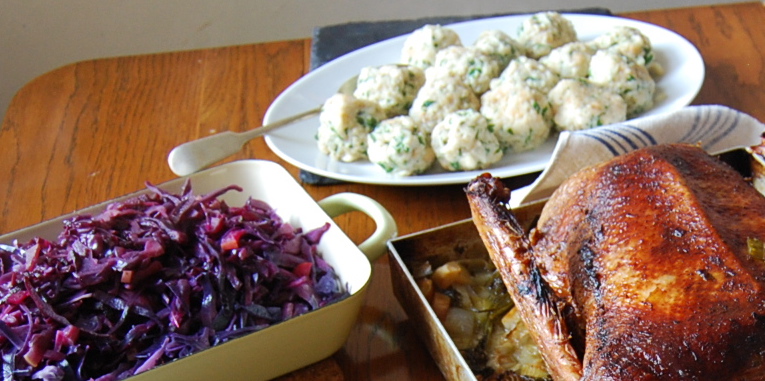
  Although you can stuff a goose as you would a turkey, with chestnuts, bread, or even potatoes, I went for a very simple version by simply filling the cavity with sour cooking apples. I served with very traditional German side dishes: braised red cabbage and bread dumplings, the latter being quite similar to the kind of stuffing most of you would be familiar with from their own traditional Christmas dinners. I’ll be posting the recipes over the next week or so, in case I got you interested. Remember the cries ‘Hurrah! There’s such s goose!’ that rang around Bob Cratchit’s house in Charles Dickens’ ‘A Christmas Carol’? The goose was used by Dickens to hint at the poverty of the Cratchit’s, who could not afford the luxury of a much bigger turkey. The goose’s flavour, however, is much superior: not only does goose not become as dry as turkey often does, its meat has a deep, intensive gamey flavour. So don’t be put off by the fat-fighting and give it a try, as this is your chance to try out something new – or old, rather – this Christmas! ‘There never was such a goose. Bob said he didn’t believe there ever was such a goose cooked. It’s tenderness and flavour, size and cheapness were the themes of universal admiration. Eked out by apple sauce and mashed potatoes, it was a sufficient dinner for the whole family; indeed as Mrs Cratchit said with great delight (surveying one small atom of bone upon the dish), “they hadn’t ate it all at last!”‘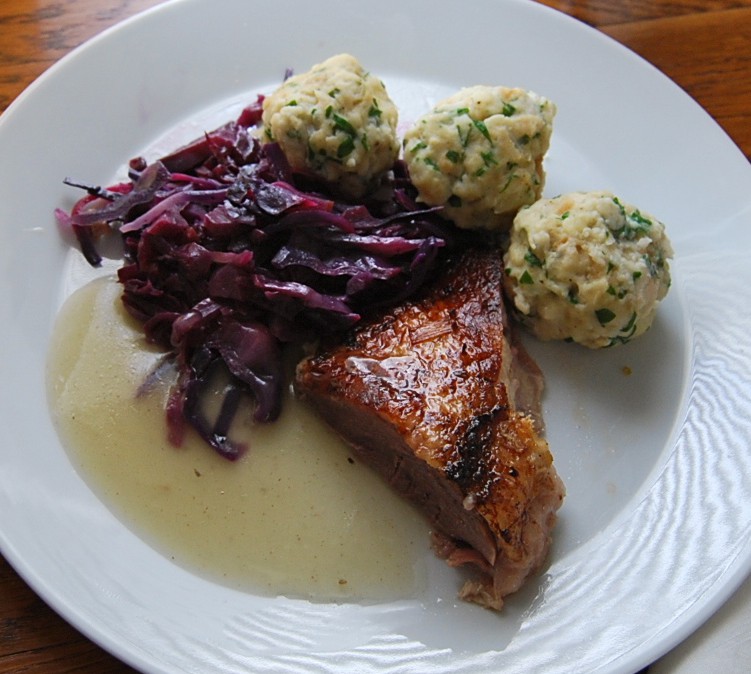
Roast Goose (for a 10lb goose, to serve 6)
(De-frosting: 1 1/2 days; preparation: 40 minutes; cooking: ca. 4 hours; resting: 30 minutes)
- 1 goose, ca. 10lb
- 4 baking apples, de-cored and cut into eighths
- 1/2 bunch of fresh parsley, flat-leaved or curly, chopped
- 2 tsp dried majoran
- 1 onion, coarsly chopped
- 2 carrots, peeled and coarsely chopped
- 1/2 celeriac, peeled and coarsely chopped
- 1 leek, washed and coarsely chopped
- 1/2 tsp nutmeg, freshly ground
- salt and pepper
Preparing the goose depends very much on your butcher: if you buy it frozen, it takes around 36 hours to defrost, either in the fridge or in another cool place. Leave it in the packaging so it doesn’t dry out. Remove the goose from the fridge around half an hour before you’re going to cook it to allow it to get to room temperature.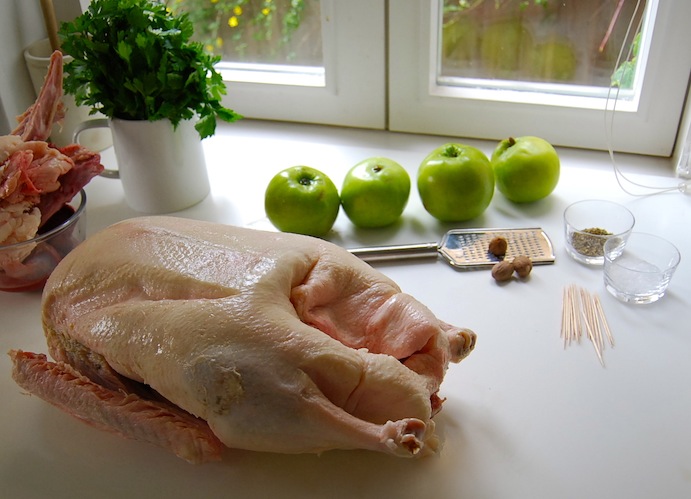 Start by removing the giblets from the cavity and set aside. Don’t worry, they come in a little bag. Obviously they don’t grow like that, but the butcher, knowing that you might feel a bit queasy about them, has wrapped them up nicely for you. If your goose still has a neck, you’ll need to cut it off as close to the trunk as possible; most geese have this already done to them, so don’t worry about this, either. All you’re usually left with is fat removal. And this is how it goes: Your first operation is to remove the layers of fat from the inside of the goose: they come off just by pulling them, so no worries. The nest operation is slightly more demanding: you need to cut off the tail (which is incidentally called the ‘Pope’s nose’ in English): right above it is a little bubble, like a pimple, which contains fat. Loads of it. You need to cut off that whole bit without cutting into that fat gland. I watched a video that demonstrates all the steps – don’t be put off by the fact it’s in German as you just want to watch what he’s doing. Once you’ve cut off the tail, you cut off the end half of the wings, too, for good measure. Heat your oven to 180C – apparently the fan-assisted mode doesn’t work quite as well for roasting as a normal oven, but I can’t really vouch for that one.
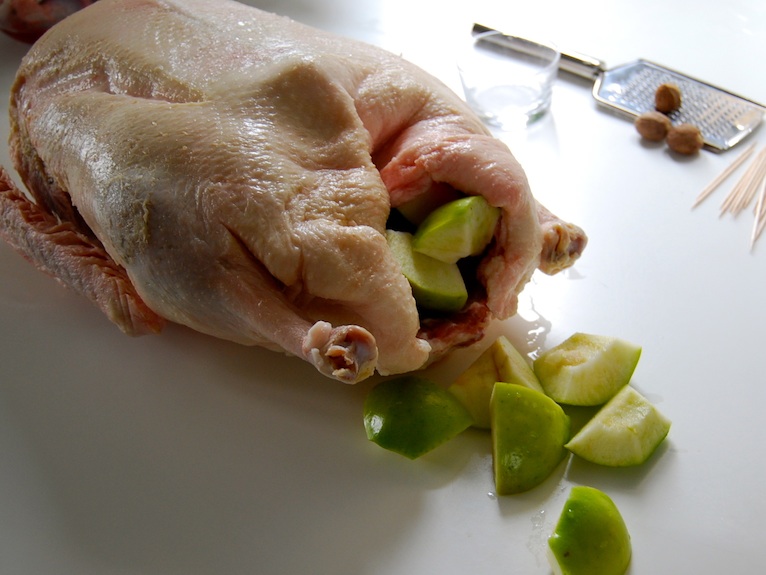 Now the stuffing begins. Wash the bird with cold water, inside and outside, and rub a generous amount of salt into both the inside and outside. Fill the bird with the apples, 1/2 the parsley. 1/2 the majoran, nutmeg and some pepper and close the cavity, using toothpicks and string: take a look at Marta’s tutorial on Plate du Jour to see how it’s done! Place the bird with the chest down into an oven tray and fill this with ca 1/2 inch of cold water. Place it in the oven for around 2 hours, occasionally pouring some of the liquid over the goose.
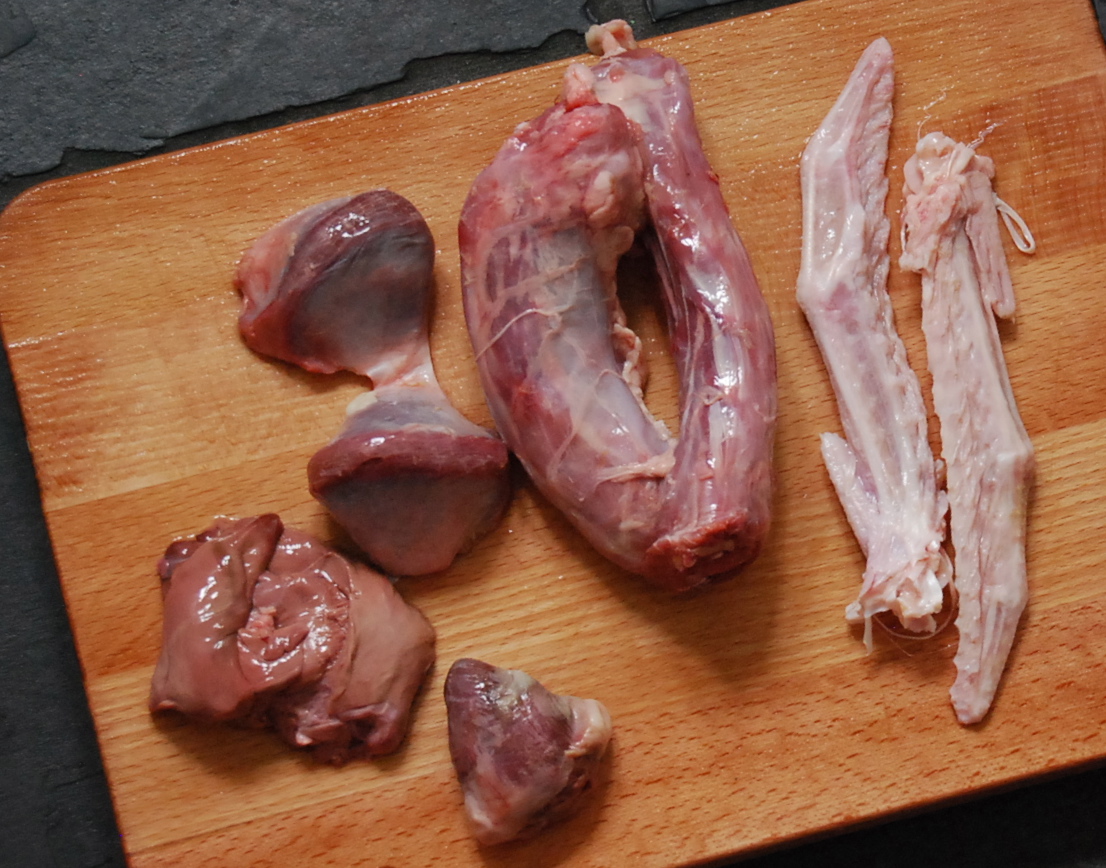
For the perfect gravy: stomach, liver, heart, neck and wings.
Now you’re left with the giblets, the tips of the wings and the neck. You can either dump them straightaway, in their little plastic bag, feeling really disgusted etc., or quickly rinse them, throw them into a small pan, cover them with water and bring it all to boil. They’ll make an excellent base for your gravy as well as adding flavour to your goose fat. And the good thing is: you don’t even have to touch or look at them ever again! Once the water is boiling, add 1/3 of the remaining vegetables and onion, as well as some salt and pepper, and let it simmer for an hour or so. After two hours, you might want to start removing some of the excess fat your goose has been sweating out. Pour it into a heat-resistant jug, then add the remaining vegetables into the tray and bake your bird for another hour or so. In the meantime, you can start extracting the fat: I sieved the juices from the roasting tray as well as the liquid from the boiled giblets into empty jam jars, to demonstrate how much fat will separate from the juices if you let them stand for around 5 minutes; it’s insane: the juices from the tray can be almost 50:50!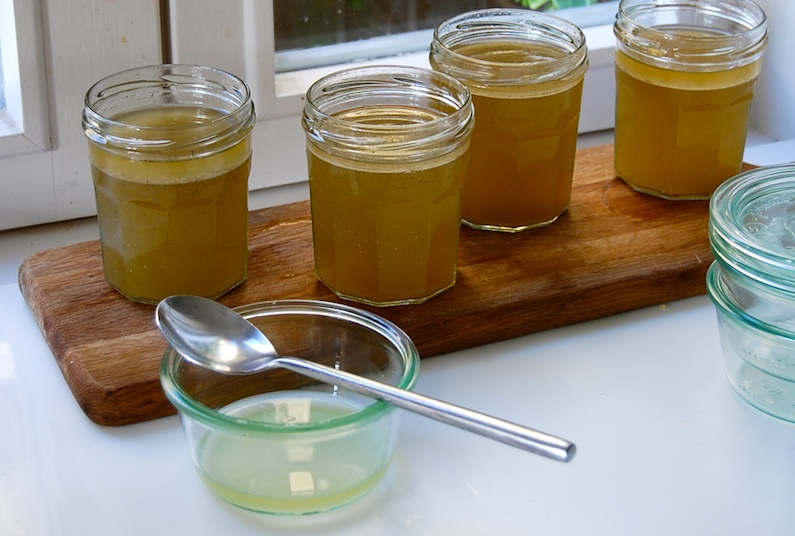 You don’t need jam jars, any heat-resistant jug etc. will do. Spoon off the fat into clean lidded containers (I cleaned the jars and sterilised them by leaving them in the oven with the goose for around 20 minutes), close the lids and leave them to cool. The fat will harden overnight and turn white. Keep the remaining juices for your gravy.
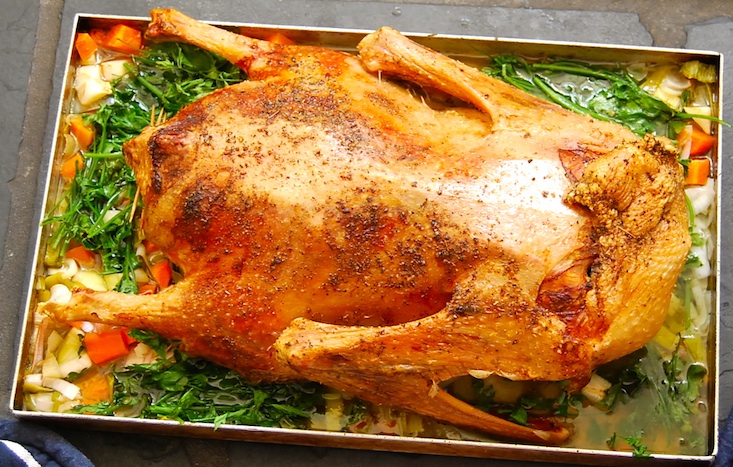
Picture by Nicole, of TooFoodToBeTrue.worpress.com
When the hour is up it is time to turn the bird on its back; put it back in the oven for another hour but remove excess fat from the tray and separate it as above. Keep basting the goose regularly with the juices. If the skin is not brown enough, raise the temperature to 200C for the last half hour. When the time is up, check the goose if it is done: cut into a fleshy part and check if the meat is cooked through. Then lift the bird onto your serving platter and cover it with baking foil to keep it warm. For the gravy, mix 1tbs butter with 1 tbs flour until you get a small ball. Bring to boil ca. 250ml of your de-fatted liquid; when it boils, add the flour-and-butter ball and keep stirring until it dissolves. Once the gravy thickens, remove it from the heat. Season with salt and pepper and serve alongside the goose.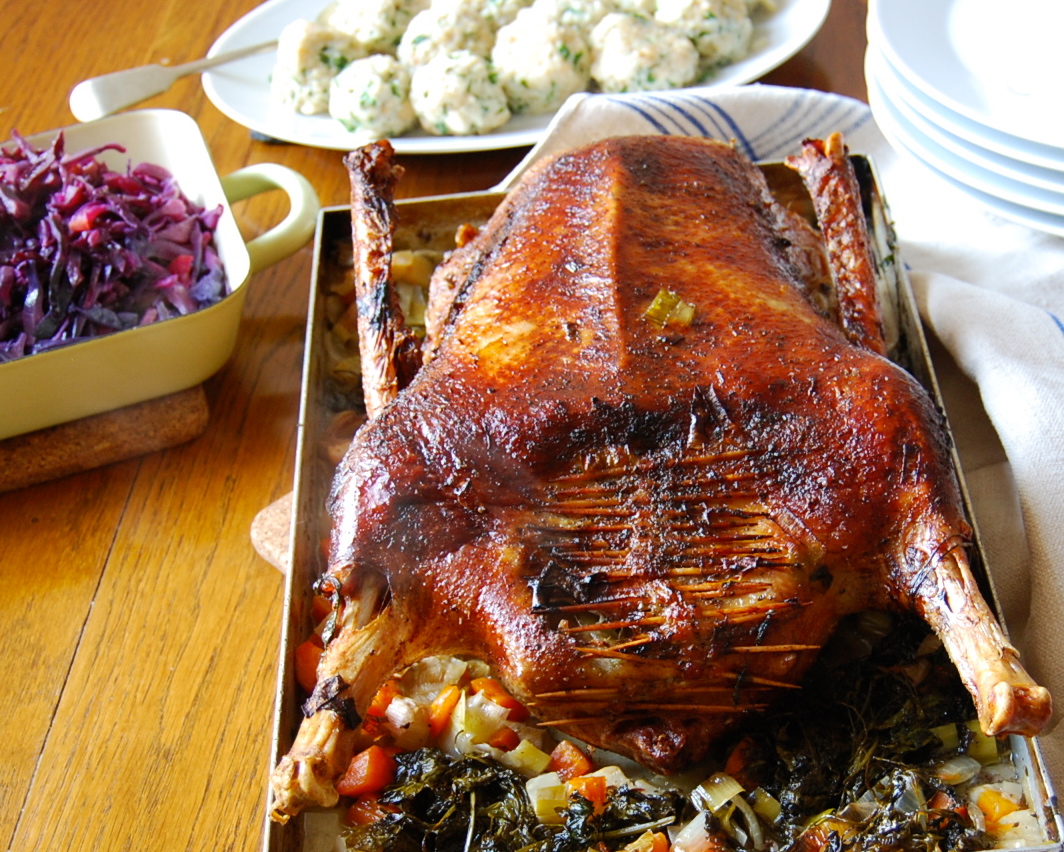 You will be surprised at the dark colour and the intense gamey flavour of the meat, and if you’re used to turkey you’ll appreciate its tenderness. Serve it with mashed potatoes and steamed apple, as Mrs Cratchit does in ‘A Christmas Carol’, or with the red cabbage and dumplings that you would have at St Martin’s day in many German families. I hope you enjoyed yet another meat-fest on my blog, but as I mentioned before, traditionally this feast would be followed by a period of fasting, leading up to Christmas. But don’t you worry: the longest I’ve ever stuck to a diet was 4 hours. I fainted, would you believe, and have never tried it again. But with only 40 days left to Christmas, the important question is: how ready are you? Have you bought the presents, written the cards – decked the halls, even?! I’m not having any of it, yet. It’s still only St Martin’s, and 40 days is plenty of time.


This looks absolutely wonderful. I love the flavour of goose (and all the fat left over for roast potatoes) though I’ve only ever eaten it a couple of times – and never on St. Martin’s. I’ll should rectify that, but it’ll have to be next year now 😉
LikeLike
I had been hoping from a post about St Martin’s on Eating Wiesbaden! Are they not celebrating it in Hessen?! In Bavaria they eat it with potato dumplings instead of the Semmelknödel I made, which might help to convince you 😉
LikeLike
Oh yes, it gets celebrated, but my husband hates goose! We’ve somehow just never had anything to do with it until this year: the Mini Dietz’s first ever Laternenfest is tonight but he’s ill, so we’re not going 😦
And as for something on Eating Wiesbaden… since I started work, I’ve only had about three minutes to myself each day but hopefully I’ll post something again before 2050!! 🙂
LikeLiked by 1 person
I’ve certainly enjoyed the cooking instructions for goose because I’ve never eaten goose. May I ask what you’ll do with all that goose fat? The goose looks very delicious and I see on the comment above the fat is for roast potatoes. Fat always tastes good…even though it looks disgusting after cooling into a white mass. Have a good week!
LikeLike
Roasting potatoes in goose fat makes them taste like something out of a posh restaurant – seriously! I use it for roasting any veg, not just for the taste but also because goose fat is surprisingly healthy in that it is high in unsaturated fats. It tastes wonderful on rye bread, with a bit of salt and pepper. There is a whole website dedicated to the stuff – goosefat.co.uk – which is quite interesting to read.
I had quite a lot of the juices left over, which, once de-fatted, I froze in ice-cube bags to use as a basis for soups or gravy. Goose is a dish that keeps on giving, it seems! I just picked up another bird from my butcher’s which I will use for a Christmas roast. I can’t wait to get my hands on it!
Have a wonderful week, too!
Ginger x
LikeLike
Oh my I’ve learnt so much from you today. Can one buy the goose fat or you have to wait for the day you roast a bird? I’m glad to learn it has unsaturated fats. Let me check out the website and enhance my goose fat skills. Thanks so much for providing the link and have a lovely day!
LikeLike
You’re welcome – you can buy it in supermarkets, so no need to buy a goose. But you’re missing out on a lovely dinner!
LikeLike
Super Fotos von Leckeressen. Bin begeistert und mir läuft das Wasser im Munde zusammen. Haben letzte Woche ebenfalls Gansbraten mit identischen Beilagen zubereitet. Leider fehlten uns die stimmungsvollen Laternen dazu. Grüße.
LikeLike
Dafür findet Ihr auch nicht immer noch bunte Papierschnipsel, zwischen Bodendielen und im Kamin … Die Gans hat uns sehr geschmeckt, beim nächsten Mal würde ich aber gerne den Wildgeschmack etwas mehr betonen. Wacholder- und Preiselbeeren, und dazu vielleicht Rosenkohl?
LikeLike
Oh my Gaaaaaaaaaaaa….Dana would say it 😀 it looks absolutely delicious! Ginger you rock! Goose fat is very healthy- I always have a jar in my fridge- my mom has been using it for years, she even adds it to the dough when she makes the apple tart- she says it’s much better after! I think I have to get ready for Christmas 🙂
LikeLike
I read that somewhere about shortcrust pastry; perhaps for a steak-and-guinness pie sometime? Thank you for the sowing-tutorial, usually my birds explode 😉
LikeLike
Oh man!!!! Red cabbage is my favorite thing in the whole world (been vegetarian for 15 years so goose is a distant memory). And those lanterns are beautiful!!!
LikeLike
I so admire you for being a vegetarian – I just couldn’t stick it! Made a lovely roast pumpkin soup for dinner yesterday, though, which ended with my family asking for the main course!
LikeLike
Oooh, I’ve always wanted to roast a goose!
LikeLike
It’s quite rewarding in that you get so much out of it; also, the bird is relatively small, so you can make it for a smaller crowd than a turkey. They are relatively expensive here in the UK, probably because they have gone out of fashion.
LikeLike
What a wonderful post – the tradition, the history and the incredible goose 🙂
LikeLike
The whole meal looks absolutely delicious, Ginger! I love your idea of stuffing the goose with sour apples. I imagine they flavored the goose perfectly. Also, the lanterns are adorable. It looks as if much fun was had. 🙂 I can claim about 30% German heritage and I’ve never heard of this feast day…it looks like I’ve missed out on a great excuse to eat!
LikeLike
An extraordinary post Ginger. The history was interesting to read as I am not familiar with the St Martin traditions and background. The instructions are clear and beautifully photographed. I have never cooked a goose exactly because of all that fat! But I have enjoyed it cooked by others. Those lanterns were lovely as were they A Christmas Carol quotes. Thank you!
LikeLike
It is worth it, I can assure you! Thanks to my wonderful butcher we have another goose lined up … I can’t wait to get my hands on it, the flavour is just amazing!
LikeLike
Credit where credit’s due: my friend Nicole, who just started her own blog TooFoodToBeTrue.wordpress.com, kindly helped me with the photographs. Thanks for your great help!
LikeLike
Pingback: Martinsmann pudding | 2nd Avenue
Pingback: Braised Red Cabbage: Adding Colour to your Table | Ginger&Bread
juts today I read something about St Martin and the geese- they also gave warm feathers for beds and quills for writing, so the time was absolutely perfect at the beginning of November. The legend of St Martin and the geese came later after those more practical things.
We will have one at christmas, slow-roasting in the oven (as I told last year)
LikeLike
I’ll have to compare notes – I’m planning one for Advent, so I need some Christmas inspiration! A lot of the Christian festivals have a much more practical explanation, and I am not surprised that the legend about the geese came long after Martin’s death.
LikeLike
Pingback: A few words about Advent in Germany
Pingback: Dumplings with Mushrooms for a Vegetarian Winter Feast | Ginger&Bread
Pingback: Seasonal Eating Guide: what to eat in December
Pingback: Serviettenknödel, a Dumpling for Special Occasions | Ginger&Bread
Pingback: What do the Germans Eat for Christmas?
Pingback: German Gnocchi: Schupfnudeln and Sauerkraut | Ginger&Bread
In my home country, Ireland, a cock was killed on St. Marin’s day and the blood was used to bless the 4 corners of the house.
A goose was the mainstay of the Christmas dinner in Ireland until the Turkey took over during the 1960’s. The goose was roasted in a cast iron pot with a fire beneath and redhot coals on top-slow cooking but all the more succulent because of that. The bird was basted regularly with the hot goose fat.
The goose was usually stuffed with potatoe stuffing garnished with onions, parsley , salt, pepper and pieces of uncooked goose fat-delicious beyond belief.
Left-over goose fat was used to waterproof boots and shoes during winter..
The goose wings were used for dusting and sweeping up and in older times their feathers were used as writing quills.
The gaelic name for the goose is ge pronounced gae.
LikeLiked by 1 person
That must have been some pot! It’s amazing how every part of the animal was put to use – nowadays, we only eat a very select few cuts and who knows where the rest ends up!
Thank you so much for sharing this, especially as I had no idea that St Martin’s was celebrated like this in Ireland!
LikeLike
The goose was roasted in what was called a “pot-oven” which was wide but not so deep. It was slung on a movable iron crane over a peat or wood fire. It was covered by an iron lid which was regularly covered with hot cinders. If the fireplace had no crane the pot-oven was placed on an iron trivet .
The practice of killing the cock on St Martin’s day is now extinct as far as I know-but maybe it survives in some counties in Ireland and maybe also in Scotland as many practices and festivals (such as Halloween-Samhain) are shared by Ireland and Gaelic Scotland.
LikeLiked by 1 person
I think I have seen similar constructions in the Ulster Folk and Transport Museum! Thank you again for your insight, so many traditions are being forgotten – in Germany, too, people are beginning to prefer an American-style Halloween party over the old-fashioned lantern parades.
LikeLike