Can you think of any symbol of man’s arrogance more potent than the Titanic? The sheer scale of it, as well as the decision not to clutter its look with too many lifeboats (or, rather, sufficient lifeboats) because, after all, the ship was unsinkable, all these factors explain our ongoing fascination with the ship. What is less known, however, is that the Titanic was built in Belfast. 
When you approach the city, by boat or plane, one of the first landmarks you see are the two giant yellow cranes that tower over the harbour: Samson and Goliath, as they are locally called, were built for the great shipbuilding firm Harland and Wolff, which built the Titanic and its sister ships Olympic and Britannic between 1908 and 1914. Those two cranes date from the 1960s and ’70s, replacing the gantry cranes that you can see on the photograph above.
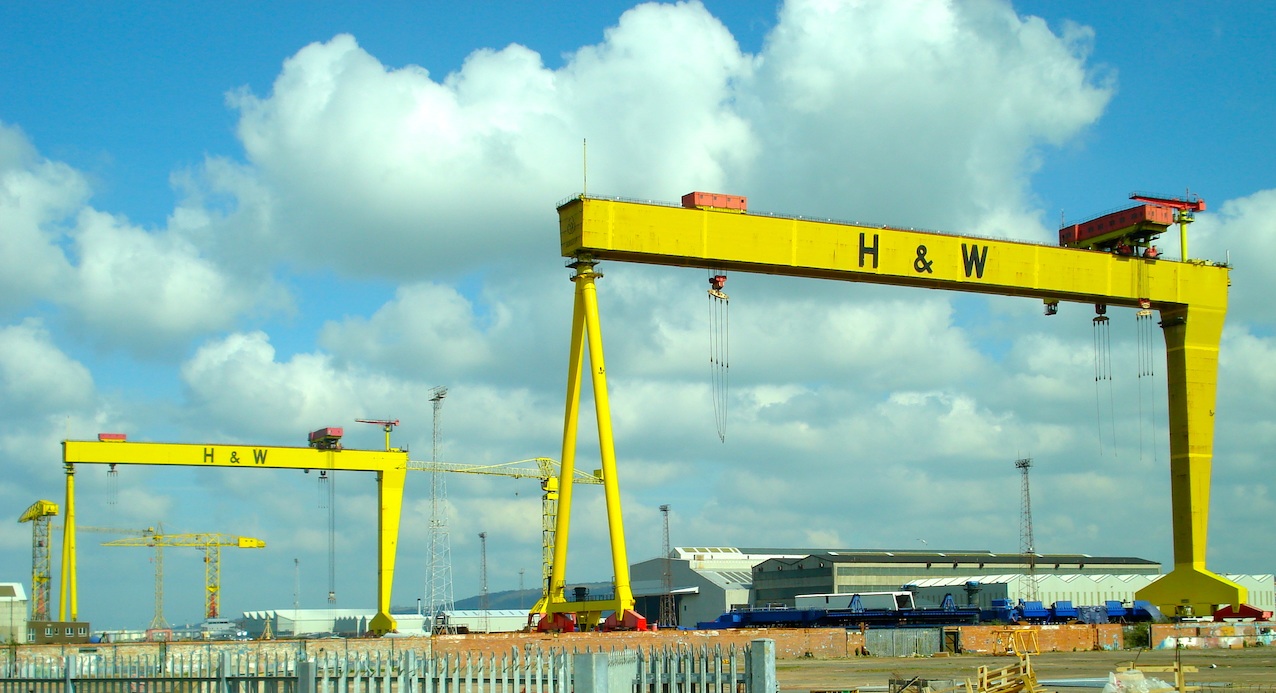
When we were living in Belfast, access to these sites was almost impossible to gain: only by boat did I once get a glimpse of the original pump house and the dry docks besides it, which were all that remained of the Titanic. In recent years, however, Belfast struck lucky to secure funding to capitalise on its Titanic heritage. This led not only to the building of the Titanic Belfast, an exhibition commemorating Belfast’s most famous export (obviously there are a range of contenders, but I’ll skip that one), as well as the restoration of what is left of the original buildings and structures involved in the building of the Titanic. You can see why a visit was high up on my list of things to do in Belfast!
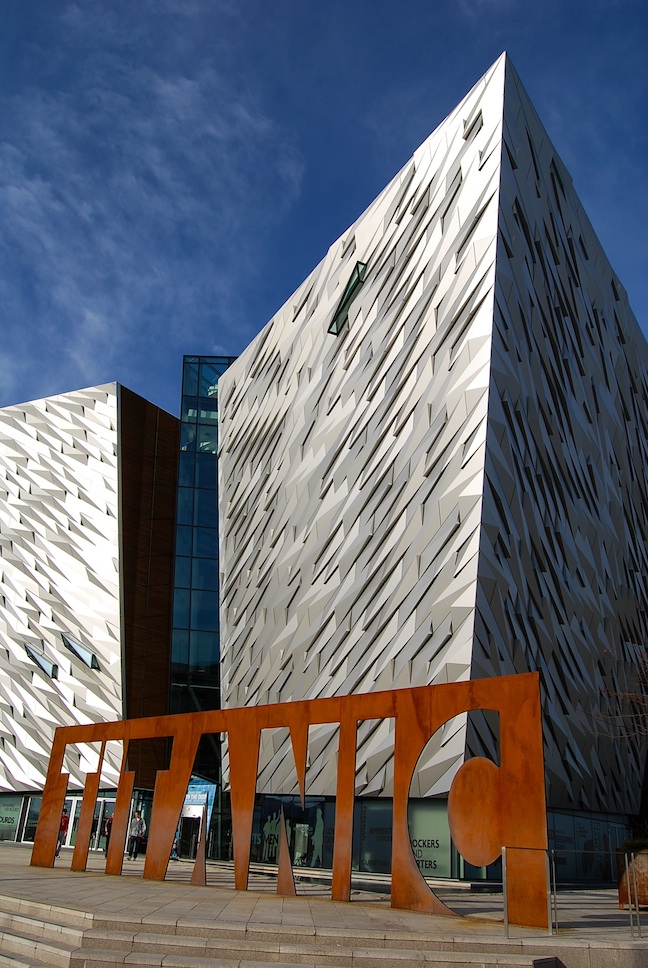
Titanic Belfast is an impressive structure: it opened in 2012, and the shape of the building is meant to evoke the keels of the three sister ships Olympic, Titanic and Britannic. The bold use of various materials is fascinating: the wall coverings on the outside reflect the sunlight, reminding us both of the bold use of steel in the construction of these giant ships as well as recalling the cold surface of the iceberg; they contrasts with the rusty iron used elsewhere, which serve as a reminder of the current position of the liner at the bottom of the sea. In fact, I would go so far as to encourage you to visit the building itself, even if you’re not that keen on the Titanic!
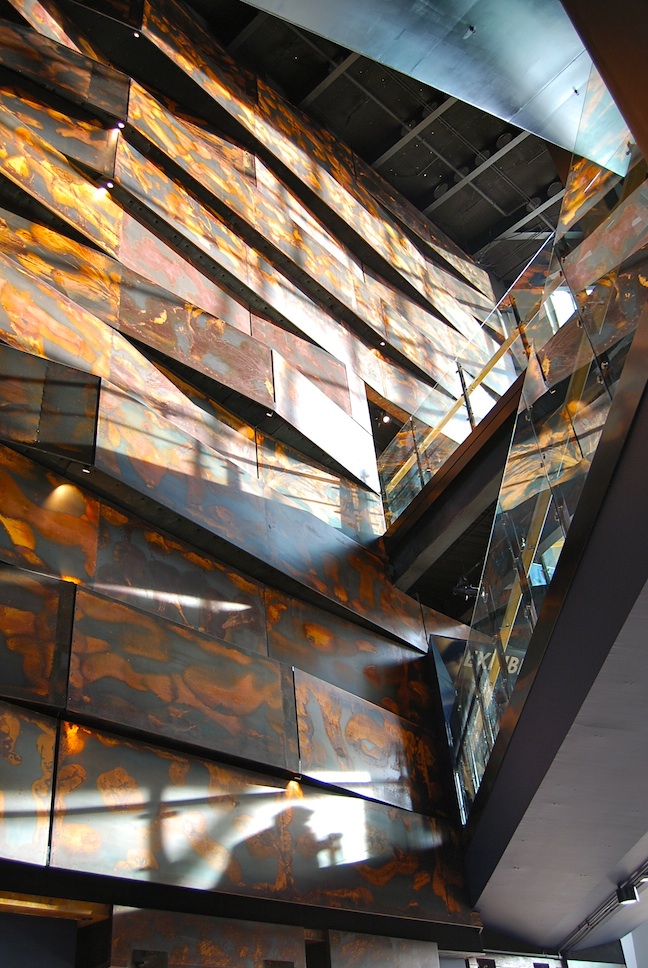
Unsurprisingly for a privately funded exhibition, Titanic Belfast is less of a museum than an ‘experience’: interactive and using a variety of media, it covers all aspects of the Titanic’s history, as well as that of the city in which it was built. Our children enjoyed the visual and aural aspects of the exhibitions, especially the cable car ‘ride’ through the shipyard, and I liked the use of various voices who told their own experience, from shipyard workers to survivors. We are presented with model cabins (first class for me, obviously!) as well as the stories of some of the passengers and crew.
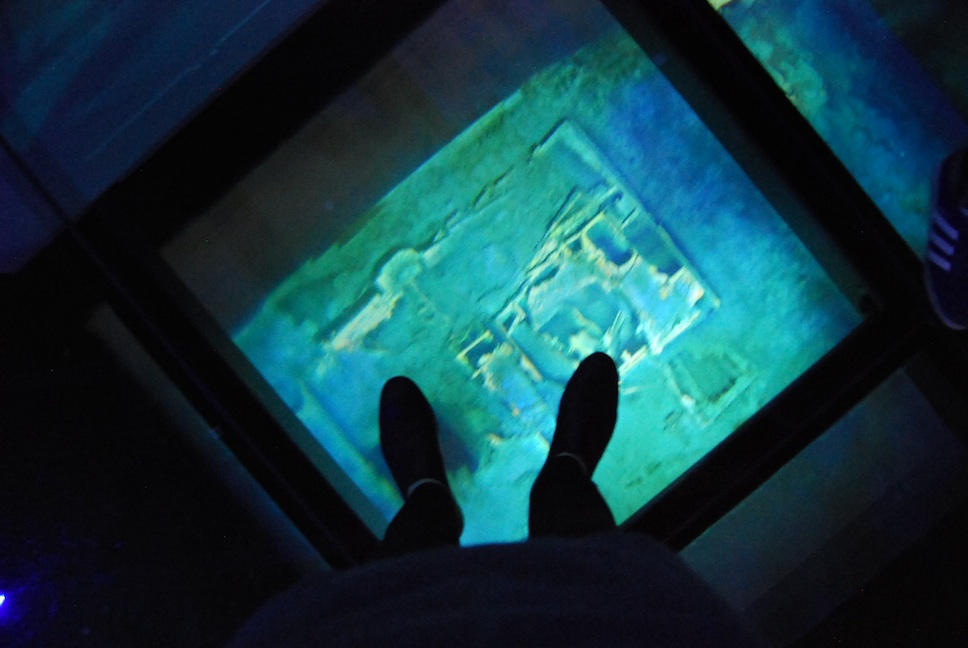
The exhibition ends – fittingly – with a view of the wreck through a glass floor, as we would see it if we were to dive down today: haunting in its fleeting presentation, still majestic, despite the obvious decay: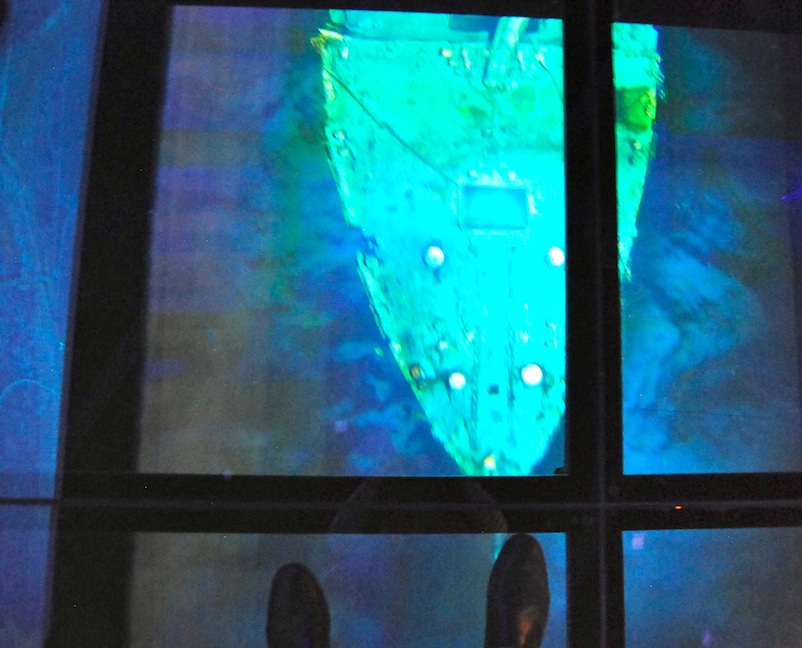
Pump House and Thompson Dry Dock
The most exciting part of the Titanic Quarter, in my view, is hidden away, like an afterthought, as it is only accessible via a 15-minute walk from Titanic Belfast. Don’t be fooled by this sales pitch: visiting the pump house and the dry dock is the real highlight of the visit, so wear appropriate shoes and bring a raincoat. No excuses!
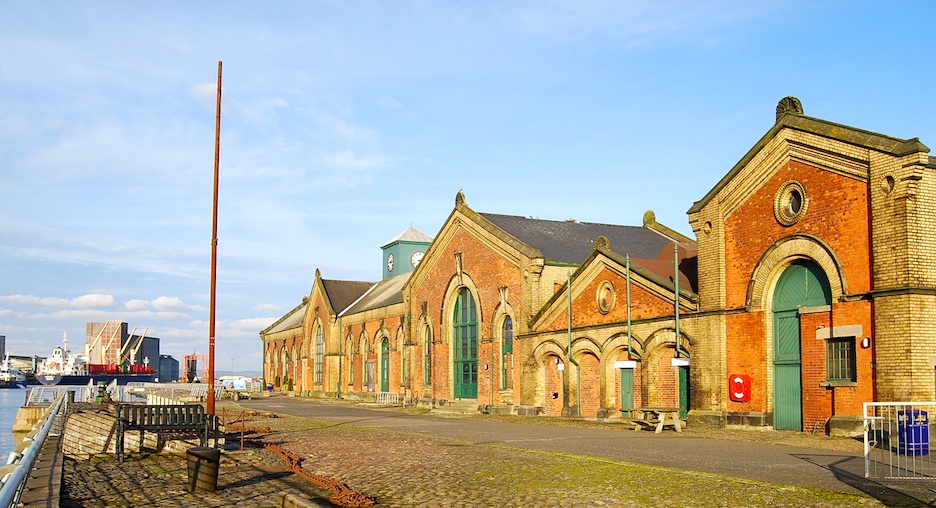
Once you have made your way past the ‘Titanic Quarter’s ‘Science Park’ (a mix of Game of Thrones film studios and call centres), you get to the only buildings that not only date back to the Titanic’s construction, but, as in the case of the dry dock, were constructed specifically to accommodate the ships’ unique size. The pump house is a typical Victorian affair, desperately masking its utilitarian purpose with an Italianate exterior. To put it mildly: a case of pimp my pump house.
Inside you can see some of the machinery used to pump water out of the dry dock and then go on to climb into the dry dock itself. The Thompson dry dock had to be built specifically for the ships: the existing dock was just not big enough. The pump house served to operate the gates that opened the dry dock as well as to pump the water out of the dock: its steam engines took more than an hour and a half to pump out millions of gallons of sea water!
The dry dock itself is massive, and needs to be explored from inside. You can see the stairs at the end of it, look at them carefully as you will need to climb them.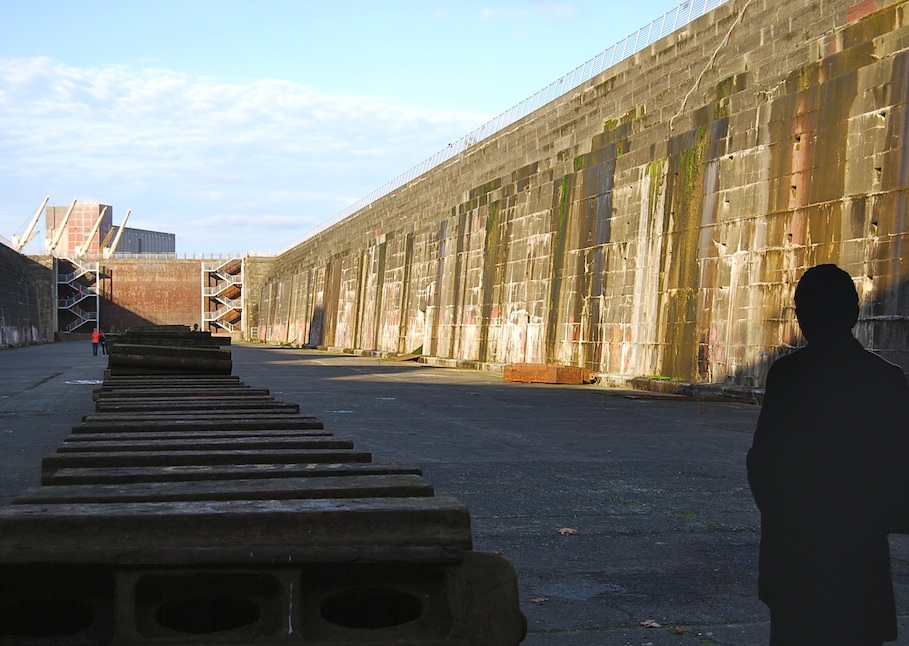
Just imagine the sheer size of the ships! The steel blocks you can see piled up along the middle were actually used to hold the Titanic in place. And to give you a better idea, here’s a picture taken during the actual building process: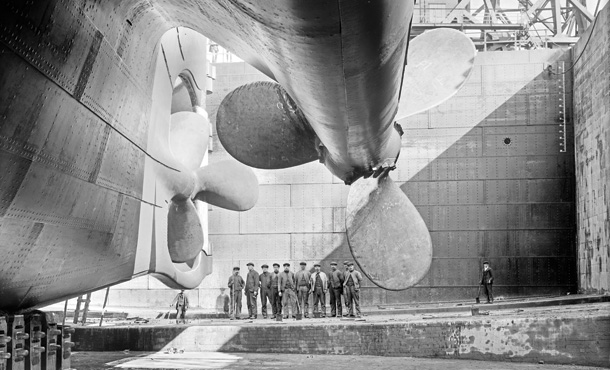
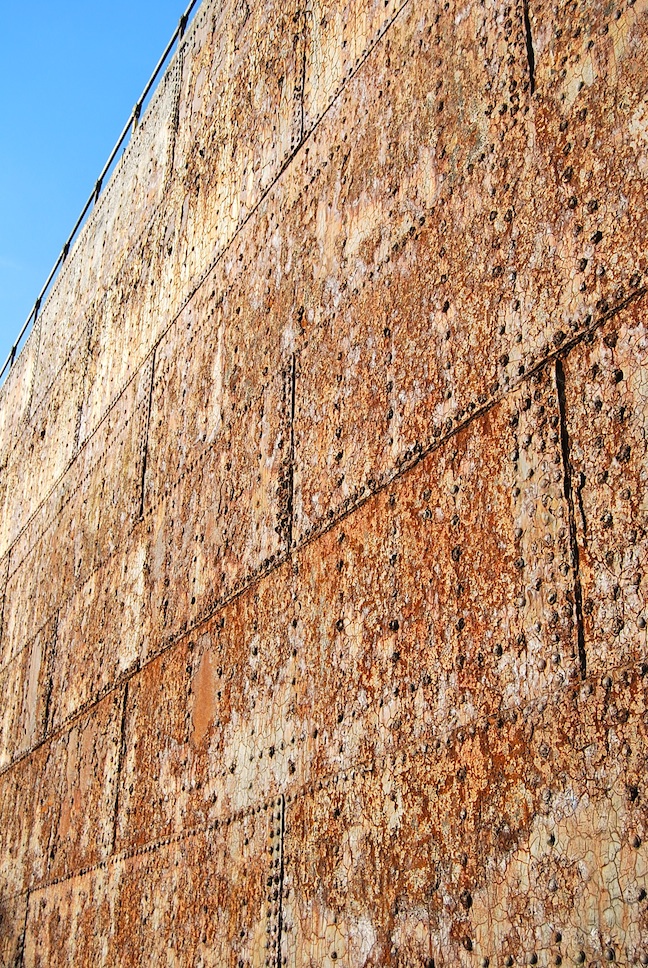
The sheer size of the hull is impressive – never mind the propellers … Behind the men you can see the doors to the dry dock: a massive wall of steel that could be opened to flood the dock and to let the ships pass. The original gate is still in place, albeit rather less shiny than on the photographs above:
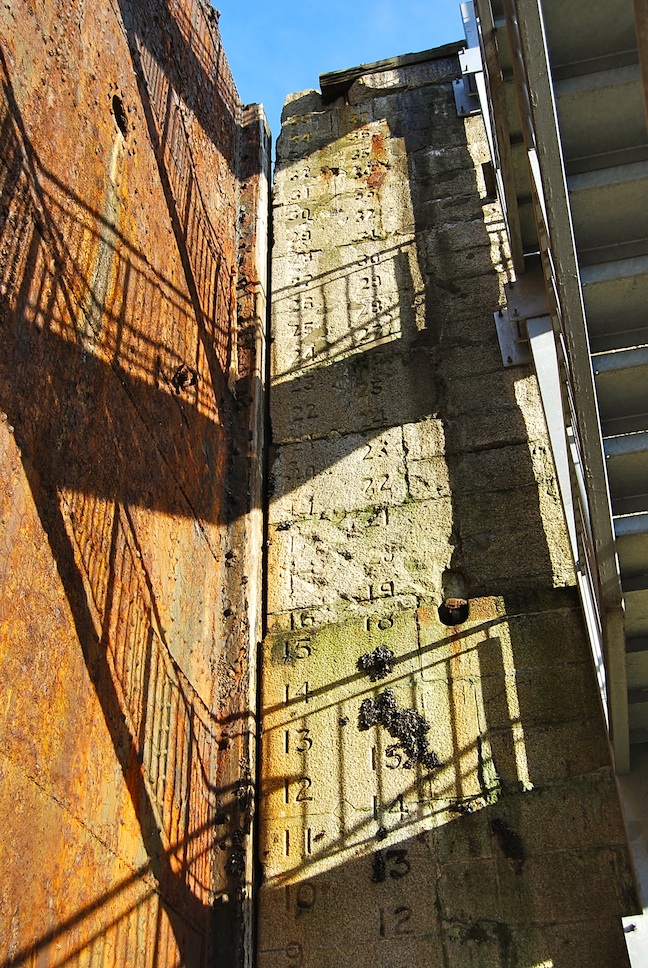
You can see where the architects of the Titanic Belfast got their ideas from: all that rust gleaming in the sunshine …
 From the top of the gates (the black pillars in the foreground are part of the original gates, the white new ones behind are a protective second gate), you get a good idea of what Harland and Wolff are up to these days: repairing ships and refurbishing oil rigs. Gone are the days of building unsinkable ships.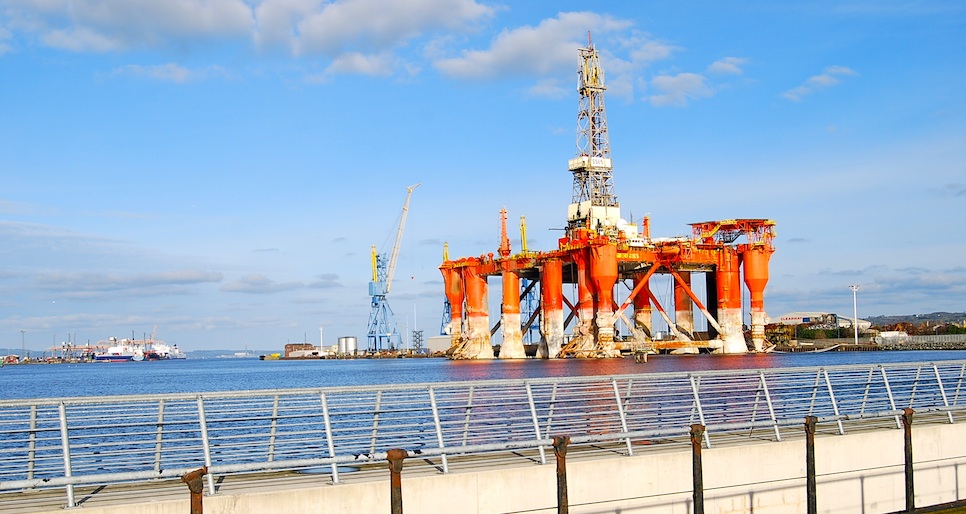
I’ll leave you with a poem by my favourite Belfast poet Derek Mahon. His grandfather had worked on the Titanic, but to Mahon’s relief was not personally responsible for the sinking. Unlike Bruce Ismay, the president of the White Star Line who owned the Titanic.
Ismay famously ignored the ‘women and children fiirst’ rule that dictated the evacuation of the Titanic’s passengers by taking up a place in a life boat – according to unconfirmed rumours, he even dressed as a woman. Ismay’s reputation was in shambles after the disaster: branded a coward, it emerged that it was possibly his decision to reduce the number of lifeboats on board, as well as the order to speed up instead of slowing down the ship when confronted with the iceberg.
Originally entitled ‘Bruce Ismay’s Soliloquy’, ‘After the Titanic’ is a dramatic monologue that recalls this strange character. His complete lack of empathy for the real victims is threatened by the constant reminders of those who lost their lives: the ‘broken toys and hat boxes’ of the women and children whose place he took. I love the haunting imagery and especially the sound of the ‘shredded ragtime’: the band, after all, was said to have played on while the boat sank. Unlike Ismay, they remained on the sinking ship.
‘After the Titanic’
They said I got away in the boat
And humbled me at the inquiry. I tell you
I sank as far that night as any
Hero. As I sat shivering on the dark water
I turned to ice to hear my costly
Life go thundering down in a pandemonium of
Prams, pianos, sideboards, winches,
Boilers bursting and shredded ragtime. Now I hide
In a lonely house behind the sea
Where the tide leaves broken toys and hat boxes
Silently at my door. The showers of
April, flowers of May mean nothing to me, nor the
Late lights of June, when my gardener
Describes to strangers how the old man stays in bed
On seaward mornings after nights of
Wind, takes his cocaine and will see no one. Then it is
I drown again with all those dim
Lost faces I never understood. My poor soul
Screams out in the starlight, heart
Breaks loose and rolls down like a stone.
Include me in your lamentations.
Derek Mahon (1985)


 Ginger&Bread
A nice little bit of history there!
PS I finally got round to making the chelsea bun thing… the dough is rising as we speak… er, type 🙂
LikeLiked by 1 person
That’s so cool! I am actually quite jealous now … might have to get baking, too!
LikeLike
That thing was so damn tasty… So damn tasty!
LikeLike
Thanks! That’s really appreciated. Although … what do you think about adding marzipan?
LikeLike
I could see that it could work but I’m not the biggest fan of that stuff so I’d leave it out 🙂
LikeLiked by 1 person
What a fantastic post – even if there was no food! 🙂 You managed to capture a scale in your photographs that makes everything seem so fantastic. I feel as if I were there!
LikeLike
Thanks! It always seemed such a stupid enterprise to me, all that biggest, fastest, most unsinkablest nonsense. But when you think of all those workers, who must have been so incredibly proud of their work … it puts it into a very different perspective.
LikeLike
It does, doesn’t it – Driven by crazy egomaniac money/fame mongers that were the leaders of industry – I guess the same thing happened with trains and planes, blimps, the space program. Even skyscrapers! Maybe everything, when I think about it!
LikeLiked by 1 person
Wow, now I really want to visit Belfast. I especially love all the textures of building materials you’ve captured in your photos.
LikeLike
It is such an interesting city, all Victorian utilitarian enterprise and drive. My architectural favourite are a row of fake façades, like a film set, that were stuck to the back of a row of terraces to make the area around the university look more grand for Queen Victoria’s visit!
LikeLike
Great post – thanks for taking us on your visit with you.
LikeLike
Thank you! I’d been so looking forward to it!
LikeLike
Lovely piece! Yes, a gorgeous building and a cool spot for anyone interested in urban history -even the one that’s unfolding there is worth a look. Can’t forget to mention the old jokes (you were the first to tell me when I arrived here): ‘she was alright when she left here’ and the current local nickname for the posh, new building: The Iceberg. Northern humour – you kind of have to warm to it. No doubt there is a recipe somewhere in the archives for the restaurant? For me, the tea served (Punjana) is still a favourite – no doubt you’ll have seen it for sale in the gift shop.
LikeLike
I saw it – good old Punjana – but I always thought only a glass of champagne would do when talking about the Titanic! Perhaps a seaweed sorbet? or is that too morbid?
LikeLike
Can Marta and I come with you!!?
We’ll come ready to cook…
LikeLiked by 1 person
Dana will cook and I will be singing “my heart will go on”!! 😀
LikeLike
Noooooooo! I’m all up for a girl’s weekend in Belfast (Merchant’s Hotel, pub crawl, the whole lot) but so not mention the film! Ever!!!
We used to have a Titanic unit at school and while all the other classes were watching the movie, my class had to watch the Lego version …
LikeLiked by 1 person
Such beautiful pictures Ginger.
LikeLike
Thank you! I should point out that I didn’t take the black-and-white ones though 😉
LikeLike
Another great “Out and About” Ginger. I never knew about the Titanic museum and the surrounding history.
Your descriptions and photos are very nice.
LikeLike