Have you ever wondered how to fit several kinds of meat into one single dish? What a bottle of wine could do to a stew? Or how to cook pig’s trotters? If yes, this traditional Alsatian stew will come as a true revelation to you, a shining light that will guide you through the cold winter evenings to come.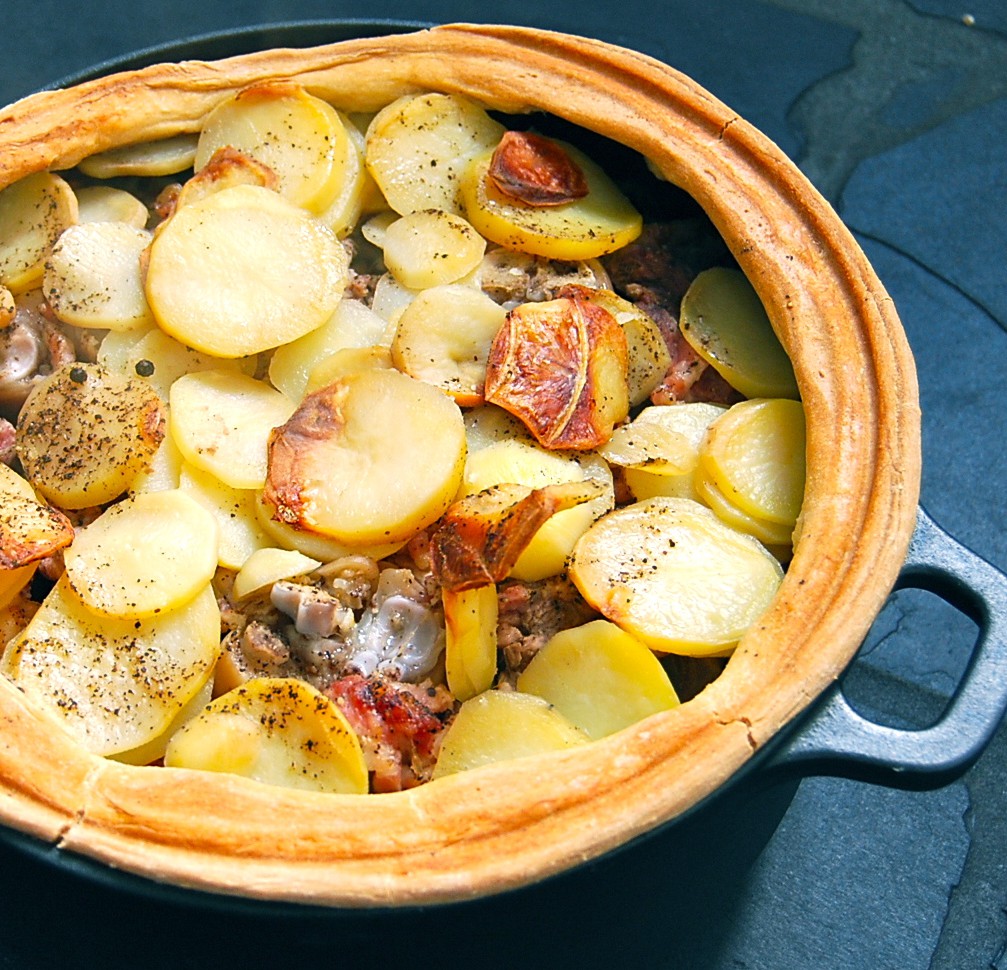 ‘Baeckeoffe’ simply means ‘baker’s oven’, and that is where these intensely flavoured rich stews were traditionally cooked. The famous French chef Hubert Keller, who grew up as a baker’s son in Ribeauvillé, a beautiful little towns in the Alsace region, described how the women of the town would drop off their meat-filled casseroles on a Monday the morning on their way to the washhouse, where they did their laundry. His father, like many bakers in the region, would simply seal the lids with some dough and pop them in his ovens. While the women were chatting away and washing their linen, the casseroles would make use of the warmth from the cooling ovens: after all, they would have been fired up early in the morning (or in the middle of the night, depending on your viewpoint) and by the time the women dropped by, all the baking would have been done already. At noon they’d pick up their casseroles on their way back and serve it – hot and ready – to their families. Keller writes engagingly about growing up and helping his father in his Souvenirs: Stories and Recipes from my Life, and you can find an abstract – including a couple of his recipes! – in Epicurious. He trained and worked with the most important chefs of my childhood: Paul Haeberlin and Paul Bocuse were the stars of the ’80 and ’90s, bringing a new, lighter version of French cuisine, the aptly-labelled ‘nouvelle cuisine’, across the river Rhine and subsequently revolutionising our concepts of ‘fine dining’. This dish, however, is anything but ‘light’: it is a hearty mix of beef, lamb and pork, potatoes, onions and leeks, with a pig’s trotter thrown in, for good measure, and all is simmered in a whole bottle of white wine. So, vegetarians, low-carb and generally healthy people, beware: the following is not for the faint-hearted!
Baeckeoffe: Stew of Beef, Pork and Lamb (serves 8-10)
For the marinade (30 mins to prepare, 12-24 hours to marinade):
- 600g shin of beef, ideally with the bones, but diced to suit your taste (ca. 2 inch for me)
- 600g pork shoulder, diced as above
- 600g neck of lamb or mutton, diced as above
- 200g smoked streaky bacon rashers, or pancetta, cut into small cubes
- 2 bay leaves
- 5 juniper berries
- 2 cloves
- 6 peppercorns
- 1 bottle of dryish white wine – ideally from the Alsace, but if you don’t fancy remortgaging your house, any white wine will do.
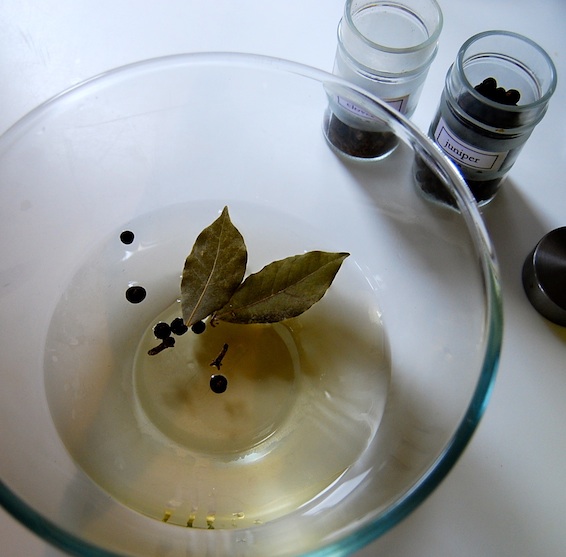 Simply mix all the ingredients in a large bowl. Cover and refrigerate overnight, ideally you’d want to mix them once or twice to ensure the pieces are marinating evenly.
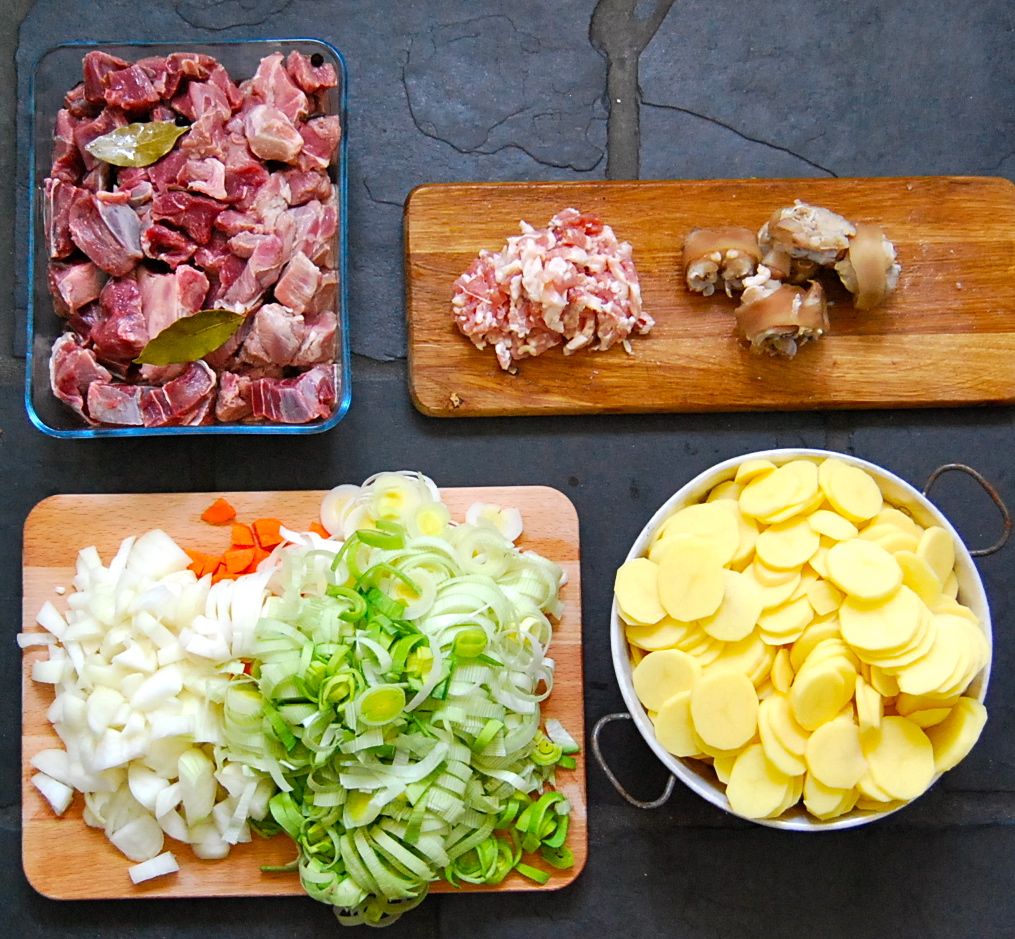
All you need for a Baeckeoffe
For the Baeckeoffe (40 mins to prepare, 3 hours to bake):
- 2 kg firm potatoes
- 4 leeks
- 1 carrot
- 5 onions
- 100g white flour
- 1 pig’s trotter, cut into 2-4 pieces
Bring a small pot of water to boil and add the pig’s trotters; boil for 5 minutes, then drain and set aside. A word about the bone marrow and the trotters: you can leave them out, obviously, if the thought of them freaks you out. However, in the past, when people slaughtered their own animals, it was necessary to use every part of the carcass – be it in various dishes, sausages and black pudding, or by boiling the bones to gelatine. You simply could not afford anything going to waste. Cooking the bones with your stew will make it much richer and give it a lovely colour, whereas pigs’ trotters will make the liquid thicker.. At the end of the day they are just a bit of meat … If you think that’s a lot of meat, you’re right. But there are also a lot of vegetables that go in: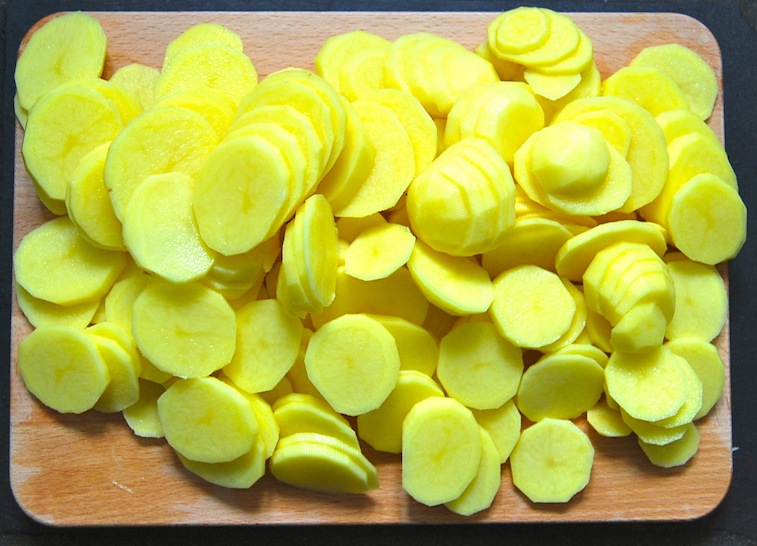
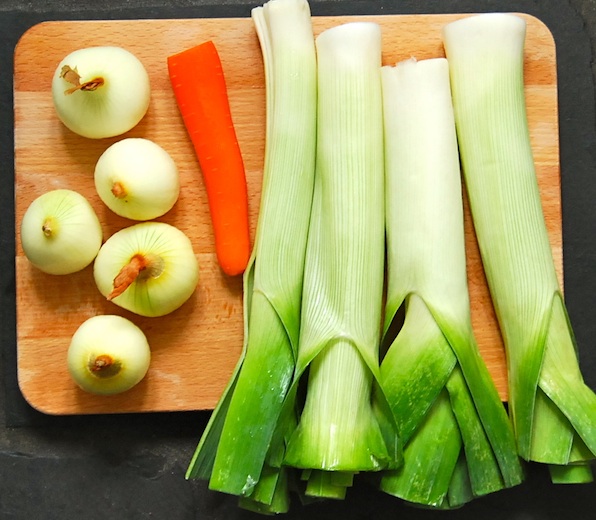 Wash, peel and slice the potatoes into thin slices. Preheat your oven to 170C. Wash and slice the leeks and carrot; cut the onions into rough chunks.
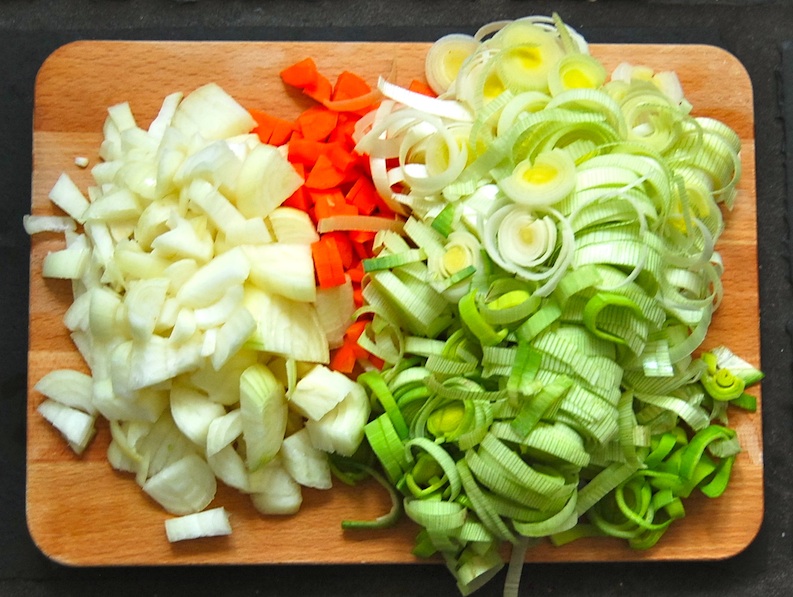 Grease a large casserole dish (mine takes over 6l /11 pt/almost 6 qt) before assembling the ingredients as follows:
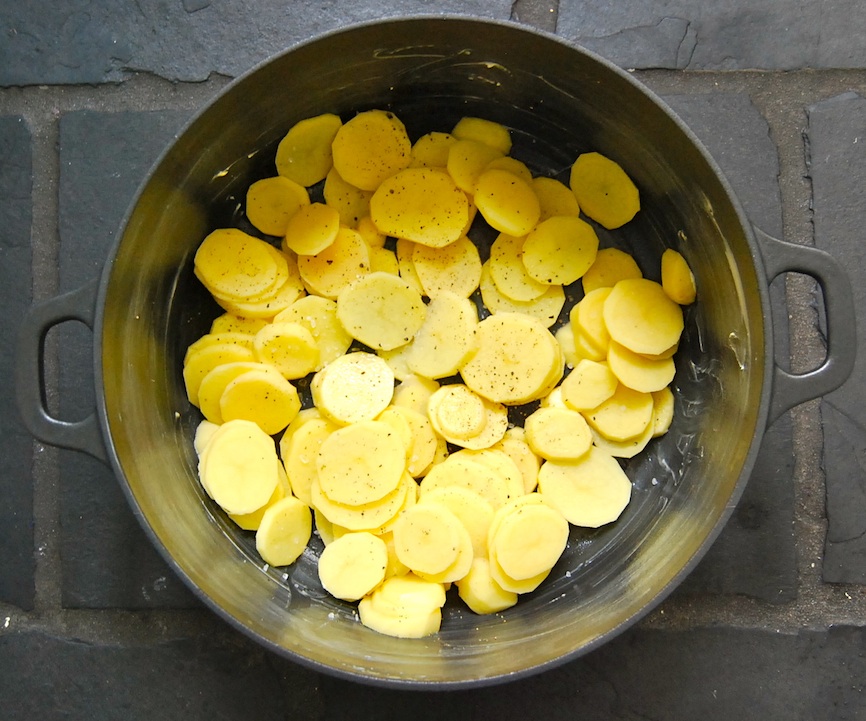 Start with a layer of potatoes (roughly 1/4) and season with salt and pepper.
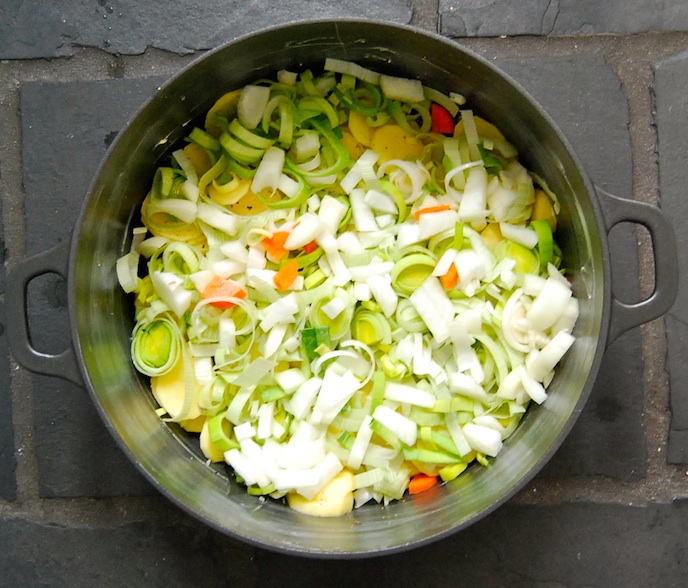 Add 1/2 of the vegetables. Season.
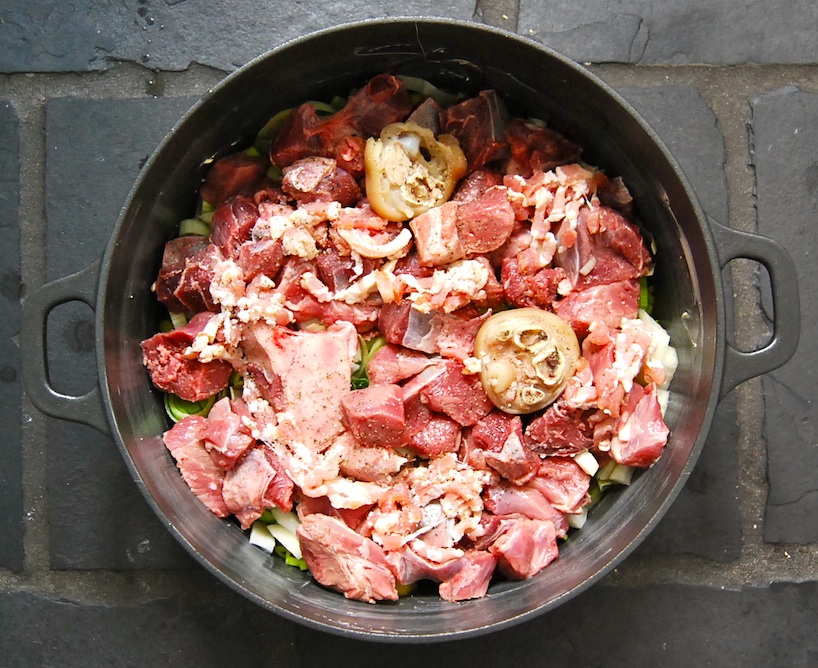 Add 1/2 of the meat, without the marinade. Add another layer of potatoes, then vegetables, then meat, seasoning if necessary.
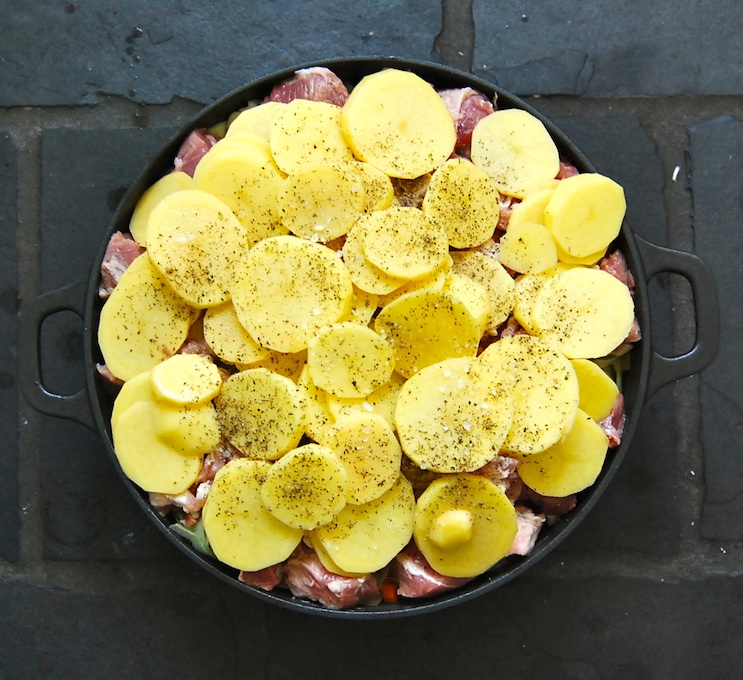 Finish it off with the remaining potatoes. Pour in the remaining marinade and top it up with more wine, if necessary: it should cover the potatoes.
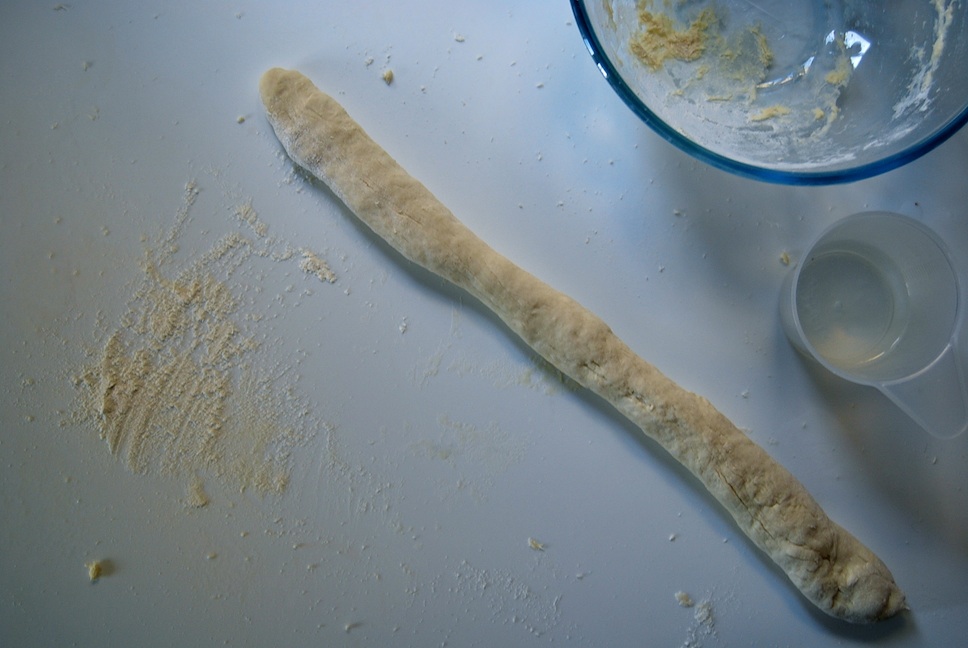 To seal the pot, mix the flour with as much water as necessary to form a firm dough, roll it into a long sausage and place it around the rim of your casserole.
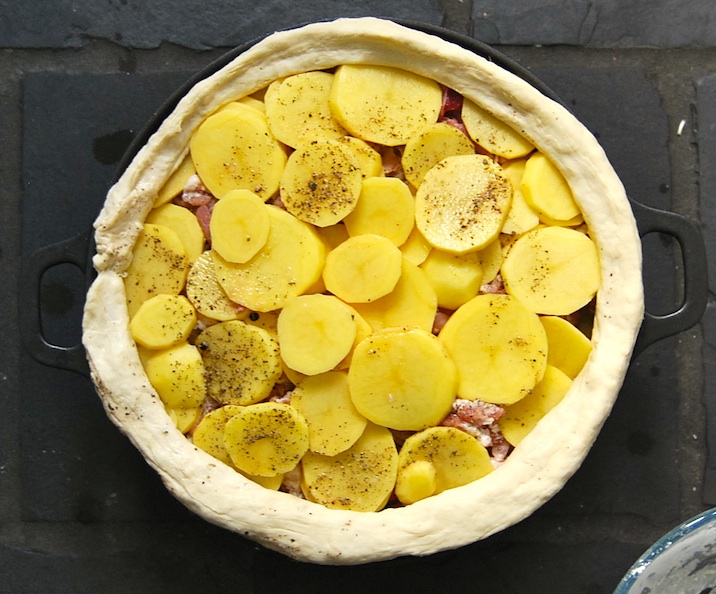 Close the lid and press it down firmly:
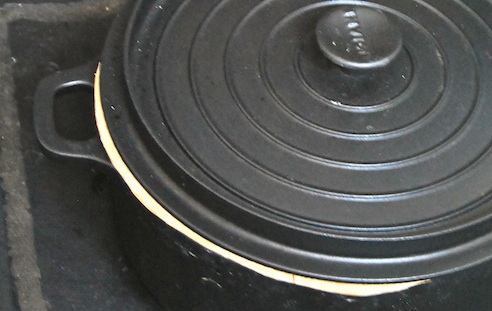 Bake it in the oven for a good 3 hours; serve it straight out of the casserole, as they would in the Alsace. Enjoy with a glass of Riesling – and aid your digestion with a shot or two of eau de vie, I suppose …
 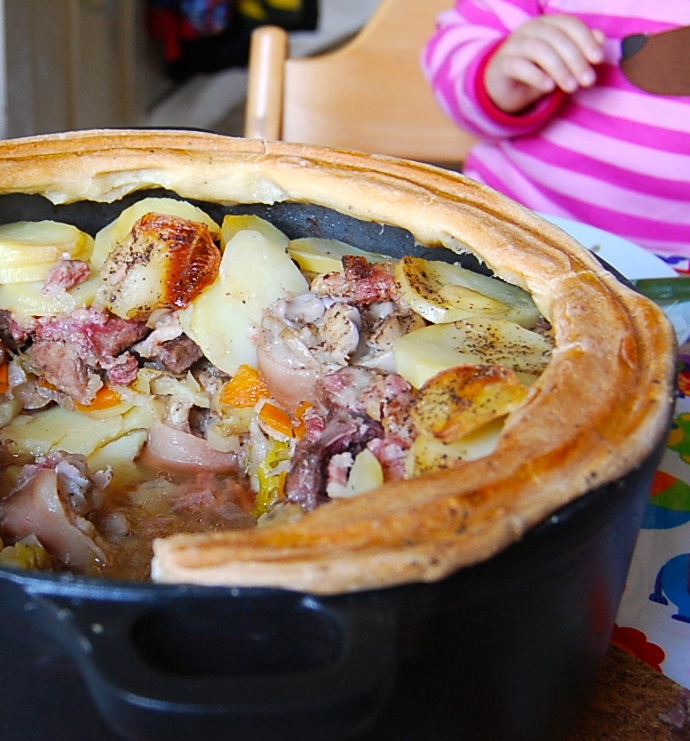 As it is Friday, I am bringing this dish along to Angie’s, who is celebrating Fiesta Friday at The Novice Gardener‘s with us, already for the 39th time! And a special thanks to her co-hosts, Suzanne from A Pug in the Kitchen and Sue from Birgerbird – I am looking forward to see what they have brought along to the party! A Baeckeoffe is the perfect party dish in that it can be prepared beforehand and warmed up when necessary; breaking the crust to open the lid is quite impressive, and you can balance the sheer meatiness by adjusting the quantities, as well as by serving it with baguette and a simple green side salad. You can bake it in the oven or the slow cooker, either way it will make a perfect winter warmer. Happy Fiesta Friday!


 Ginger&Bread
I effing love these style dishes that got cooked in the bakers ovens… and three types of meat is certainly right up my alley, too. Damn fine, my friend 🙂
LikeLike
It’s man-food I suppose, especially the trotter …
LikeLike
Mmmm… Trotter
LikeLike
Should you have a spare pig’s tail, add it but boil it with the trotter. There’s always space for a pig’s tail.
LikeLike
🙂
LikeLike
This looks like absolute heaven. I’m all for using every last bit of the animal, though I rarely choose recipes that do. I’m also all for putting casserole dishes in the oven for a very long time, especially at this time of year (we’ve been doing it all this week, in fact). I am absolutely going to give this a go – thank you so much for sharing!
p.s. Lovely photos. Again 🙂
LikeLike
Thank you – they are hard work, especially with a dish like this 😉
LikeLike
I bet!!
LikeLike
LOVING THIS!!! the mix of meats must be really interesting..
LikeLike
It is actually – they play off each other in a way that brings out the flavours of each of them. I’m a great fan of lamb stew and I like the way I can still taste it, as part of the overall dish. It’s wrong, I know, but in a good way 😉
LikeLike
I am liking your wrong..
LikeLiked by 1 person
OMG all this meat – I’m going starry eyed !!!! 🙂
LikeLike
It is insane, I know. Try and serve it with a side salad, though, and nobody will notice 😉
LikeLike
Oh my gosh this is the PERFECT dish to bring !!!!! This is absolutely one of my all time favorite dishes and isn’t the technique for sealing the pot so smart!!!! Then you can break off and dip into the stew. You know, I really like Hubert Keller and when I was living in San Francisco even though I never went to his restaurant I made two of his recipes that were published in a magazine, one for lobster soup and the other for kataifi (filo dough) wrapped shrimp with an asian type sauce and they both turned out amazing. I really think the european chefs trained in the old school traditions make some of the best tasting food ever, even though it may lack bells and whistles. Thank you for joining us today and have a great weekend!!!
LikeLike
Thank you! Funnily enough, he isn’t that well known here in the UK, and I can’t speak about France. But I read about him in the Epicurious article and I certainly know all his French connections – he trained at the Auberge d’Ill, which is a place I almost went to when I was a kid, almost, and I remember everybody talking about what I had missed 😉
I have a recipe of theirs for an onion tarte, which I am looking forward to make someday!
LikeLike
Ginger this dish looks great! I love this German efficiency 😉 all important ingredients in one pot, it has to be good. I will definitely try it. I got your email, will reply this weekend. Happy Fiesta xx
LikeLike
Don’t call it German efficency – the Alsace is very French indeed! Although, I went on work experience there as a teenager, in order to learn French. Everybody over 40 spoke either fluent German or the Alasatian dialect, which mixes French and German. Needless to say, my French didn’t really take off. Ever.
LikeLiked by 1 person
Haha when we went there this year- my boyfriend is French- we felt like it was Germany believe me! So clean and in perfect order, and frankly I don’t think they feel like French at all- they are not another thing, we loved it and it’s our favorite part of France 😉
LikeLiked by 1 person
Those border countries are a funny mix! We went to the Ticino a couple of years ago, and it was just like Italy – but Italy after a 2-week visit of an OCD pressure group 😉
LikeLiked by 1 person
Alsace has been both French and German, as has the north of Italy. The cuisines in these areas reflect that history, much like the cuisine of Portugal tastes of the vast travels of its days as a nation of explorers and traders.
LikeLike
The Southern Tyrol too, many years ago, and their defiance against ‘Roman occupation’ was quite amazing! But I loved living in a border area during my time as a student in Aachen: 5 mins to the Netherlands, 10 to Belgium – and all by public transport!
When you think of those endless wars though, pushing the borders back and forth – what a waste of lives.
LikeLike
is there a quantity/ weight for the neck of lamb or mutton missing from this recipe
LikeLike
Oh, I am so sorry – forgot the forest over all those trees!
LikeLike
Pingback: Fiesta Friday Birthday Edition (FF39) | The Novice Gardener
This looks amazing! Love the step-by-step pictorials. Such a satisfying, classic stew for sure. Happy FF!
LikeLike
Thank you, Loretta! It is a wonderful dish for the cold season – I loved the layering of the ingredients, so I got the camera out 🙂
LikeLike
What an impressive dish! I can’t wait to try this. I love the dough around the perimeter. I’ve never seen this before. I am sure this stew only gets better as it has chances to sit.
LikeLike
Do let me know how it works for you! I used a very German spice mix, junipers I use in most meat casseroles, and the cloves just complement it really well. A more ‘French’ way would be to use a bouquet garni – I’ll be giving that a try the next time round 🙂
LikeLike
This is so VERY much our kind of food – perfect for a crowd and the winter. And we love pigs trotters…well, everything including the “oink”! Love the history of the dish and adore your casserole 🙂
LikeLike
Thanks! BTW there’s always room for a tail, too!
LikeLike
Indeed – but don’t they look a bit rude when they’re cooked (or is that just my vulgar mind)?!
LikeLike
Wait until I get started on my sausage recipes 😉
LikeLiked by 1 person
I just showed this to my husband and he started saying I gotta make it. I told him to make it himself. That’s when he looked at me doe-eyed and said pleeease…… I actually knew I was going to be in trouble the minute I called him to look at it. This is totally his kind of meal! I shall attempt to make, Ginger. What a wonderful cold-weather recipe! 😀
LikeLike
I hope you enjoy it as much as we did! My partner was the same, btw. Never seen him happier 😉
LikeLike
Oh, you read my mind. I saw pig’s trotter at the market this weekend, and I was wondering what to make with it. The flour-seal is also so cool.
LikeLiked by 1 person
I have ancestors that came from that region – I can’t wait to try this lovely stew, and imagine that I’ve found a link through time and space!
LikeLike
Pingback: Loaded Pumpkin Waffles | Fiesta Friday #40 | The Novice Gardener
My maternal ancestors are from Besançon but I have never seen or heard of this dish. The French Canadians do eat pigs feet in stews and that tradition must have originated from this dish. With 3 sons ages 19, 20, 21, they will LOVE all this emat in pastry. What an awesome presentation! Thank you for sharing it with us Ginger! Happy FF!
LikeLike
Besançon has its own regional cuisine, and due to its turbulent history I think Alsatian dishes have generally more in common with the food of its German neighbours than with French recipes. Even the name, ‘Baeckeoffe’, is Germanic (the Standard German would be ‘Backofen’)
I’m not surprised the French Canadians make good use of their carcasses! I hope your family will like the dish 🙂
LikeLike
Yum! Great recipe. Thanks for sharing 🙂
LikeLike