This is a post about cheesecake. Not any cheesecake, but the one you’ve always wanted to make. The one your granny or aunt made for you when you were little, but when you asked how they did it they just told you not to bother, it was too difficult. And that was it.
When Marta from PlateduJour suggested a bake-off in the style of Dana’s of I’ve Got Cake’s ‘Friendly Fire‘ – one dish, two versions, made simultaneously to often surprising effects – we decided on cheesecake simply because Marta had mentioned a family recipe that included an insane amount of eggs and that she had therefore never dared to make. I was intrigued. In my house, the no-go recipe was a strudel: the delicate, paper-thin dough which needed to be stretched out on an old bedsheet was usually filled with apples; my mum took years to perfect it, and it took me years to come up with the courage to not only make the pastry, but to fill it with quark, to recreate a classic Austrian cake, the ‘Topfenstrudel’.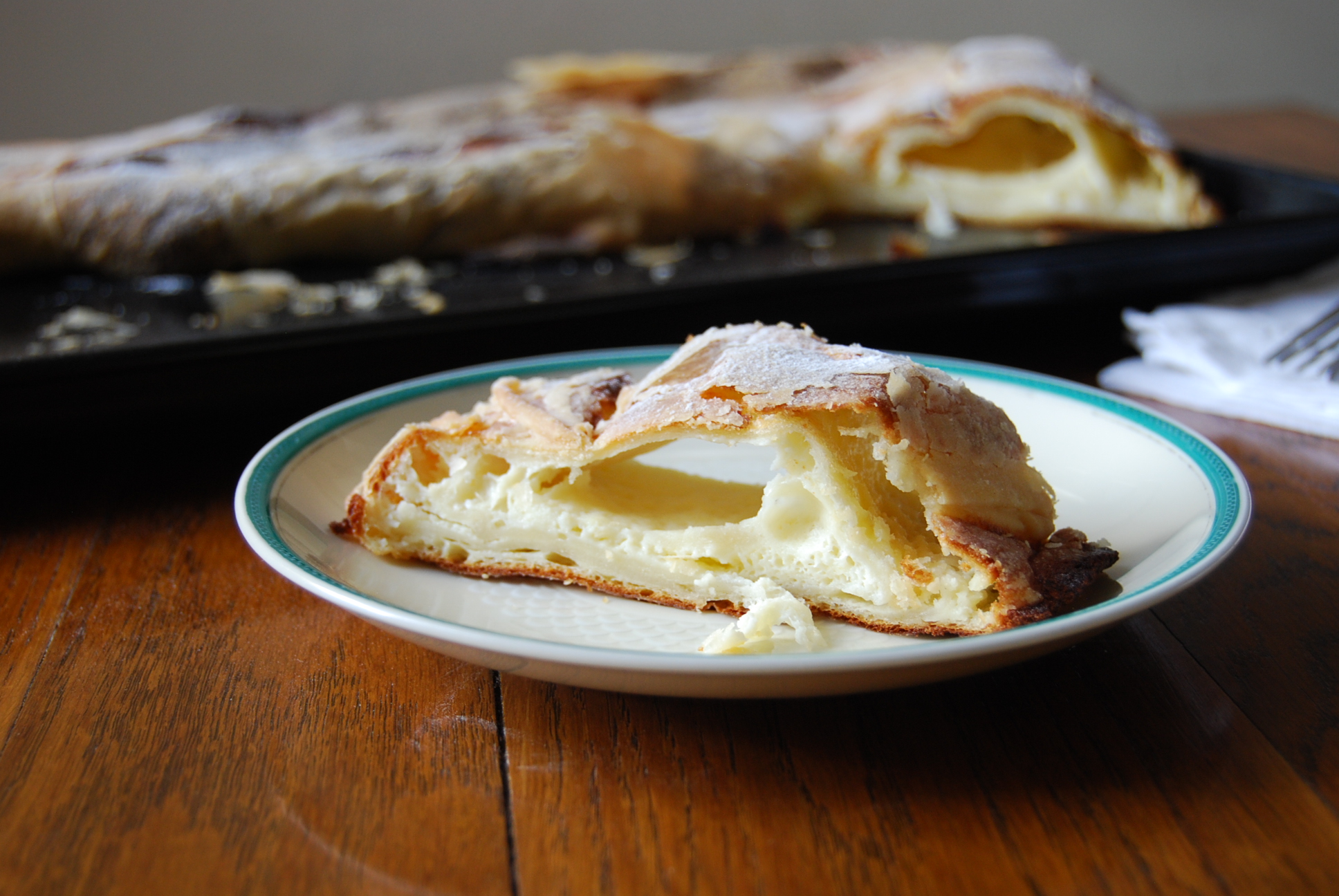
Topfenstrudel is a cheesecake that seems to defy physics: a rich and creamy cheese filling, with hints of vanilla and lemon zest, is held together by flaky, paper-thin pastry. It is a combination to die for.
Needless to say, there are reasons why I never attempted to bake this: for a start the pastry is incredibly delicate and thin, it needs to be pulled into shape without breaking up, and you then need to wrap it around a filling that is quite heavy and desperate to get out. Unsurprisingly, my fist attempt ended in what could be described either as an ‘interesting traybake’, or as a ‘complete disaster’: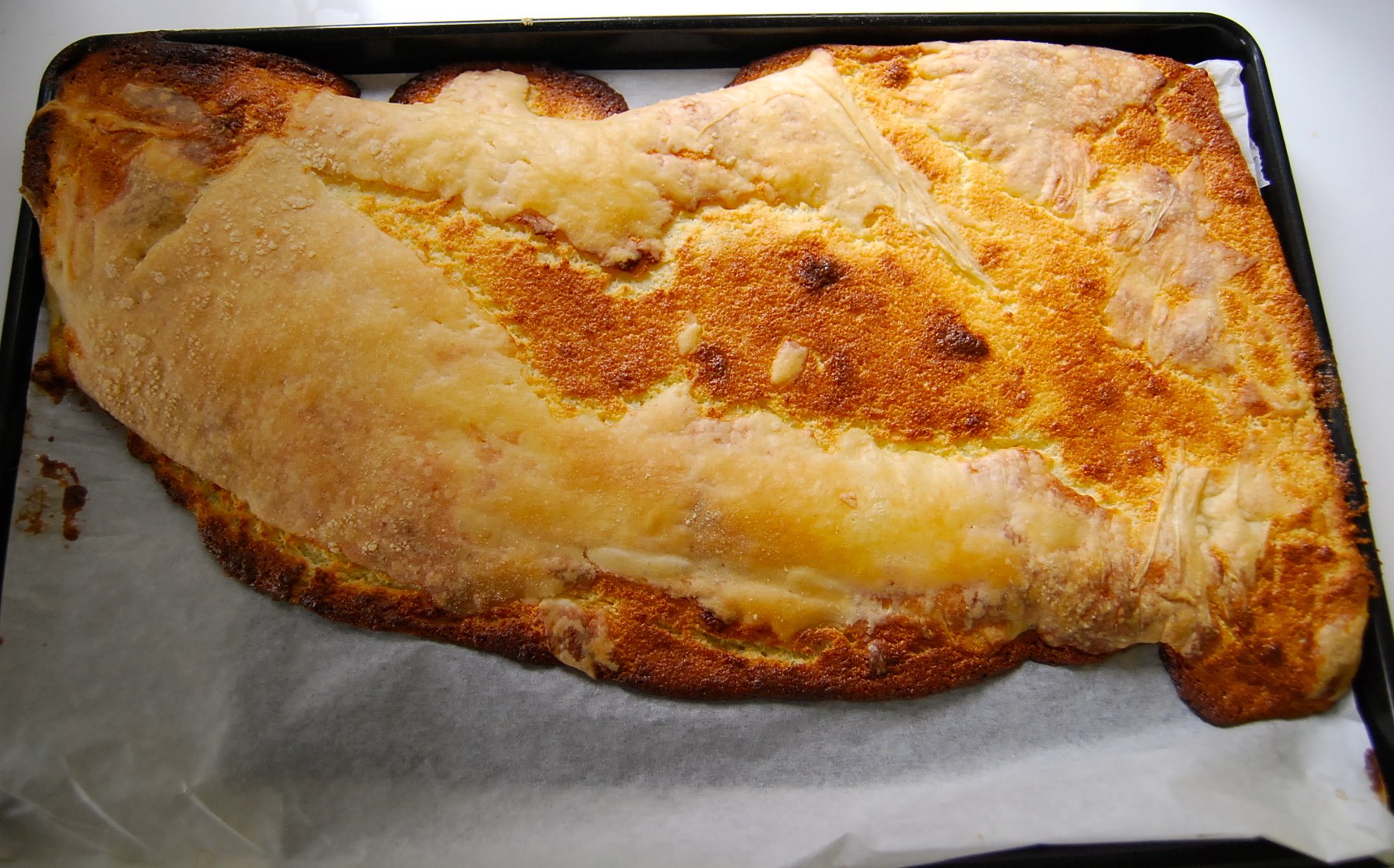
24 hours later, equipped with a new pot of quark and enough determination to singlehandedly climb the Eiger north face, blindfolded and on stilts, I tried again. And hey presto, this time the finished cake resembled -at least partially – the original.
The following recipe comes from a fantastic Austrian blog called ‘Prostmahlzeit‘, which translates as ‘Cheers and enjoy your meal!’, a very appropriate title. Thank you, ‘Turbohausfrau’, for the brilliant introduction to strudelmaking! As for the filling, I experimented first with a classic mix based on a Viennese cookbook from the 1950, which Hiwwelhubber uses for his Topfenstrudel recipe. I blamed the traybake-experience only partially on my assistant, and mostly on making a filling that was simply too wet and heavy. After a few adjustments (including a babysitter), this is the final recipe.
Needless to say, if you like the idea of it, but not the heartache of the strudel pastry, use ready-made filo instead. Nobody but an Austrian would notice 😉
Classic Viennese Cheesecake: Topfenstrudel
Strudel pastry (following Turbohausfrau):
- 200g plain flour
- 100ml lukewarm water
- 40g vegetable oil
- pinch of salt
Mix these ingredients using your hands – you need to knead the pastry thoroughly until you get a perfectly even ball, like this one: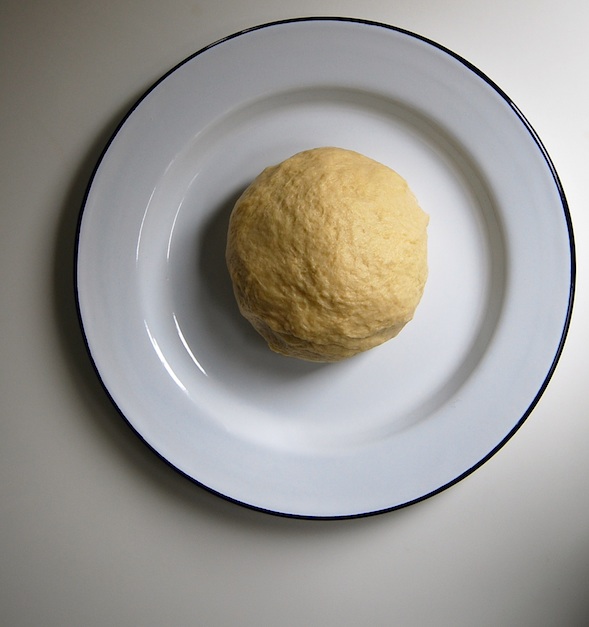
Brush with a little oil and set aside to rest for one hour at room temperature.
Filling:
- 500g quark, or fromage frais, at 20% fat
- 2 tbs of soured cream
- 4 eggs, separated
- 100g soft, unsalted butter
- 80g sugar
- 20g vanilla sugar
- grated peel of 1 lemon
- 50g corn flour
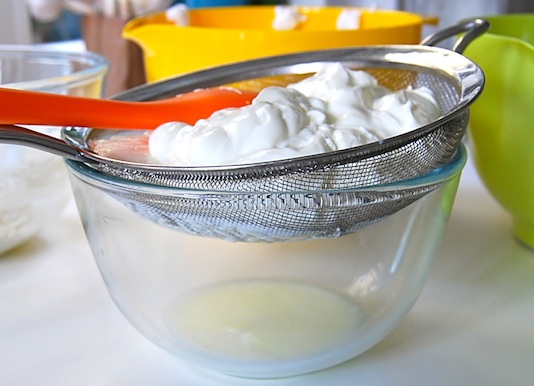
From my traybake experience I learned that it makes sense to strain the quark or fromage frais and the soured cream thoroughly beforehand: simply turn the whole pot of quark into a fine sieve, add the soured cream and leave it in it until needed. About ten minutes before the end of the resting period of your dough you can heat the oven to 200C and slightly grease a large oven sheet.
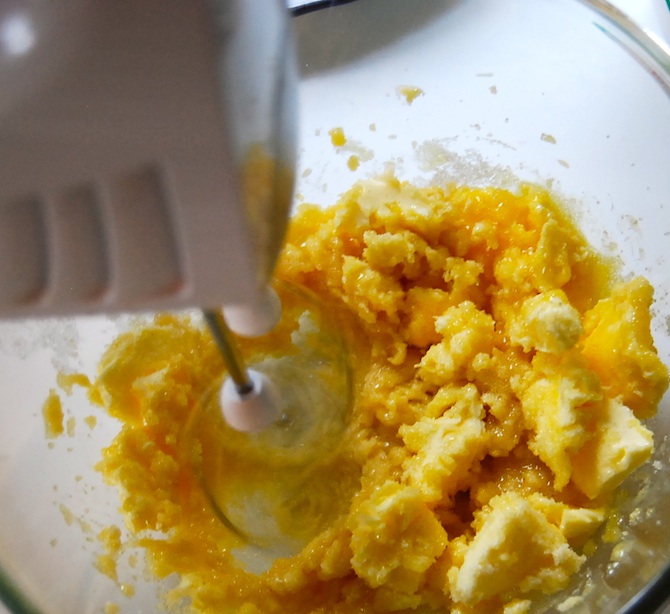
Beat the egg whites until they form firm peaks and set aside. In a second bowl, beat the yolks with the sugar, the vanilla sugar and the soft butter until creamy:
Add the lemon zest, the corn flour, the strained quark and sour cream and mix well.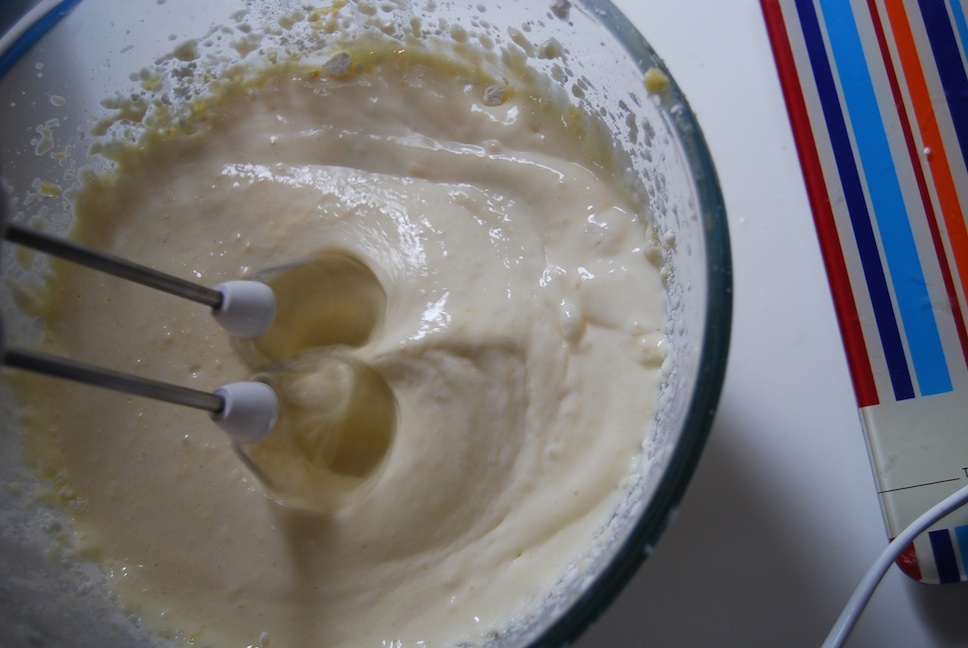
Now it is time to pull the strudel into shape. This is definitely the trickiest bit, especially when you try to do it for the first time. But no worries, you can always keep a roll of ready-made filo in your fridge, just in case it doesn’t work … At home we used part of an old linen bed sheet, ca. 1 m x 1 m big, as a basis, whereas in Austria you can buy proper ‘Strudel sheets’, just for this purpose. I started out with a cloth nappy, which I found too flimsy. For the second attempt I used a half-apron: the size and the thickness of the material proved to be perfect for the task. Whatever you use, make sure you liberally sprinkle flour all over it to make sure the pastry comes off easily! Unfortunately I have to use the pictures from the first round, which shows some of my mistakes (too wobbly filling and the use of a brush … more of this later). My photographer, who did a brilliant job in this first fisrt but ultimately unsucessful round, was not available the next day due contractual obligations as resident teenager (consisting of, mainly, moping around in his room, or hiding dirty socks to cover up dusty corners). The technique that I am trying to demonstrate, however, is the same!
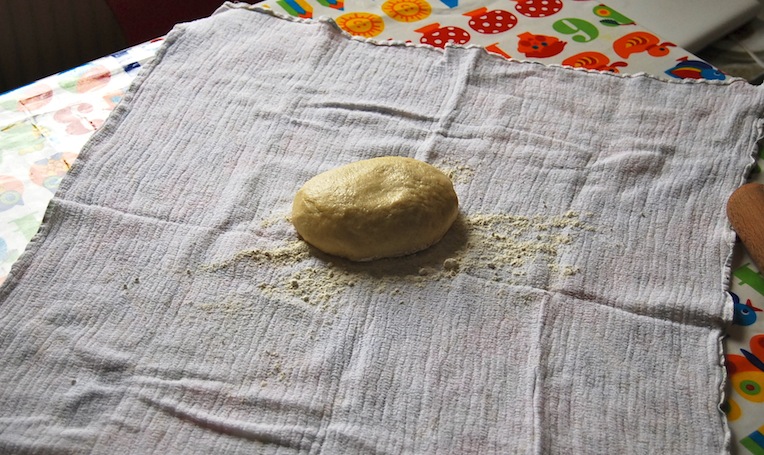
Place the ball of pastry in the centre of your sheet and beginn by rolling the pastry to a flat circle, the size of a dinner plate. 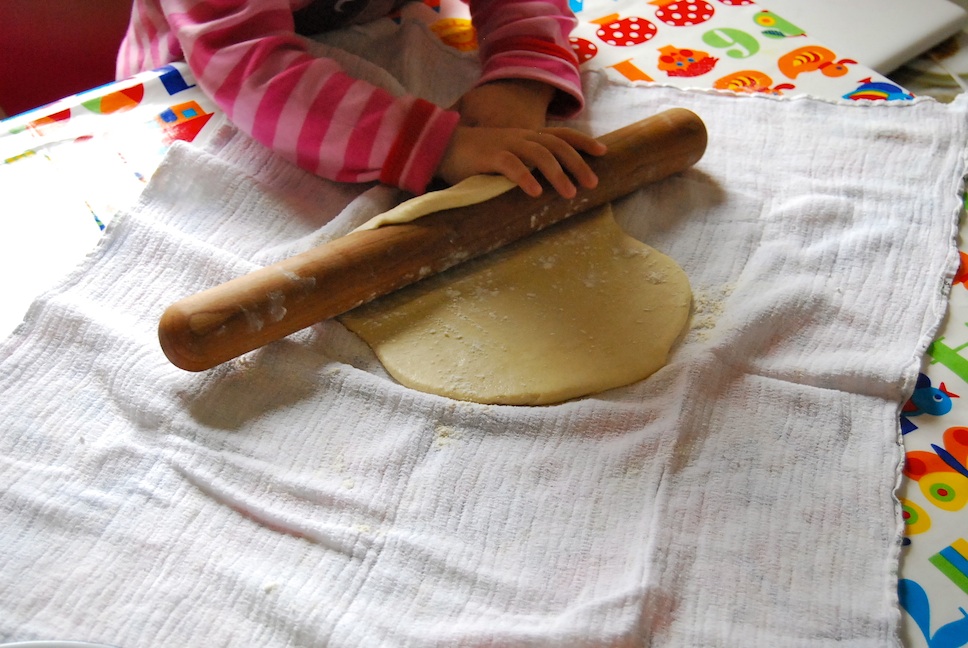
Now the pulling begins: don’t worry too much about holes, you can always try to stick them together by pulling into another direction.
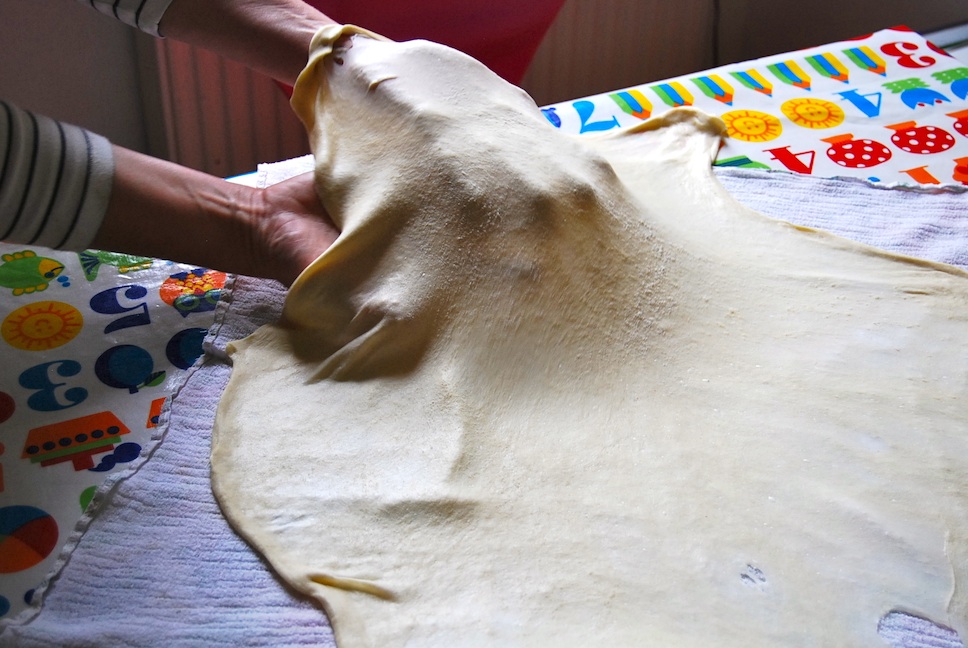
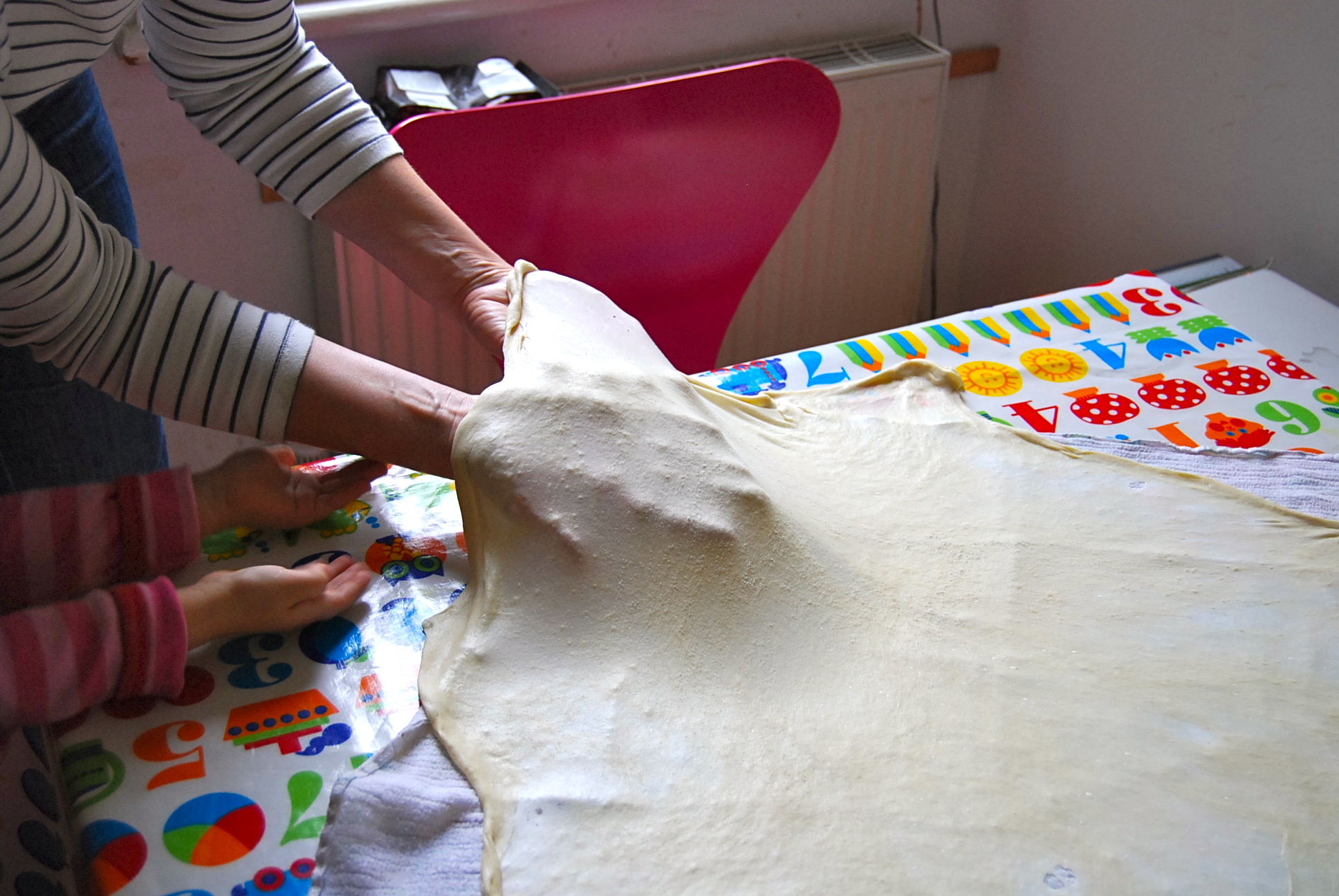 Don’t forget the edges as they can become quite thick! Once you are happy with the size of the pastry, finish off the filling by folding in the egg whites.
Spread the filling evenly over 2/3 of the pastry, making sure not to touch the pastry with your spatula as it is very delicate! Leave the edges free to fold in the filling.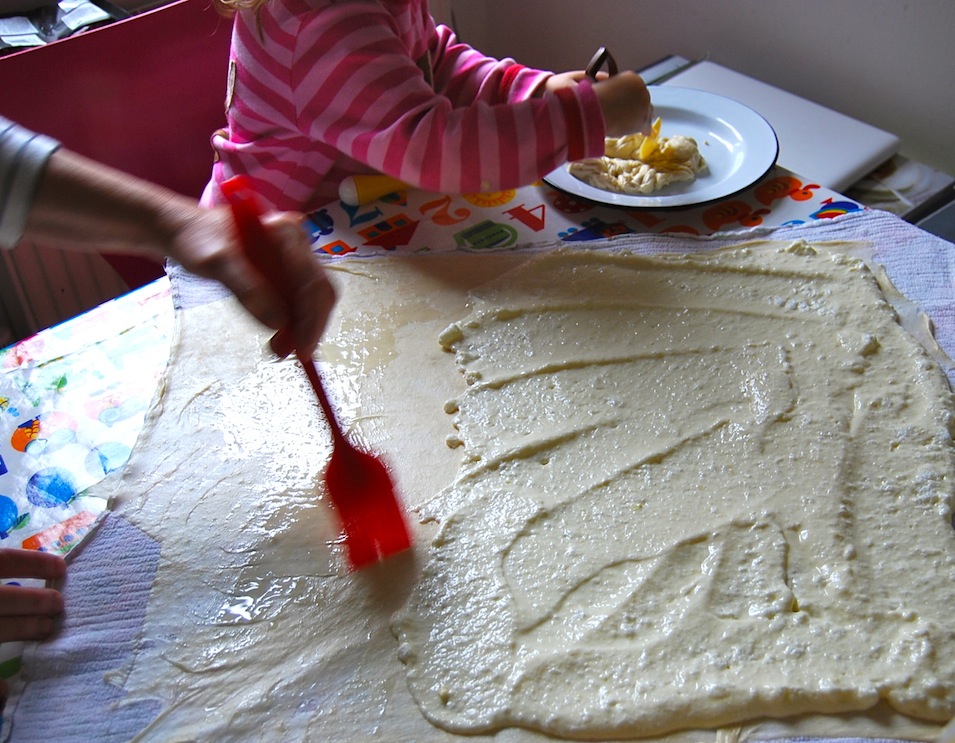
Drizzle some vegetable oil onto the remaining 1/4, but DON’T use a brush as this might damage the pastry. I’m speaking from firsthand experience 😉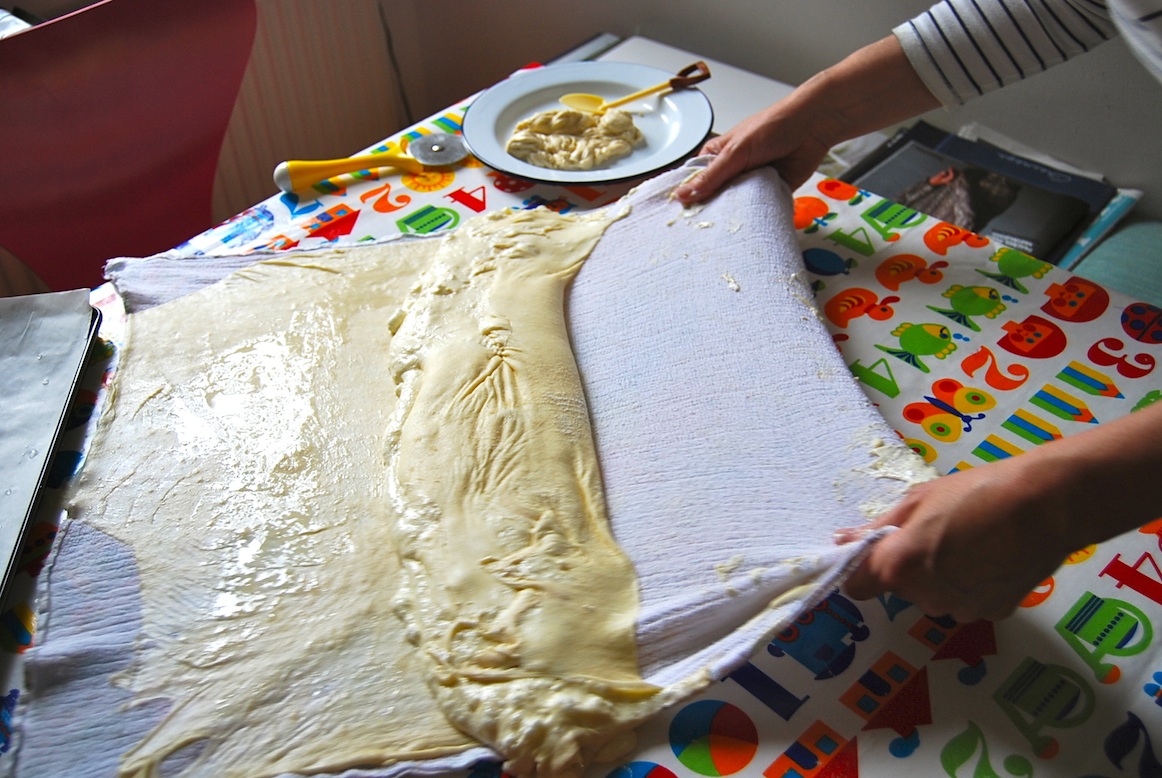
The next step is the rolling up: working from the end with the filling, fold in the pastry (and the filling!) by lifting the sheet. You might need to fiold in the sides a little bit to prevent the filling from spilling. It shouldn’t look quite as flat and runny as mine, but I hope you can see how it works in theory 😉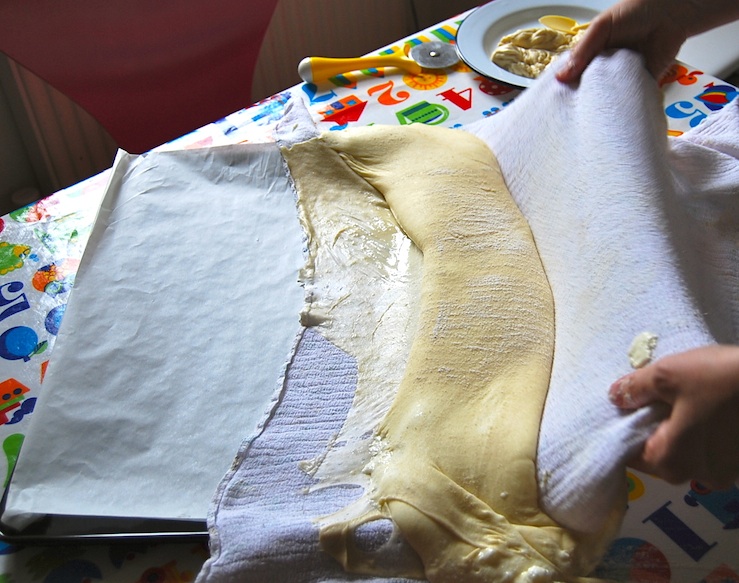
It pays off to have your sheet dusted liberally with flour, especially along the edges. Repeat the process until you’re almost finished, then lift the whole lot into your baking tray. By lifting the sheet, you can roll the cake into your baking tray: usually it ends up in some sort of an u-shape: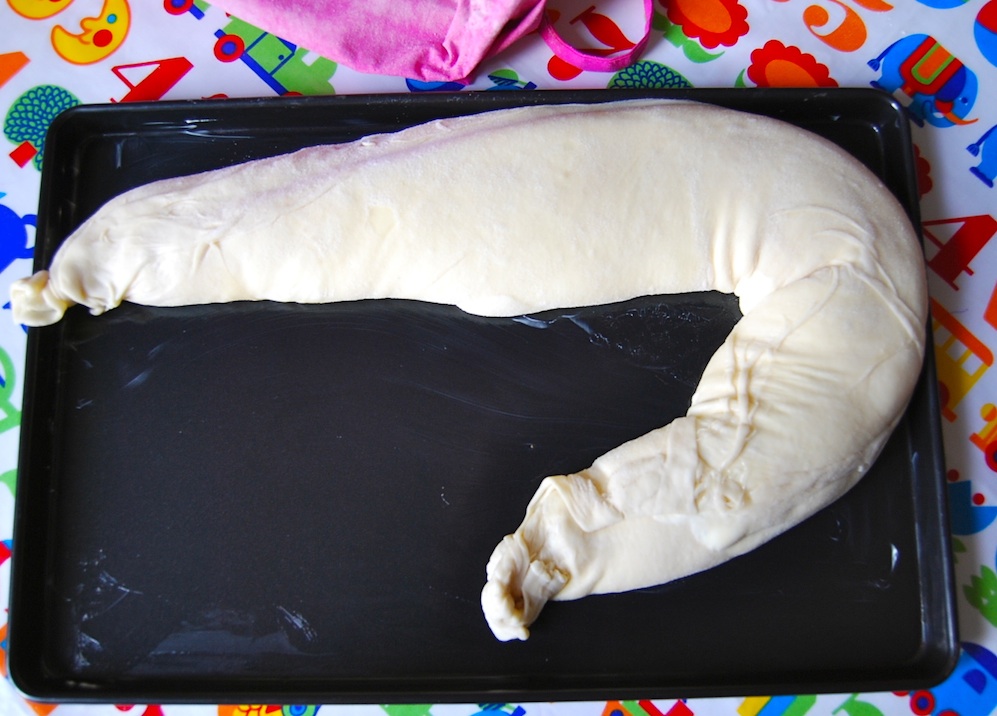
Here you can see the much more compact roll I achieved the second time round. Drizzle a little oil on the top and bake for 45 minutes, or until golden brown.
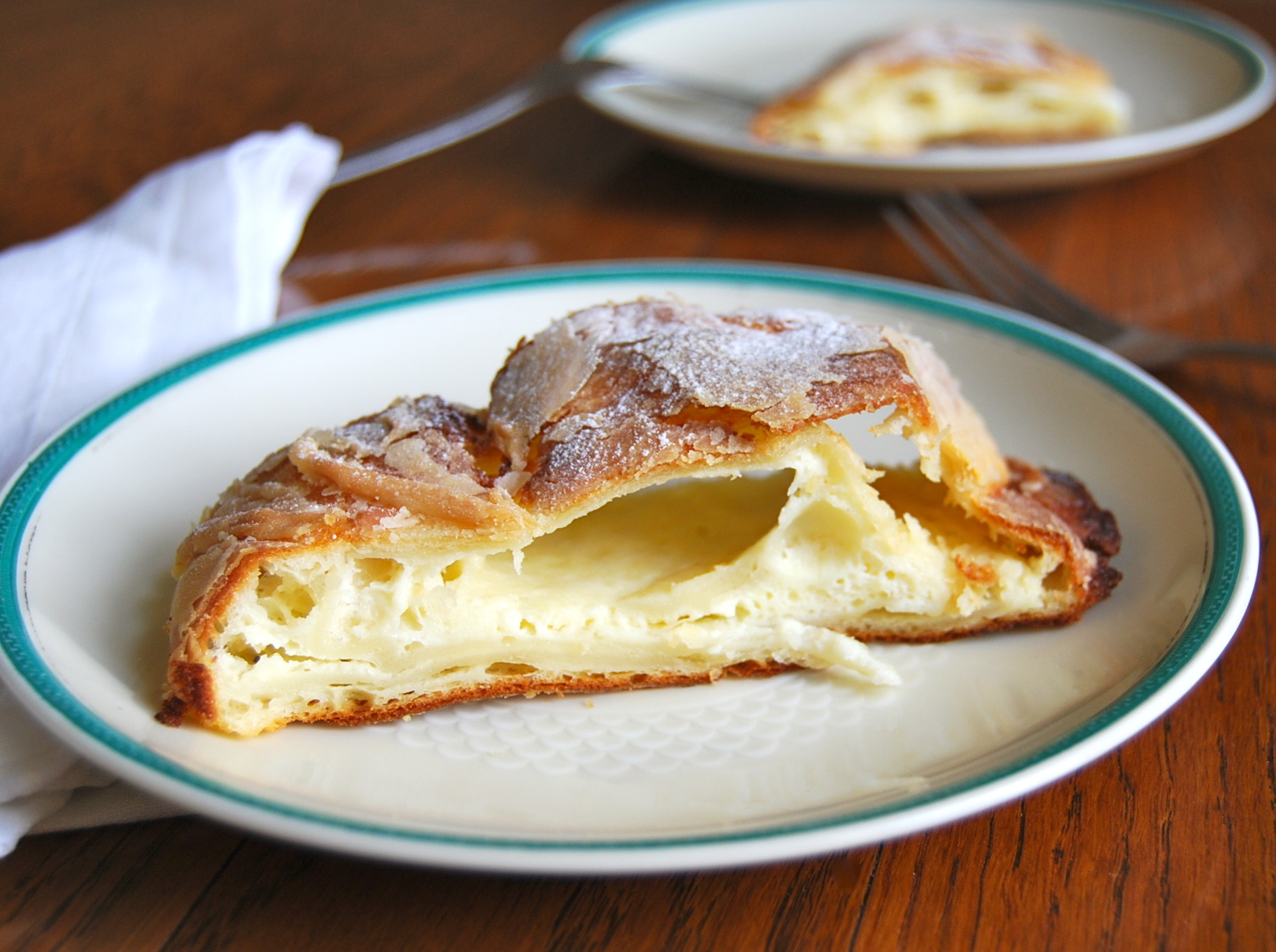
Don’t be taken aback by its looks: an old Austrian proverb I just invented states ‘Never judge an ugly dough sausage by its looks’. This cake is later on sprinkled with icing sugar, which covers up most sins, and is served cut into slices. In Austria, you always eat it warm, and sometimes eat with custard, but I thought I’d better not overdo it.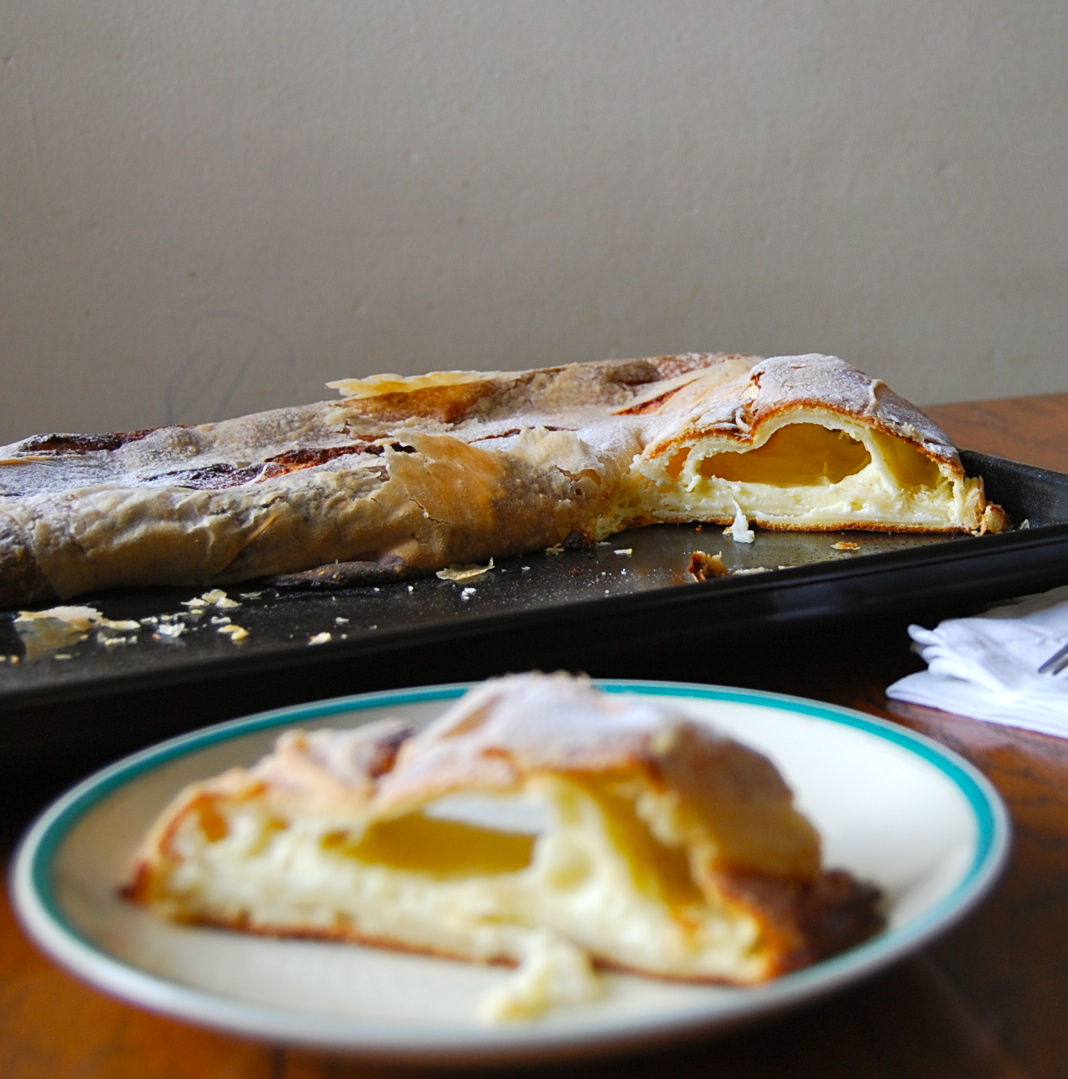
 At this point, coffee in hand, I would like to thank Marta for this challenge – it’s been a real pleasure baking with you and I am dying to find out how your cheesecake went! As you had asked to see the fancy bag I was given a few weeks back at the dumpling-making class, I will leave you with these pictures, as part of my disclosure policy 😉
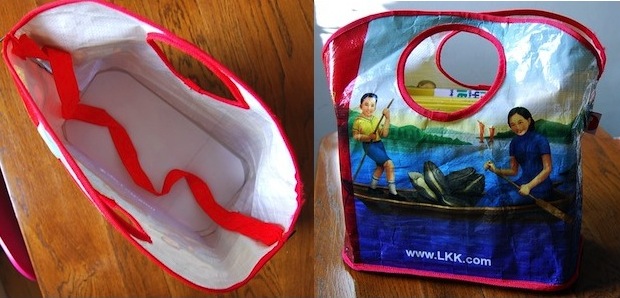
What looks like an ordinary plastic bag …. filled with a class set of marking, it becomes a work of art.
Well, having faced my demons, at least the cake ones, I wonder what cakes or dishes have eluded you so far: a family recipe that just sounded too daunting, or too unhealthy, perhaps? Or a dish that seemed just a step too far? I’d love to hear your stories! And perhaps you, too, might like to team up with someone for a bake-along? I hope you do! I’m off over to Marta’s now, to check up on the result of her egg-fest 😉


 Ginger&Bread
OMG Ginger!! And I used only 6 eggs in the end! I didn’t have the baking form so big for that, so I had to decrease the recipe for about half! Yours looks so impressive, I think I should make it once again in full version- 24 eggs no excuse!
LikeLiked by 1 person
Go for it!!!
LikeLike
Ginger I want your little assistant too 🙂
LikeLike
To open your oven? Half way through the baking process?!
LikeLike
Haha yes!! Please!
LikeLike
I am seriously impressed – thanks for sharing this with is. I might give it a go with filo (ensuring of course that I have not invited any Austrians over for afternoon tea that day)! My family recipe is for a pasta that my Calabrian aunties used to make on high days and holidays – all by hand. After the regular bit, making the dough, it was rolled out and cut into very, very thin strips, like thin spaghetti. Then each strand was rolled in a spiral around a very thin stick (think of a thin flexible stem of willow) so that it looked like a long curl. Repeat several hundred times and make sure you make enough to feed 20-30 of the family. Then lay it on sheets all around the house to dry out a little before cooking. The bit that is not recommended is for your English granny (mine specifically) to become completely distracted by the whole process and sit down on the sofa (over which a lot of the pasta was spread to dry) and squashing several hours work 😉 She was mortified and cried for ages and all the Italian aunties were jabbering away telling her not to worry and pouring wine down her. A family story which has gone down in our history!
LikeLiked by 1 person
OMG, that must be the best food story ever! Having made pasta as students, with strands of tagliatelle hanging off broom sticks and clothes horses all over the flat (and us not really that sober anymore …) I can totally relate to it! I wonder if someone will challenge you to a pasta cook-along? It would be great to see you make them! Even just a few ones, for the picture 😉
LikeLike
Maybe one day….but only maybe 😉
LikeLiked by 1 person
I am so tempted to invent an Italian granny for that one 😉
LikeLiked by 1 person
Pingback: All you ever wanted to bake: Cheesecake with peaches | Plate du Jour
Oh wow. My brain just short-circuited thinking about trying to make this. Very, very impressive. It looks absolutely delicious and I have to say, I absolutely love that photo of the dough on the tin plate. You have lovely crockery! 🙂
LikeLike
Thanks! I only bought it the other day, in preparation for a very English dish 🙂
LikeLike
That is a remarkable pastry. I have never managed to make one so paper-thin before, but your bed sheet tip should be a big help. Thanks for making it and posting.
LikeLike
Apparently in Austria you can buy a special strudel sheet – but a decent old bed sheet – not a fitted one though! – that’s around 1m x 1m (or 3ft x 3ft) should do the trick. My apron, being sturdier than the cloth nappy, worked perfectly!
I’ll be learning how to make filo over Christmas, when my friend’s family arrive from the Balkans – I’ll probably pick up a trick or two to share!
LikeLike
Good lord Ginger!!
Now I’m scared to do FF with you!
I might need Marta to whisper techniques and hints in my ear 😐
You play for keeps!
Great job and yet another great result!!
LikeLike
Thanks! You inspire me, Dana!
LikeLike
Really impressive, wow!!! Thats a tough one and you were determined and did it. Good for you. It really looks wonderful.
LikeLike
Thanks! And it’s so much easier than I thought (after the first round went to the pastry, obviously…)!
LikeLike
I’ve never had this, but it sounds like a wonderful dessert!
LikeLike
It is actually – I’ll be making the more famous apple strudel sometime, just to prove to myself that I’ve got the knack 😉
LikeLike
wow! Just wow! Such an impressive effort on your side! The pastry looks like something to die for! thanks for such an elaborate and detailed post!
LikeLike
Thank you, Indu! I was a bit concerned about the amount of detail, but in order to show how easy it really is (unless you are as careless and clumsy as me) I needed the pictures. All of them. Including the one of the crash site 😉
Thanks for stopping by! I’ve been meaning to visit your blog for a while, I love the idea of Southern Indian food but am usually too wimpy for all the spices …
Happy Diwali!
LikeLike
An amazing and delicious dessert, Ginger 🙂 This a beautiful work too and more with your little helper!
LikeLike
Thank you Linda! A helper in need is a helper indeed 😉
LikeLike
What an artist you are! And I particularly love your proverb! I have seen recipes for this, but have never known anyone to attempt one…and yes, I still have my own demons I’ve yet to face, primarily timing, it seems. I’ve been wanting to make several cheeses…
LikeLike
Cheeses? Wow! What kind of cheeses?!
LikeLike
Thanks to my daughter, I’ve mastered really good yogurt, and I’ve tried some Ricotta from the whey with mixed results. I’ve made mozzarella & cottage cheese, too. I would like to try others.
When I was young, my dream was to own a goat farm and make cheese like some kind of wild, hippie red-haired Minnesota Heidi! Well the goats didn’t happen and I was really born too late to be a hippie, plus I like baths too much, but I figured that now the kids are gone maybe I can start to experiment a bit.
Funny, but Quark is on the list of things I would like to try, and Feta. Those are pretty easy ones, but I’d like to move on to aged cheese, too. But I don’t have any definitive agenda – I would just like to master one and then move on to another. Weird, huh!
I ran into a lady at the pharmacy the other day who gave me the number of a farmer who sells milk that’s unpasteurized so maybe it’s time to move forward! I have the coolest basement with brick walls and stone floors and I think it would be a wonderful place to try to age a few cheeses. Very small scale.
LikeLike
That sound just amazing! I’d love to read about it 😉 Maybe some budding cheese maker out there will pick you up on that one … I’d definitely like to try making quark – just to see if it really works!
LikeLiked by 1 person
Oh wow, I loved this post, so many things to learn and that cheesecake looks amazing! Love that rolling technique!
LikeLike
Thank you, Naina! It is a fun cake to make – there are lots of savoury options, too, to explore…
Happy Diwali!
LikeLike
Now I’m ready to try to make strudel! Strudel recipes have always looked so intimidating before, but yours looks encouraging. I’ve only had apple strudel before, but you’ve sold me with this description “Topfenstrudel is a cheesecake that seems to defy physics: a rich and creamy cheese filling, with hints of vanilla and lemon zest, is held together by flaky, paper-thin pastry. It is a combination to die for.” I love your food descriptions. 🙂
LikeLike
Thank your, Myriam! You should give it a try, especially the savoury variations. The dough is so cheap to make, and yet so impressive. Excellent on a student’s budget!
I used to prepare dhals whenever there was too much month left at the end of the money – much more glorious and exotic than lentil soup 😉
LikeLike
My!!! That’s real hard work. But it sure is worth it. looks delish 🙂
LikeLike
It wasn’t as hard as I first thought – once you know what you’re doing it’s not that bad, really 😉
Thanks for stopping by!
LikeLiked by 1 person
I love it. I love this whole friendly fire thing. Effing good times for all :). That cheesecake sound damn tasty!
Now, I best go and check Marta’s result!
LikeLike
Ha ha – it’s so difficult to swear outside Dana’s page -) I’m glad even you succumbed to the minced oath, despite your title!!!
LikeLike
Pingback: Fabulous Friday #2 - The Crumby Cupcake
Wow, this is so cool, I love Topfenstrudel, and yours looks perfect! Love the pictures of the dough and the bedsheet, I had no idea this is how it’s made.
LikeLike
Thanks – it is an amazing cake! If you ever try it, do let me know how it went 🙂
LikeLike
Wow. I’m impressed. Looks divine too. Yum
LikeLike
Thank you – it’s actually not that complicated – once you know what you’re doing, obviously 😉
LikeLike
Pingback: Apple Pie, Under Friendly Fire | Ginger&Bread
Pingback: Filo Pastry Masterclass: Sirnica | Ginger&Bread
Pingback: The Schnitzel Challenge: Viennese Schnitzel, the one and only | Ginger&Bread
Pingback: Apple Strudel – The last Word in Apple Cakes | Ginger&Bread
Pingback: Say Cheese: My 15 Seconds of Fame | Ginger&Bread
Pingback: Macmillan Coffee Morning – Vote for your Cake! | Ginger&Bread