Last week I stumbled across Frau Dietz’ blog Eating Wiesbaden, where she describes her life as an British expat in Germany. I loved her introductions to various German delicacies, such as the cheesecake, in her list of top 4 German cakes. Having previously posted recipes for Sachertorte (Frau Dietz’ no. 3) and the Schwarzwälder Kirschtorte (no. 1), I realised that it was high time to present you with this typically German version of a cheesecake, which came second in her list.
In Germany we use Quark for cheesecake, not the elemental particles but a milk product similar to fromage frais or paneer, which you can get in many supermarkets in the UK. In Austria it’s called Topfen, by the way, and used for the most amazing dishes and desserts.
Although Quark is possibly made of quarks, the latter were in fact a made-up name, although helped by an expression found in James Joyce’s Finnegan’s Wake. Having lived in Zurich for many years, Joyce probably had come across the word (and the food!), and used it for its unusual sound for his experimental novel.
Quark, like fromage frais, usually comes in different versions: low fat, ‘regular’ (20%) and ‘full fat’ (40% fat in dry mass). For this cake, I used the full fat version, as this seems to be the most common one in British supermarkets. If you can get hold of the regular 20% version, simply add 100ml of whipped cream; the low fat version needs a good 200ml to get a nice creamy filling…
You can make your own Quark quite easily, as my old cookbook advises, by leaving milk out to turn sour. Once the sour milk is thick enough to be cut into slices you warm it up to separate the cheese from the whey: the latter will form a green liquid on the top of the mass. Pour it onto a cheese cloth and leave to set; alternatively, buy the Quark in the supermarket 😉
The base is the same short crust pastry, or Mürbeteig, which I have already described in my recipe of the Träubleskuchen.
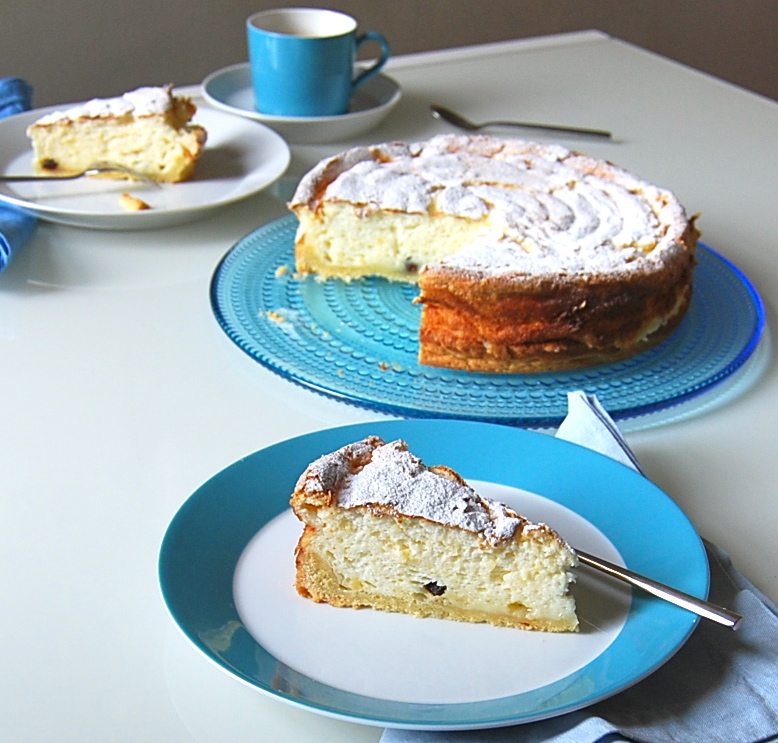 Cheesecake (for a 27cm springform)
For the shortcrust pastry/pâte sucrée/Mürbeteig:
- 180g plain flour
- 120g butter, not too soft
- 60g caster sugar
- 1 egg
For the filling:
- 5 eggs
- 250 g caster sugar
- 2 tbs vanilla sugar
- 100g plain flour
- 500g Quark or fromage frais (20%)
- peel of 1 lemon
- a handful of raisins
Begin by mixing the ingredients for your shortcrust pastry on a cool surface, ideally with a spatula or similar to prevent the pastry from getting too warm. With cool hands, quickly work the mix into a soft dough; if necessary add a little bit of flour but don’t overdo it as it takes away from the lovely taste and texture of this pastry! Wrap it up and put it into the fridge for at least 1 hour.
When you’re ready – or rather when the pastry is, having cooled down enough to be handled, grease your springform (ideally sprinkle some semolina onto the butter, to ensure the pastry comes off; it’s optional, though: with that much butter there shouldn’t be a problem…). Preheat the oven to 175C.
Carefully roll out the pastry on a slightly floured surface and fit it into your tin: again, avoid handling it too much; if it breaks, just worry about the rim as that’s the only bit of it that will be visible in the finished cake 😉. One way of doing this is to roll the dough back onto the rolling pin, then gently roll it out over your tin; alternatively fold it twice, lift it into the tin and unfold. Personally I find this easier. Press the dough into the tin, then cut off the excess. You need around 1 inch for the rim.
If you feel like it, blind bake the base for around 10 minutes. I find that although it helps to keep the pastry firm, the rims always sink in, so it’s up to you whether you do this or not.
For the filling, beat the egg whites until they form soft peaks. Add half the sugar while mixing it, to ensure it is incorporated fully.
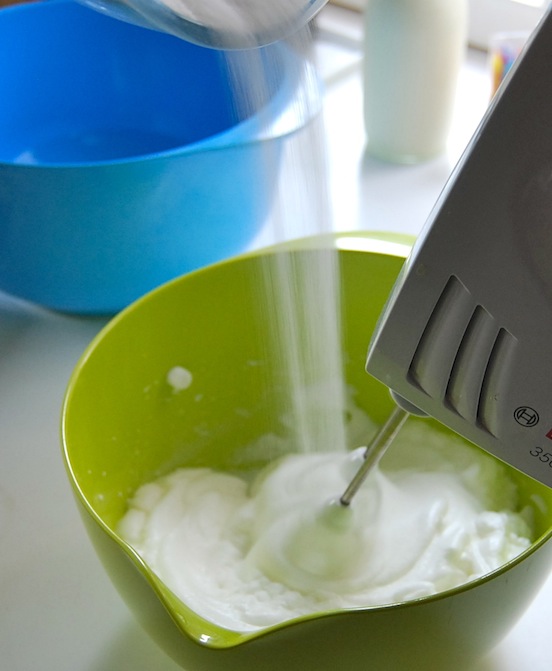
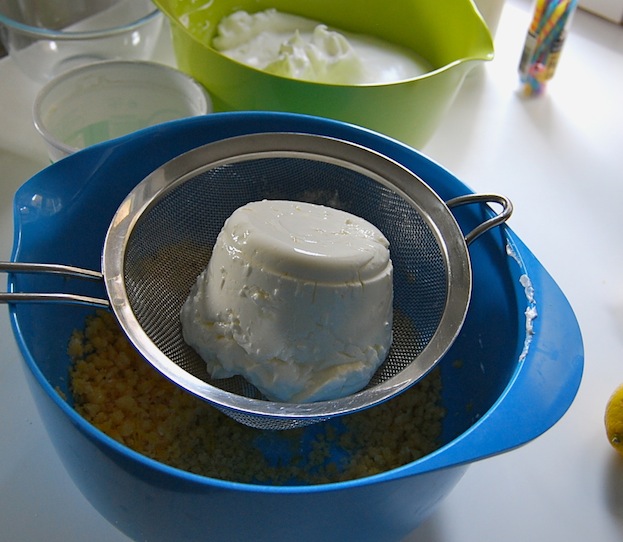
In a separate bowl, mix the flour and the remaining sugar, lemon peel and egg yolks before straining the quark through a sieve to break it up. Mix well, then fold in the egg whites.
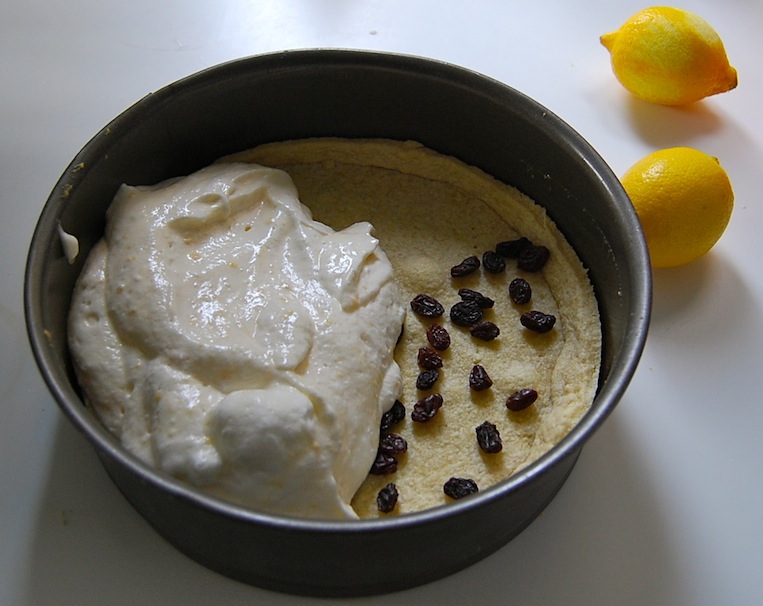
Sprinkle the raisins on the pre-baked base, or not, if you happen not to like raisins. Some of us don’t, so we have opted for a half-and-half solution. Fill ill in the quark mix and flatten it a bit with a spatula to ensure a neat finish. Bake on the bottom shelf for around 30 minutes without opening the doors!
After that first bake, take out the cake and make an incision ca. 1 cm inside the rim, using a sharp knife. This is to prevent the surface from breaking up as you bake the cake. Return it to the oven and bake for another 15 minutes.
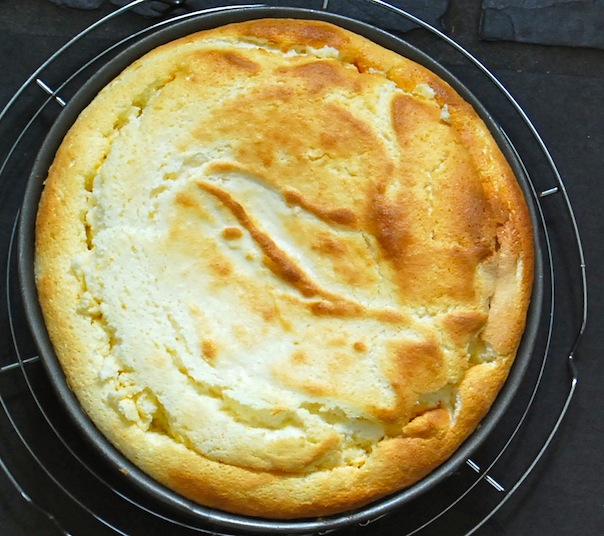
When you remove the cake from the oven you can either leave it to cool, or you can turn it out on a round wire tray to give it a nice pattern.
Should it break up, use the baker’s equivalent to the architect’s Russian vine, icing sugar, to cover up any mishaps 😉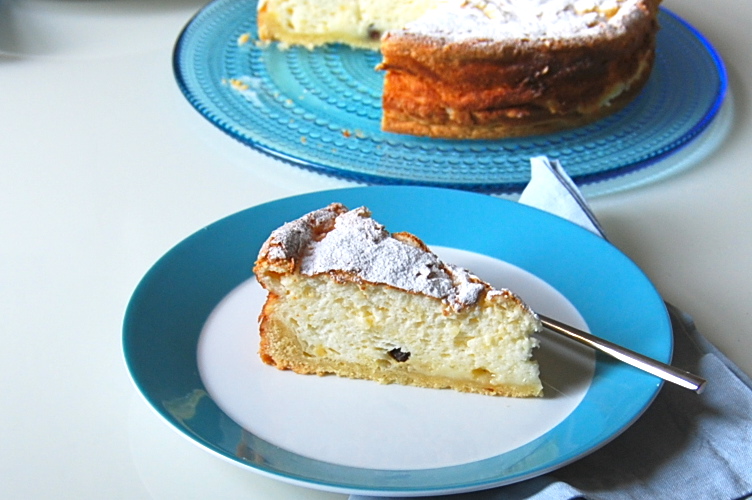
Should you like it, try it with apricots or other fruit – or add a few spoonfuls of soured cream to give it an extra edge.
Frau Dietz names the Black Forest Gateau as her favourite cake, whereas mine will always be Sachertorte. Which cake makes your heart beat faster – not literally, obviously, as in clogging up your arteries due to the ridiculous amounts of sugar and cream used …?


 Ginger&Bread
Thank you so much for mentioning me! I am really happy to have discovered your blog in return 😀
Your Käsekuchen looks absolutely beautiful… mine turned out an absolute disaster the first time I tried it, I kept burning the top in the oven and the gluten-free pastry fell apart at the touch of a fork. But it still tasted good 🙂 I love having the raisins scattered across the bottom of it, they’re delicious.
And incidentally you can find Quark in the UK – I’ve seen it in Waitrose 🙂
LikeLike
Even Sainsbury’s stocks it now – you just have to work around the fat content as they don’t always have the one you need.
The gluten-free flour is difficult to work with, my heart goes out to you!
Thanks for the thumbs-up: I really enjoyed my visit to your blog and I had to check your sausage post before I got the ingredients for the Krautkrapfen I want to make this week 🙂
LikeLike
Yummy…I’m officially a cheesecake monster in case you didn’t know 😀 my mom makes the quark at home and it’s the best thing ever. I will try this recipe for sure as it’s easy enough- my mom uses the old traditional Polish recipe which requires 24 eggs!! Never had a courage to make it! Thank you for sharing this 🙂
LikeLike
I’d love to see that Polish recipe!!! There was an interesting article in Die Zeit about the Untergang des Abendlandes in form of the introduction of pudding powder into cheesecake baking – http://www.zeit.de/2012/17/Kaesekuchen. I had no idea, I’ve always made it roughly like the recipe here, often with the addition of soured cream. I’m glad you enjoyed the post!
LikeLike
Well, it was always scary for me to try that recipe, but the cake is fabulous, I can tell you that. My mom uses peaches as well, and it grows big and it’s puffy, and oh and ah 😀 I’m thinking of posting it on my blog but it’s not an easy one. I should start from yours for sure!
LikeLike
Go for it! Perhaps we should have a Great Cheesy Bakekoff someday?
LikeLike
Why not! 😀
LikeLike
Dammit Ginger!!
It’s moments like this that I wish I could eat dairy products without consequence.
Looks soooo goooood.
Whyyyyyyyy!!!
LikeLike
How can you live like that?!
LikeLike
Plants and seafood help… But only just
😵
LikeLike
I could honestly pick this straight up from the screen and push it all into my mouth. What a gorgeous looking cheesecake; and I’ve never used quark to make a cheesecake before, I usually add heaps of herbs and chill for a spread. Now I have GOT to make this – thanks!
LikeLiked by 2 people
Käsekuchen! No question. Here’s my Mum’s:
http://ladyofthecakes.wordpress.com/2013/08/08/real-bavarian-cheesecake-topfenkuchen/
No Puderzucker on top, though 😉
LikeLike
Puderzucker if it cracks … I have to admit I wouldn’t have used it if it hadn’t been for the pictures 😉
Looking forward to comparing notes now!
LikeLike
Ah, yes, to camouflage the cracks, of course! Also useful if the top goes a bit too dark, as it often does 😉
LikeLike
Thanks for the follow and bringing me to your blog where I found this delicious cheesecake. The summer after I finished high school I worked in a German coffee house in Toronto where they had this kind of cheesecake, and have been looking for a duplicate – I think this is it. Thanks.
LikeLike
Thank you – cheesecakes are on the brink of extinction, according to a German newspaper article a while ago … a lot to do with people cutting corners and using instant pudding powder etc. I hope this one works for you! 🙂
LikeLike
Wow I loved this recipe and loved the results even more. I will definitely give it a go! 🙂
LikeLike
I love cheese cake any way. That looks delicious!
LikeLike
Thanks – do try it someday, it’s delicious!
LikeLike
I love how top is well-brown and golden! And of course I love your cheesecake! But 250g of sugar seems too much for me 😀
LikeLike
Yes please. I’ll have a piece.
LikeLike
Pingback: Everything You Always Wanted to Bake: Cheesecake | Ginger&Bread
Pingback: Say Cheese: My 15 Seconds of Fame | Ginger&Bread