Germany has many different dialects, probably due to the fact that the country as such used to be a whole bunch of kingdoms, duchies and whatever else they could come up with, including free cities. Only with the formation of a German empire in 1871 did Germany, or Deutschland, as such come into existence, and the local rulers gradually lost their power until they were completely demolished after WWI. The Swabian dialect is closely linked to the historic Germanic tribe of the Swabians, and then with the former kingdom of Württemberg, with Stuttgart as the capital.
The difference between an accent and a dialect, apparently, is in the vocabulary and grammar: a local accent is usually recognised by the way certain words or sounds are pronounced, but once a region has its own words for different things, and even a different way of forming a tense, we talk of a dialect rather than just an accent. The vocabulary difference are often most pronounced in the words people use for local fruit and vegetables, as they would have been in use for centuries. Thus Germany is divided – linguistically – by the Appel/Apfel- or Speyer line, a vertical line roughly through the center above which people call apples either Appel (north) or Apfel (south of the line). This line coincides with the so-called Weißwurstäquator, or white-sausage-equator, which (humorously) describes the cultural split between the North and the South: only South of that line, white sausages (a metaphor for proper food) are consumed. Unsurprisingly, unlike the Speyer line, there is no scientific evidence for this one…
In Swabian, anything can – and will – be shrunk by adding the suffix -le to the noun. Thus a car – Auto – becomes an Autole, a little car, and a house – Haus – a Häusle, a small house. Red currants look a little bit like small grapes, which are Trauben, hence in our dialect they are called Träuble, or small grapes. We used to have lots of these when I grew up, to the point that each year we had to emotionally blackmail family, friends and neighbours into coming round to pick some for themselves. As kids we didn’t particularly see a point in picking them as you would not really eat them straight from the bush; instead, my mum turned them into delicious jams, jellies, juices and into this cake, where the tartness of the berries is balanced out with a sweet almondy meringue. The recipe is based on the one in my standard Swabian cookery book, with slight alterations.
A word of warning, if you are ever in Germany: before asking for this cake, check your map: outside the Swabian-speaking parts, red currants are called Johannisbeeren, St John’s berries, and nobody will have a clue as to what you mean by a ‘small grape cake’. Trust me. It has happened to me more than once …
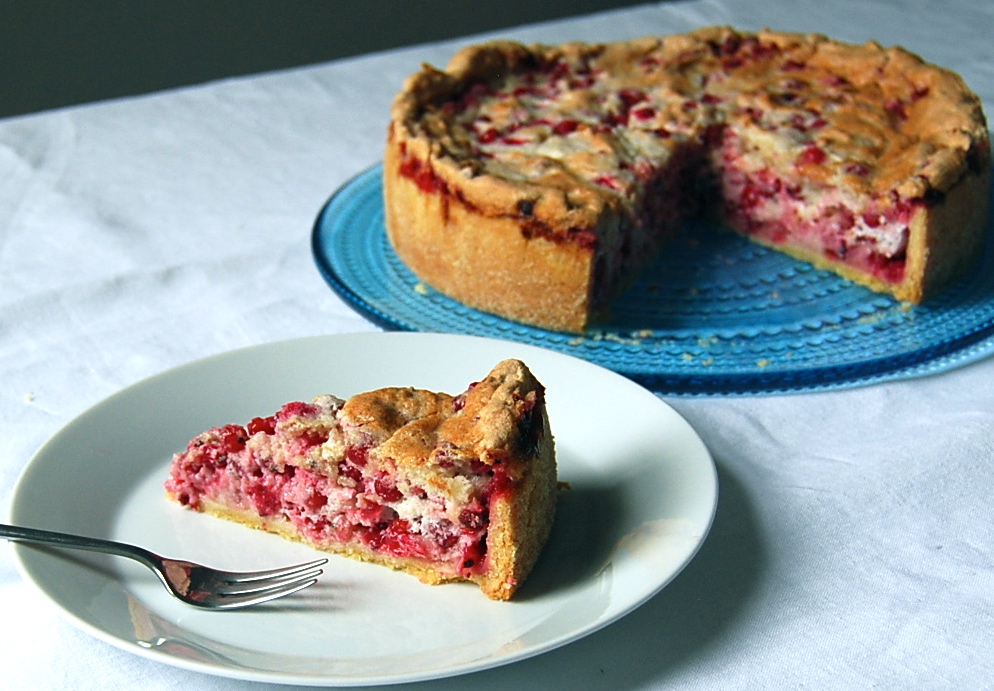
Träubleskuchen: literally a small grapes cake!
Red Currant Meringue Cake – Träubleskuchen (for a 27cm springform)
For the shortcrust pastry/pâte sucrée:
- 180g plain flour
- 120g butter, not too soft
- 60g caster sugar
- 1 egg
For the topping:
- 1.5kg red currants, washed
- a handful of breadcrumbs (sorry – it’s just to soak up excess juices so it’s hard to judge!)
- 5 egg whites
- 180g caster sugar
- 50g ground almonds
- peel of 1/2 lemon
Begin mixing the ingredients for your shortcrust pastry on a cool surface, ideally with a spatula or similar to prevent the pastry to get too warm:
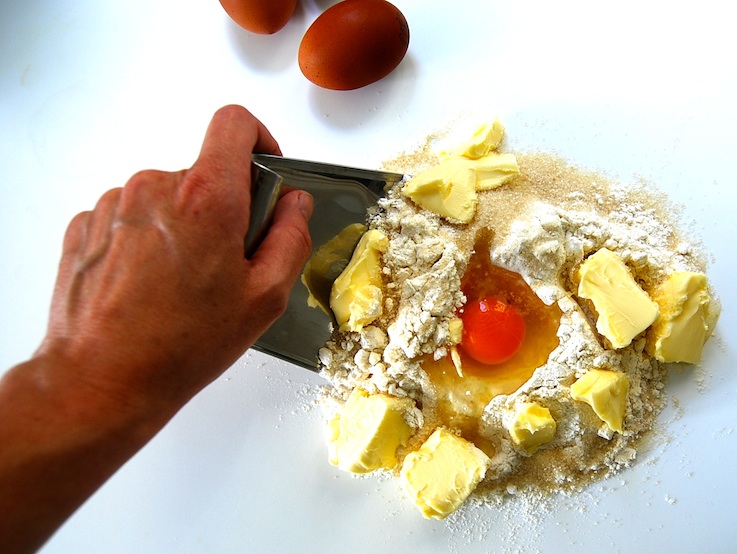
Mixing the ingredients for the shortcrust pastry
I use a scraper that I have for making traditional Swabian pasta, but more of that later. Cutting up the butter and mixing it with the other ingredients is the aim here, until you have it all nicely crumbled up:
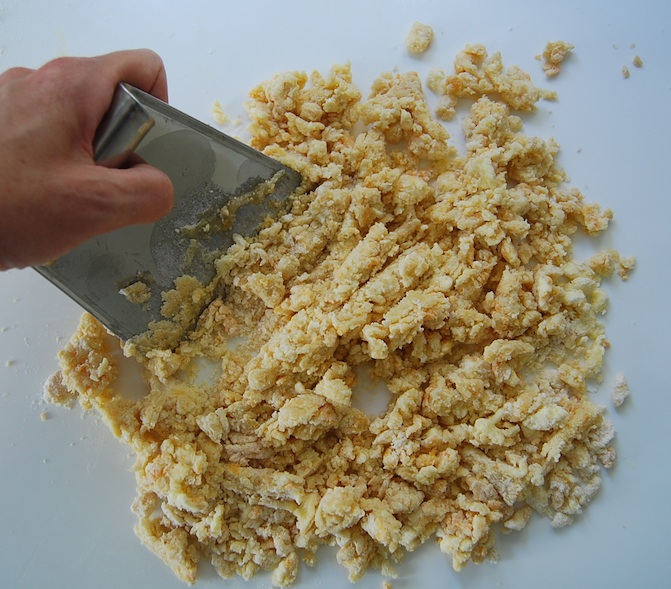
These crumbles are ready to be worked into a dough
With cool hands, quickly work the crumbs into a soft dough; if necessary add a little bit of flour but don’t overdo it as it takes away from the lovely taste and texture of this pastry! Wrap it up and put it into the fridge for at least 1 hour.
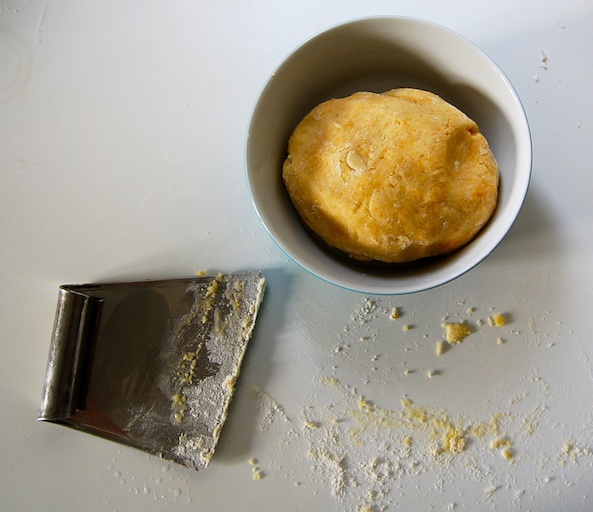
Don’t try to get the perfect pastry at this point as it needs to stay fairly cool
When you’re ready – or rather when the pastry is, having cooled down enough to be handled, Grease your springform (ideally sprinkle some semolina onto the butter, to ensure the pastry comes off; it’s optional, though: with that much butter there shouldn’t be a problem…). Preheat the oven to 175C.
Carefully roll out the pastry on a slightly floured surface and fit it into your tin: again, avoid handling it too much; if it breaks, just worry about the rim as that’s the only bit of it that will be visible in the finished cake ;-). One way of doing this is to roll the dough back onto the rolling pin, then gently roll it out over your tin; alternatively fold it twice, lift it into the tin and unfold. Personally I find this easier. Press the dough into the tin, then cut off the excess. Sprinkle the breadcrumbs evenly over the surface and put the whole lot into the fridge until you’re ready.
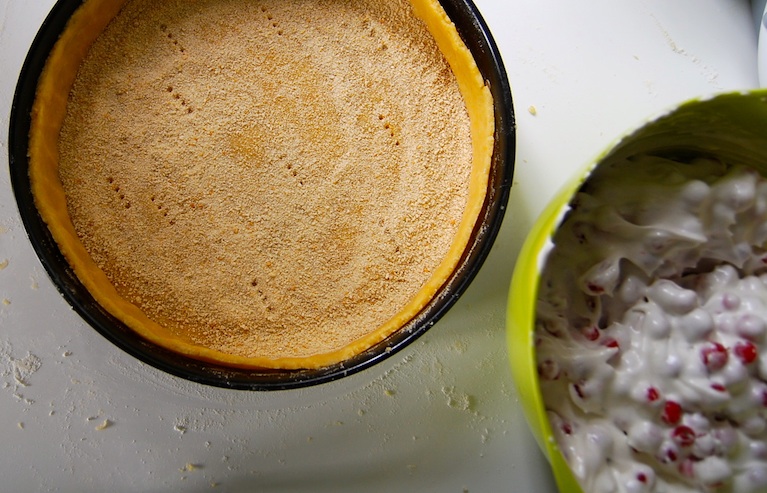
Beat the egg whites until they form stiff peaks, then add the sugar and give it another good beating. For a perfect finish, put 1/4 of it away to cover the finished cake. I always forget, getting carried away by the sheer beauty of the red currants in white snow …
Carefully fold in the berries, sugar, ground almonds and the lemon peel into the rest before filling your cake tin. Cover with the rest of the meringue mix and bake it for around 45 minutes on the bottom shelf: you might have to cover it with a bit of tin foil after a while to prevent it from getting too dark!
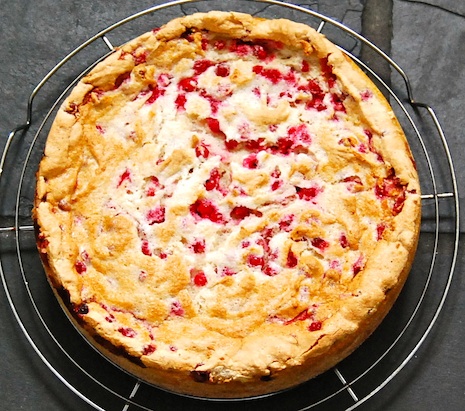
I clearly need to remember to keep some of the beaten egg whites aside for a neater finish 😉
Serve with coffee and more cakes for a traditional Kaffee & Kuchen afternoon!


 Ginger&Bread
Yummy:-)
LikeLike
Thank you!
LikeLike
Lots of good, insightful information here Ginger!
And as usual, incredible result 🙂
LikeLike
Ta 😉
LikeLiked by 1 person
It looks delicious, and I agree about German, even the way they say Good Morning can be different in some parts! I looked at this cake a few times already while writing this, it’s really something you know 😀
LikeLiked by 2 people
My god, this looks completely delicious. Also makes for some really interesting reading, thanks!
LikeLike
Thank you!!
LikeLike
Loved this post – the history and info (the white sausage line – fantastic!), the photos, the delicious recipe and the wonderful end result…fabulous!
LikeLike
It does exist, the white sausage line! Seriously!! I’ll be having some white sausages next weekend so I can post some pictures 😉
LikeLike
That is such a gorgeous cake! Love the color!!
LikeLike
It is so summery! Unlike the weather 😦
LikeLike
Genau so bäckt ihn meine Mutter auch! Schön, daß der Hanstraubelkuche (Saarländisch :-)) mir hier begegnet!
LikeLike
Das freut mich – die saarländische Küche ist der unseren ja auch recht ähnlich! Ich glaube ja immer, daß das am Weinanbau liegt 🙂
LikeLike
Interesting information regarding the German language. There are many German ex-pats here in Spain. Whilst I know few German words all the expats sound the same to me LOL.
I’m not a fan of any currants but have ideas in adapting this to my tastes, thanks.
LikeLike
I know the feeling – expats are a strange breed (and I would this first hand 😉 I find it hard to distinguish different Spanish accents although I usually get the Andalusian pretty quickly!
LikeLike
a german friend of mine told me about these currants. they sound amazing. the cake looks wonderful.
LikeLike
Das sieht so lecker aus *-*
LikeLike
War es auch – leider ist die Saison schon wider vorbei…
LikeLike
Pingback: Cheesecake, the German way | Ginger&Bread
wow that looks seriously good! I’ll have to see if I can find redcurrants 🙂
LikeLike
They’re so hard to find once the season’s over! Some frozen berry mixes contain red currants, but you might need to adjust the sugar in the meringue to take into account some of the sweeter berries in the mix 😦
LikeLike
Pingback: Linzer Torte | Ginger&Bread
Pingback: Tarte aux Fraises – Strawberry Tarte | Ginger&Bread