Following the World Cup Finals I was getting a bit homesick … and homesickness is best expressed in food. Where I come from, Stuttgart in the south west of Germany, you don’t judge people by their looks or by their personality, you judge them by what they eat. And although we love to try out new things, deep at heart we love the traditional food our mothers and grandmothers prepared for us, and often taught us to make.
One of my favourite dishes is Maultaschen, noodle parcels filled with spinach and meat. You can buy these at the butcher’s, and you’ll find them on the menu of most restaurants and pubs in the region. In recent years, following the trend for regional produce and regional food, chefs have rediscovered the classics and even in the poshest restaurants you’ll find the most amazing versions of this humble dish.
These raviolis can be served in a broth, often as a starter, or on their own with a side salad. I’ve had them filled with fish, which was delicious, as well as with a mushroom filling. If you’ve ever been to Southern Germany, the Black Forest or Lake Constance, you’ll have seen them and maybe even tried them – if not, here’s your chance to get your own piece of world champion food!
Historically, Maultaschen – literally ‘mouth pockets’ – were served on Fridays, and especially on Good Friday, when the custom demanded meat-free food in respect of Jesus Christ who died on that day. Because of the noodle covering and the spinach, so the traditional view, God is not able to see the meat, which makes this the perfect vegetarian option for meat-loving Christians.
Personally, I let you be the judge on that one:
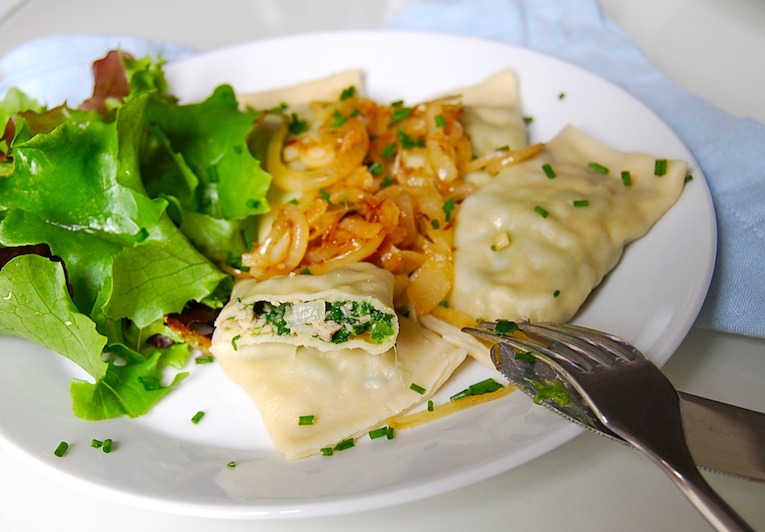
Maultaschen (serves 6)
For the noodles:
- 3 eggs
- 300g plain flour
- 1 tbsp soft butter
- 1 tsp salt
- some water
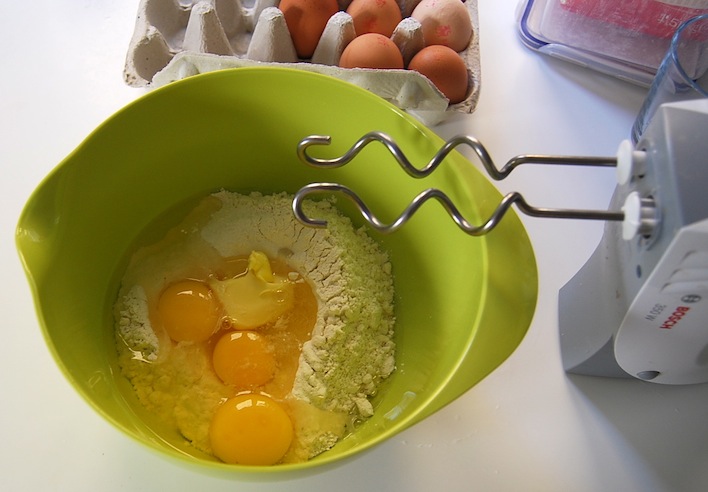
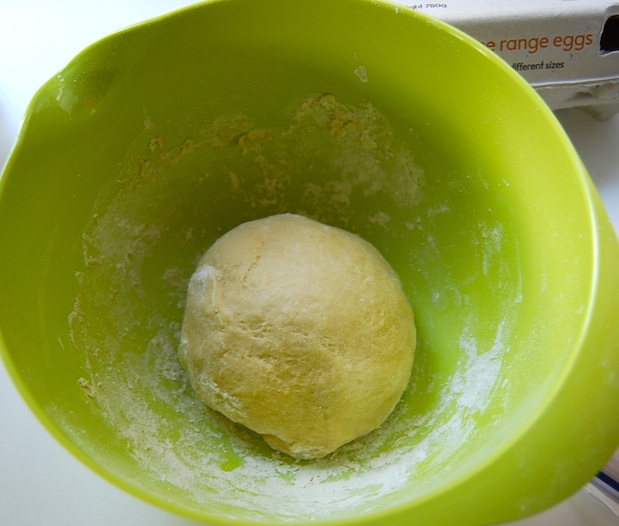
Using a wooden spoon, your hands or the kneading attachment of your mixer, knead the ingredients until you get a firm pasta dough. Add water if necessary but remember that you need a very firm dough, especially if you’re using a pasta machine!
Leave to rest while you prepare the filling.
For the filling:
- 1 onion
- 50g smoked streaky bacon or pancetta
- 200g stale bread
- 1 bag of fresh spinach (260g)
- 200g Bratwurst (a German sausage) or leftover roast beef or pork
- 1 bunch of curly parsley
- 1 egg
- salt, pepper
- fresh nutmeg
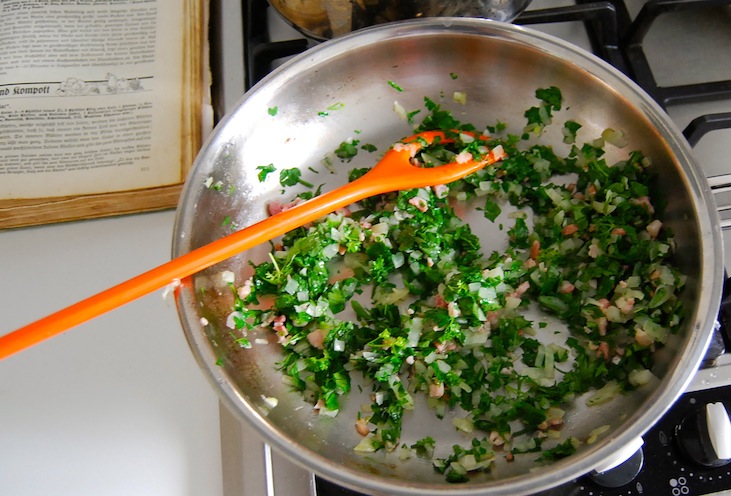
Finely dice the onion and the bacon and fry them in a little butter until lightly browned; add the chopped parsley, give it a good toss and leave to cool.
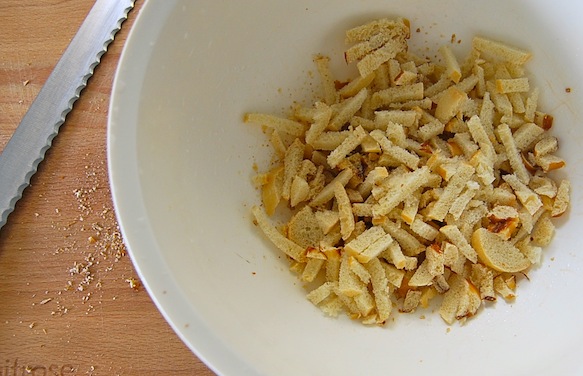
Cut the stale bread into small dices and soak them in cold water while you prepare the rest of the filling.
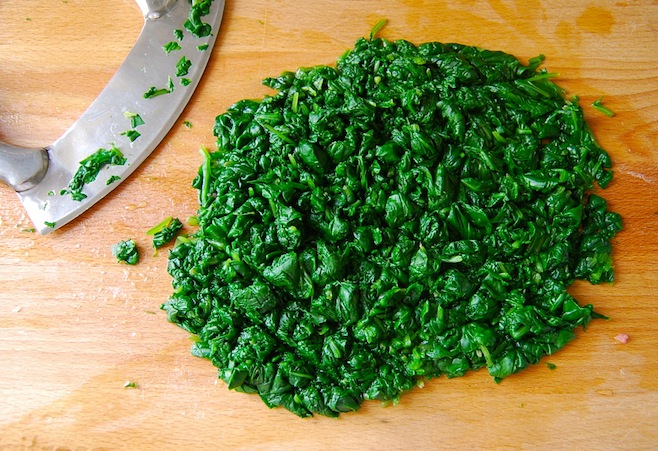
Wash the spinach, drain it thoroughly and cut it very finely. This one needs another go:
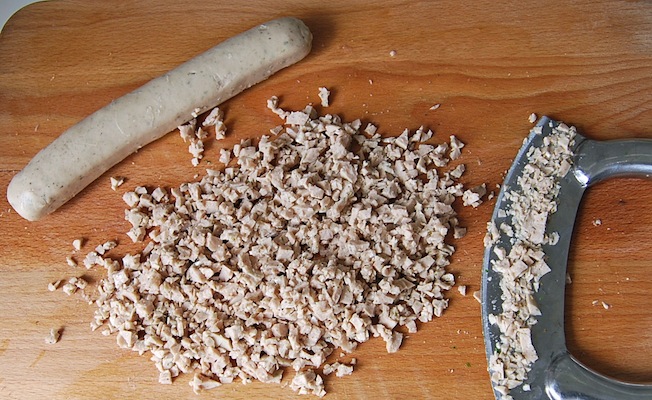
Peel the Bratwurst, if you’re using it, and cut it very, very finely – the same if you’re using leftover meat: remember the filling needs to pass for vegetarian!
Squeeze the water out of the bread and miix all the ingredients of the filling with an egg, salt, pepper and some freshly grated nutmeg. Season generously!
Assembling the parcels:
Roll out the dough, which is traditionally done using a normal rolling pin. But if you have a pasta machine you might as well use it as it makes the whole process child’s play. Literally.
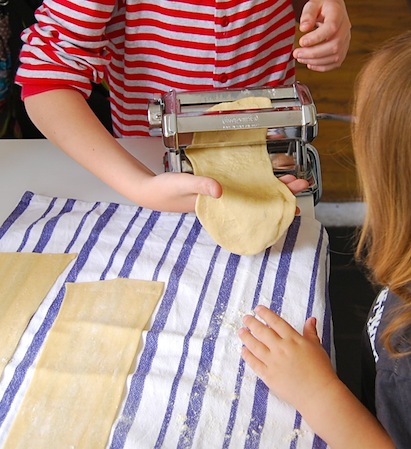
Roll out the dough quite thinly (we went down to a no. 4 setting) and cut it into strips of roughly 8cm/3in width. Leave them on a lightly floured kitchen towel to prevent them from sticking to the surface.
Once you have rolled out all the dough, place little heaps of the filling onto the strips and fold them carefully as in the picture:
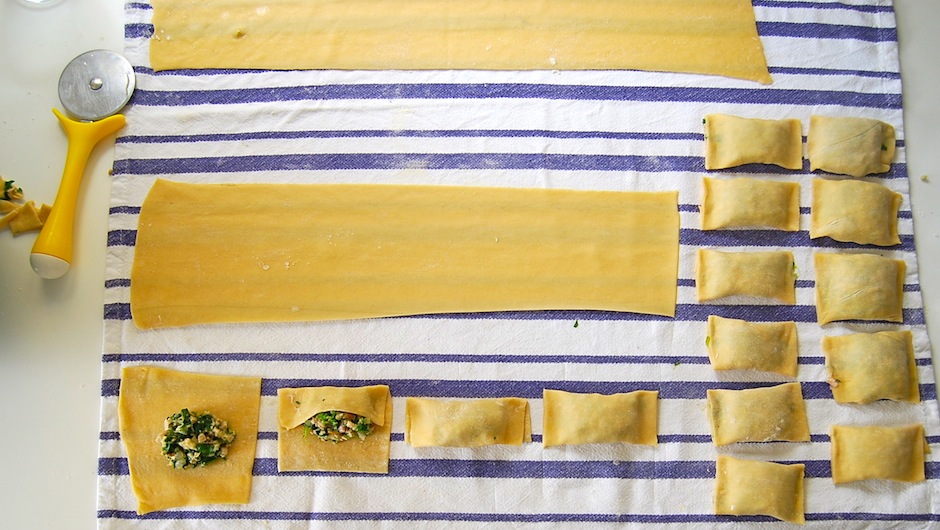 There is no need to seal them other than by lightly pressing them together. The finished parcels should be roughly the size of raviolis but they’ll end up slightly bigger – it’s up to you how your prefer them. Most butchers at home sell them as rather large parcels, but I prefer them almost half that size.
Bring a large pot of water to boil, add salt and simmer the dumplings for around 10 minutes. They’ll sink to the bottom but will then rise again and you will need to simmer them in batches. Keep them warm while you simmer the next portion.
To serve:
Maultaschen can be served as a starter, like Polish pierogi, in a clear meat broth, or bouillon, decorated with finely cut chives. In that case you can already simmer them in the broth, rather than the water, and simply add the chives before serving.
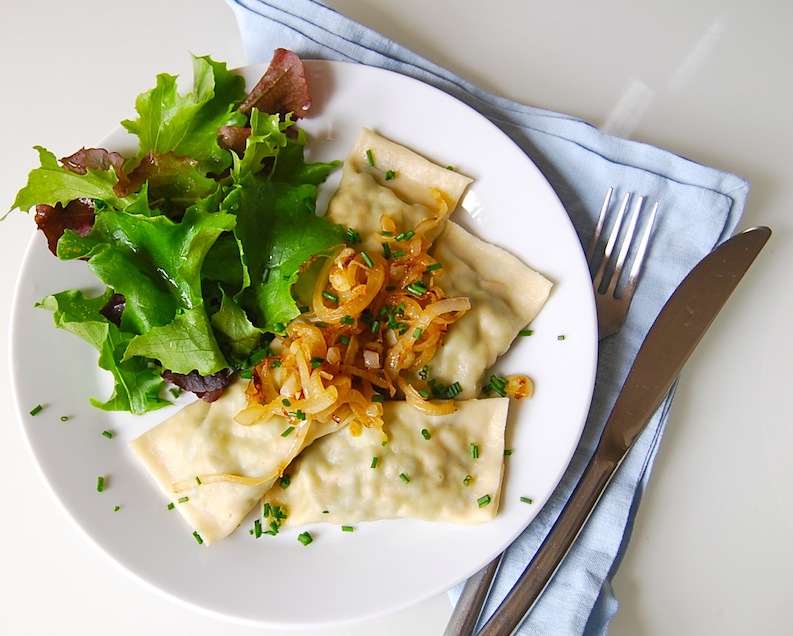
I like to serve them with fried onion rings and some freshly cut chives, together with a green salad or – even more traditional – a potato salad.
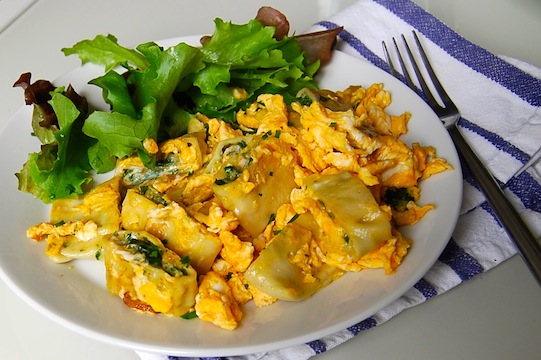
 Alternatively – especially when you have leftovers – you can cut the Maultaschen into thick slices and fry them with scrambled egg. The perfect hangover meal!
I have to admit that this dish is representative for most of the vegetarian dishes in our traditional cuisine. I cannot think of a vegetable side dish that does not include fried bacon…


Wow homemade looks delicious:)
LikeLike
Thanks – I’m glad you like it!
LikeLike
Ginger, your homemade Maultaschen looks so good and you make it look so easy. I like the story behind the Maultaschen 🙂
LikeLike
It’s a good story, but it’s still wrong 😉
LikeLike
Oh great job on this!!!
The pictures and details around these mouth pockets are spectacular!
LikeLiked by 1 person
never heard of maultaschen before.. definitely something i need to try. thanks for the idea!
LikeLike
Thanks for your comment, Thalia! They are a regional speciality, really, although you can now buy ready-made ones all over Germany (and in our local German ex-pat shop, too!). Do try them if you can get hold of German ‘Bratwurst’ sausages, but someday when I have a bit of time on my hands I’ll make a more refined fish-filled version!
LikeLike
Ich vermisse den Kartoffelsalat als Beilage… Sehen trotzdem sehr lecker aus!
LikeLike
Es ist so dermaßen heiß hier im Moment daß ich an Kartoffelsalat garnicht denken mag … Die waren aber auch sehr lecker!
LikeLike
I’m not very good at fiddly little stuffed pastas so your pics are great – love the shape and the filling.
LikeLike
I’m not very patient either, but the kids love it – I suppose they like the mess while I’m busy preventing it …
LikeLike
Pingback: Chinese-inspired Pork Dumplings | Ginger&Bread
Pingback: Consommé with Crêpes – Flädlesuppe | Ginger&Bread
Pingback: German Wine, traditional Onion Quiche, and a German Wine Giveaway | Ginger&Bread