Some of you might remember my Zeljanica, the traditional Bosnian spinach pie I made last year as part of my challenge to post a recipe for each country taking part in the football World Cup. Incidentally, it’s been the most popular recipe on my blog last year, followed closely by my cheesecake strudel recipe. How closely connected the two recipes were never occurred to me until my friend J invited me to come along when her mum was visiting her the next time and watch her making filo pastry, just as women all over the mountainous regions of Bosnia would have been doing for centuries, to fill it with meat, potatoes or cheese for a satisfying dish or even snack. 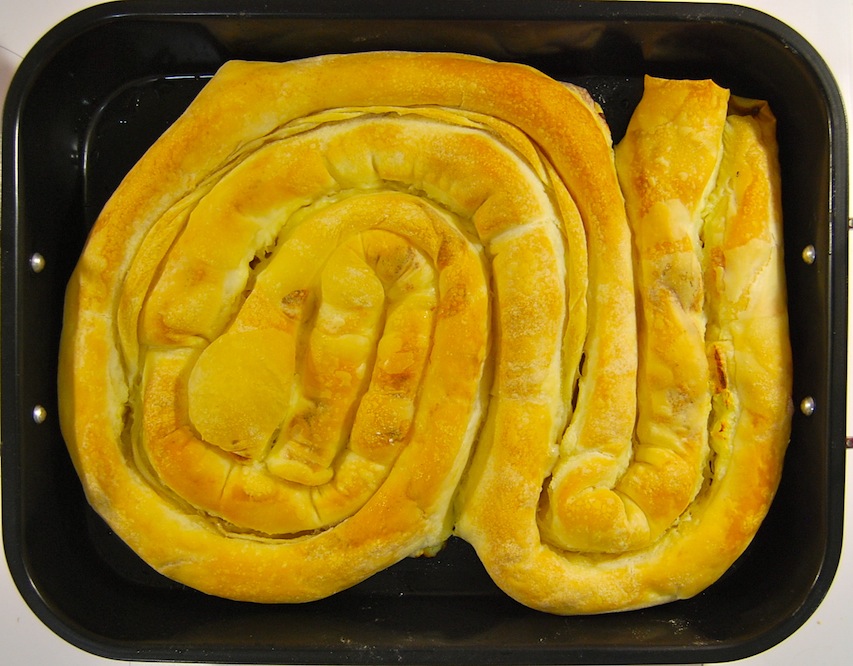 I have to admit, the idea of making my own filo pastry had never occurred to me, and it was only after watching J’s mum that I realised what I had been missing out on. Filo pastry takes a bit of time to make but it is incredibly exciting and fun – if in doubt, invite a couple of friends round to share the fun (and, ultimately, the responsibility). You’ll need a large table, though, and a cotton cloth of a similar size, in order to achieve the beautiful shape of the finished pie. A table cloth or bed sheet will do the trick. We made two batches of the dough, to make two different pies, one of them the vegetarian Sirnica, which I will describe below. We also made a poplasena pita, or ‘scaredy pie’, named to point out that some of the meat filling had been scared away (or replaced with) the cheaper potatoes. Don’t despair, my carnivore friends, I’ll be posting the recipe for this at a later stage! First, however, I’ll have to convince you that making your own filo is fun!
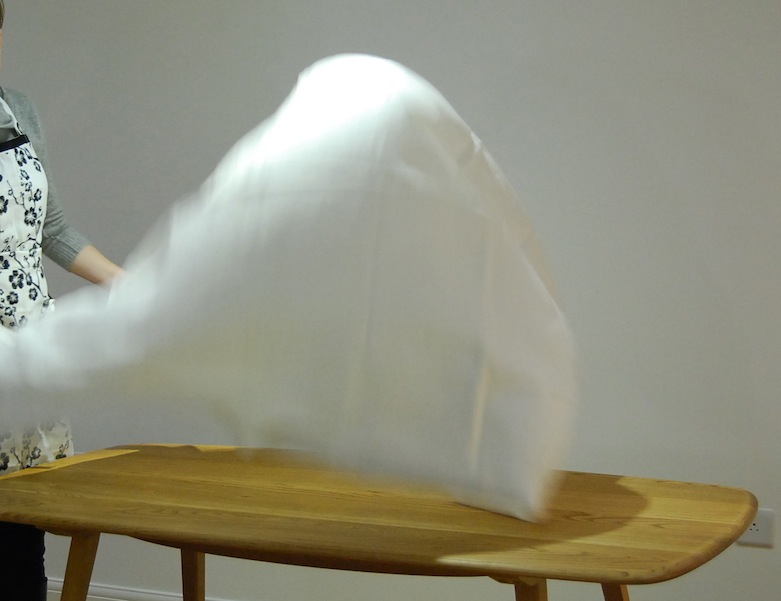 One of my reasons to start blogging was to share the traditional food of my region, which I had been taught to prepare by my grandmother and mum. So many time-consuming processes are being lost because pressures on time make us choose convenience foods! To watch a mum teaching her daughter how to make something as time-consuming and complicated (in relative terms) as filo was simply amazing: their conversations in the incredibly exotic-sounding Serbo Croat, mum carefully demonstrating and continually giving a hand, slowly coaxing her daughter into getting it just right – just as mothers having been passing on skills to their daughters for centuries. I just hope my pictures manage to convey something of that special moment to you, reminding you to pass on your skills to those around you. As for the Viennese Strudel, the Austrian probably came into contact with the much older Ottoman filo, phyllo or yufka pastry in form of baclava and borek when they conquered Constantinople (the modern Istanbul) in the 15th century. The ingredients and the process are very similar, so you can use this recipe as well as the method to make Austrian strudels or, indeed, to make your own boreks or even baclava. Go for it – I haven’t had that much fun in the kitchen in a long time!
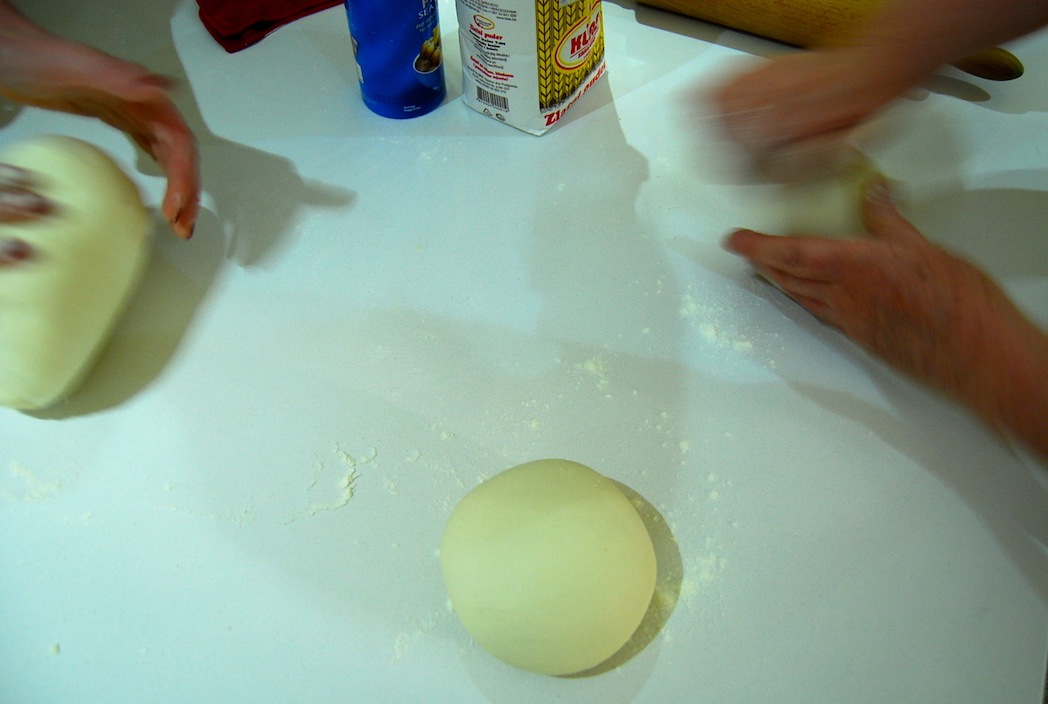
mum and daughter working side-by-side, with the perfectly formed ball of dough in the centre
Filo Pastry (makes one pie)
- 600g 00-flour
- 2 tbs vegetable oil
- 2 tbs salt
- ca. 400ml water
- vegetable oil for brushing
Making the dough: Mix the ingredients in a bowl, adding water as necessary.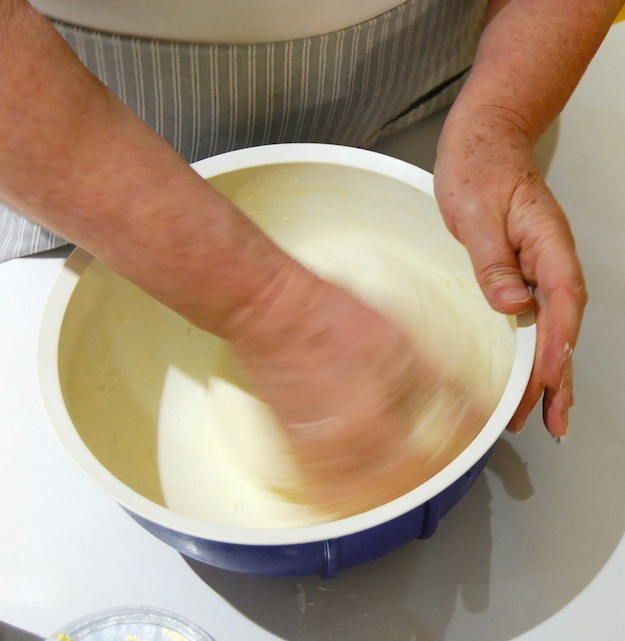 Once the dough comes together, place it on your work surface and knead it vigorously, beating it occasionally, until smooth. This will take at least ten minutes. If you make filo regularly, you’ll get the most amazing muscles on your upper arms; to be able to show them off you’d better not eat any of the pies, though 😉
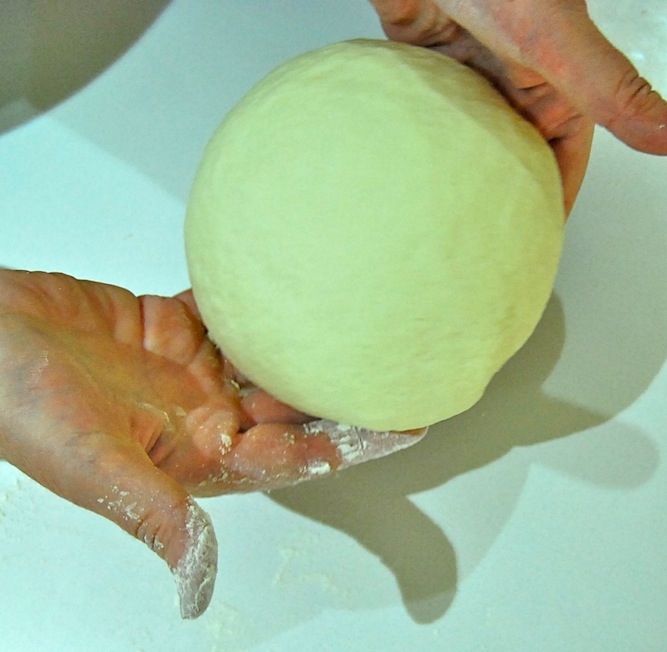
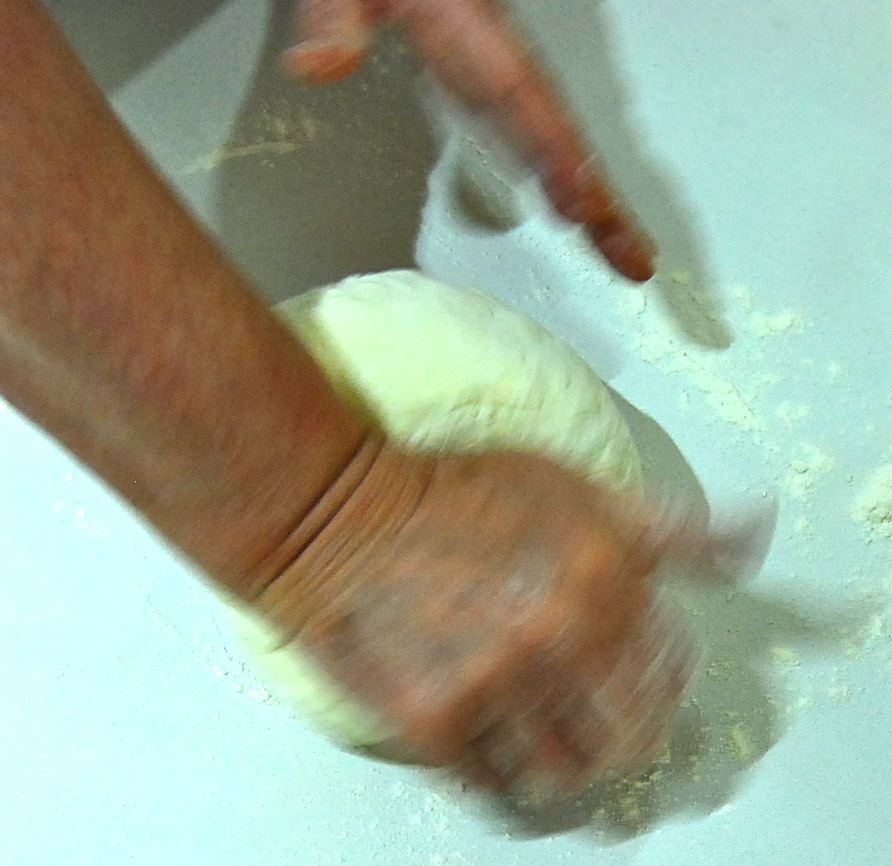 Keep kneading it between your two hands, using one to shape the ball against the other hand, which keeps it in place, Rotate and repeat until the surface of the ball is completely smooth.
 Place the dough ball into the bowl, cover it with cling film and leave it to rest for about an hour. Use the time to prepare your fillings – more of that later. After the resting period, cut the ball into two – ideally little bubbles should have formed:
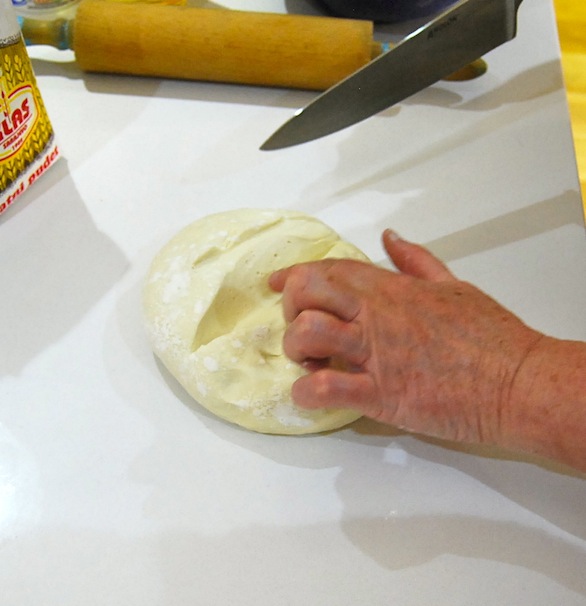 Roll out one half to a circle the size of a small plate; place it on a sheet of oiled cling film and brush it with some more oil.
 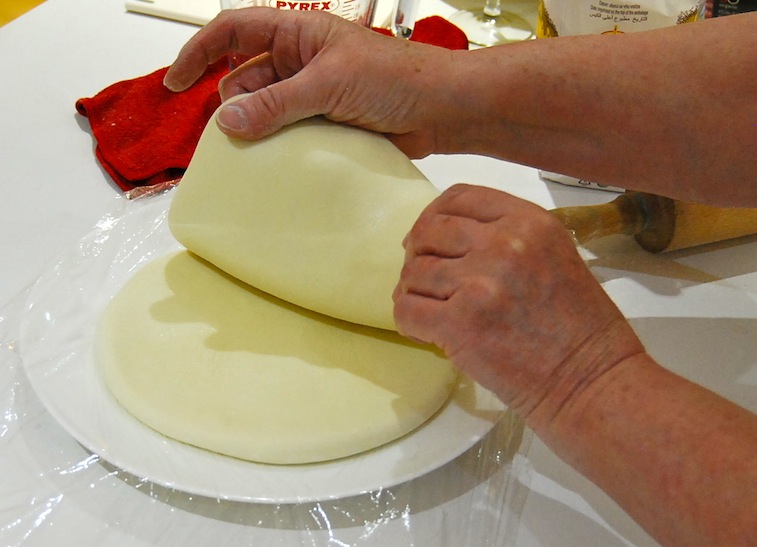 Roll out the second half and place it on top of the first, oiling it and covering it with cling film and a kitchen towel, to keep it warm. Leave to rest for a further 30 minutes.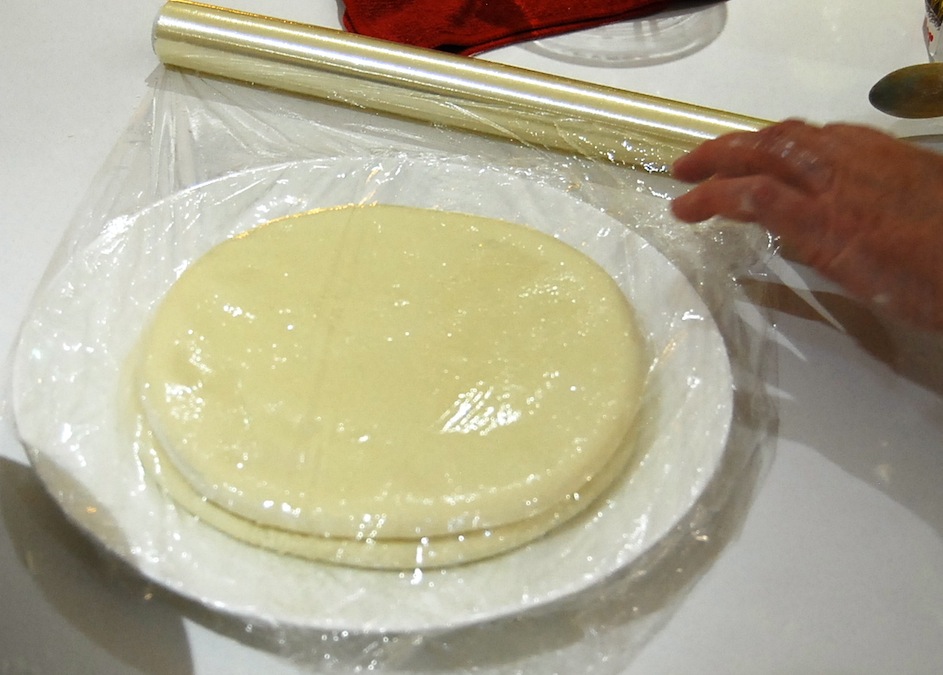
Preparing the filling for a Sirnica (Bosnian Cheese Pie) (serves 6)
- one portion of filo dough, as above
- 200g sour cream, drained
- 300g cottage cheese, drained
- 200g curd cheese or cream cheese
- 3 eggs
- salt and pepper, to taste
Mix the ingredients in a bowl while the filo is resting – once the pastry is pulled out it will dry very quickly and break, so you need to have the fillings ready before your start pulling! Pulling the Pastry: 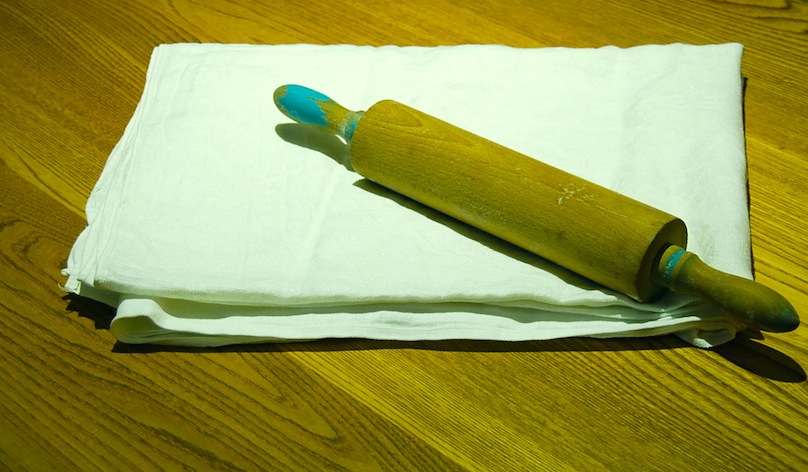 Once you have your fillings ready, preheat the oven to 180C/360F (no fan). Oil a large round baking tin (for the perfect spiral you’ll need one of around 40cm/16 in diameter) or an oven tray, using vegetable oil. Now place your cloth on the table and sprinkle plain flour over it to make sure the pastry is not going to stick to it.
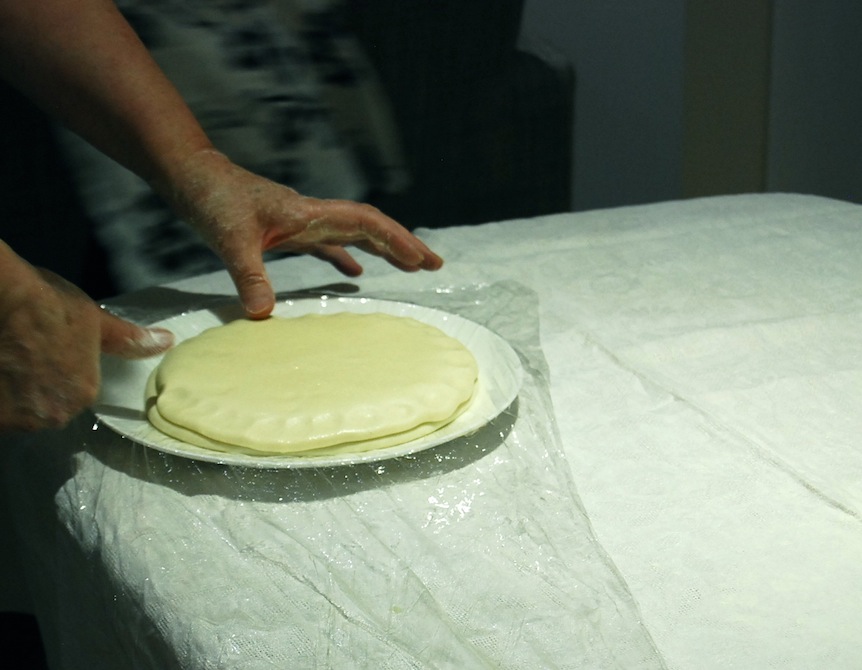 Place the dough onto the cloth and roll it out, using a rolling pin. Once it has the size of a baking sheet you can lift it up and allow it to be pulled down by its own weight, rotating it carefully to ensure it is spread evenly across the whole surface – you want to avoid a thin patch that will tear.
 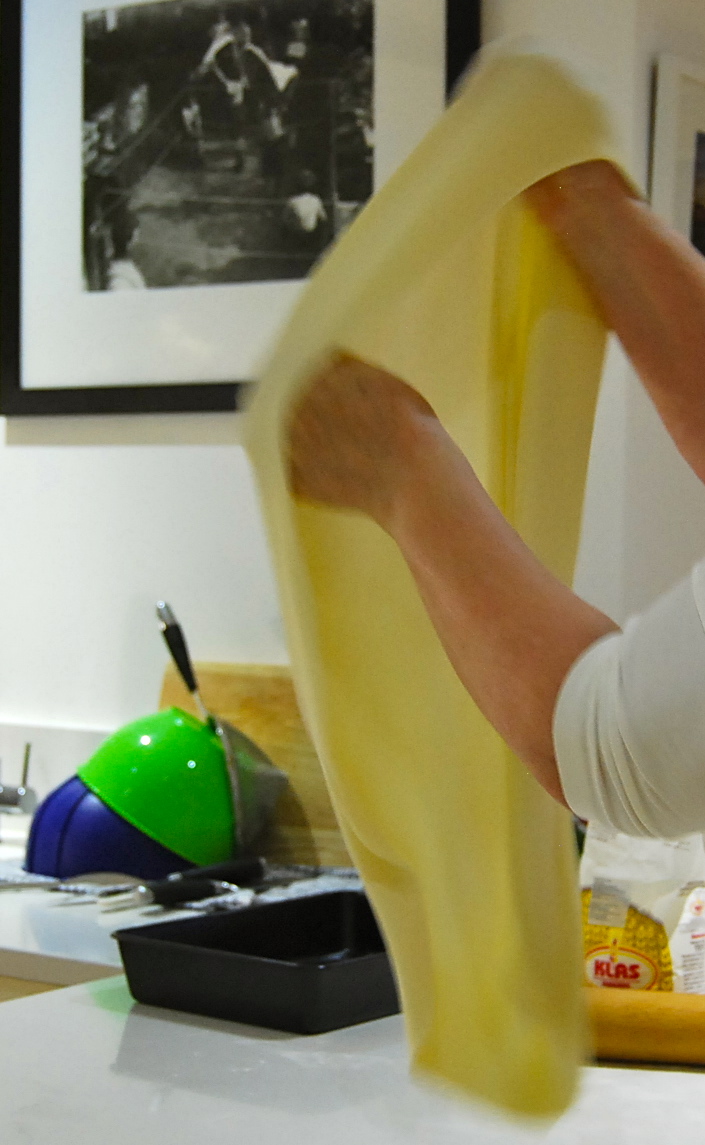 When you’re ready, place the pastry on the cloth and begin pulling it carefully, walking around the table as you do so. Keep pulling it and walking, holding the thick rim between your fingers and pulling it out from there.
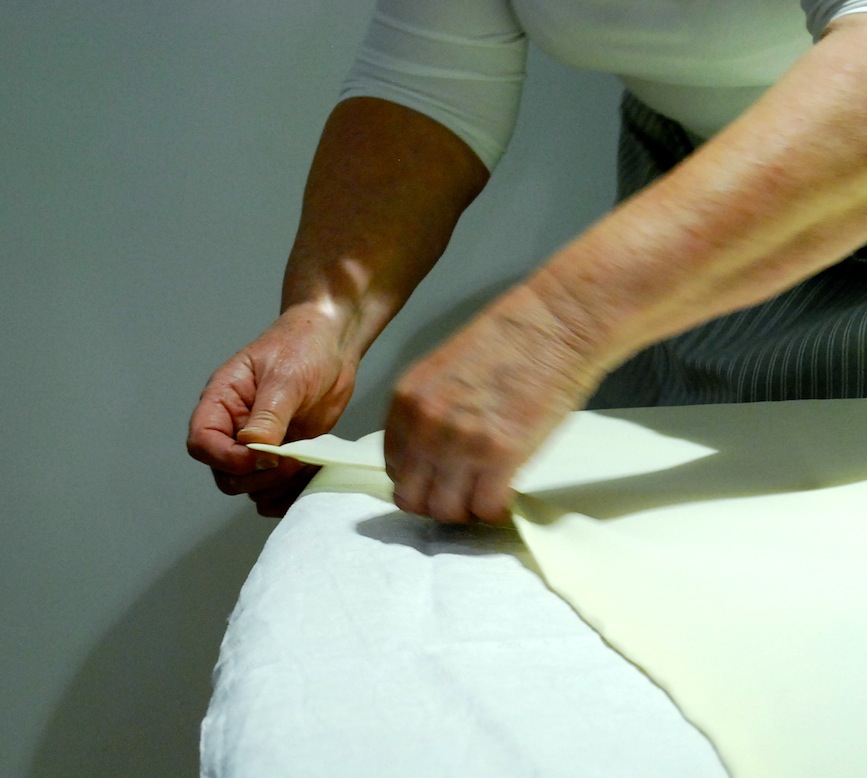 As you keep going, the sheet will become thinner and cover more and more of the table. Keep going, always trying to reduce the thick rim. Should the sheet tear avoid aggravating that area but keep pulling the remaining dough. You can glue it back together afterwards with a little water.
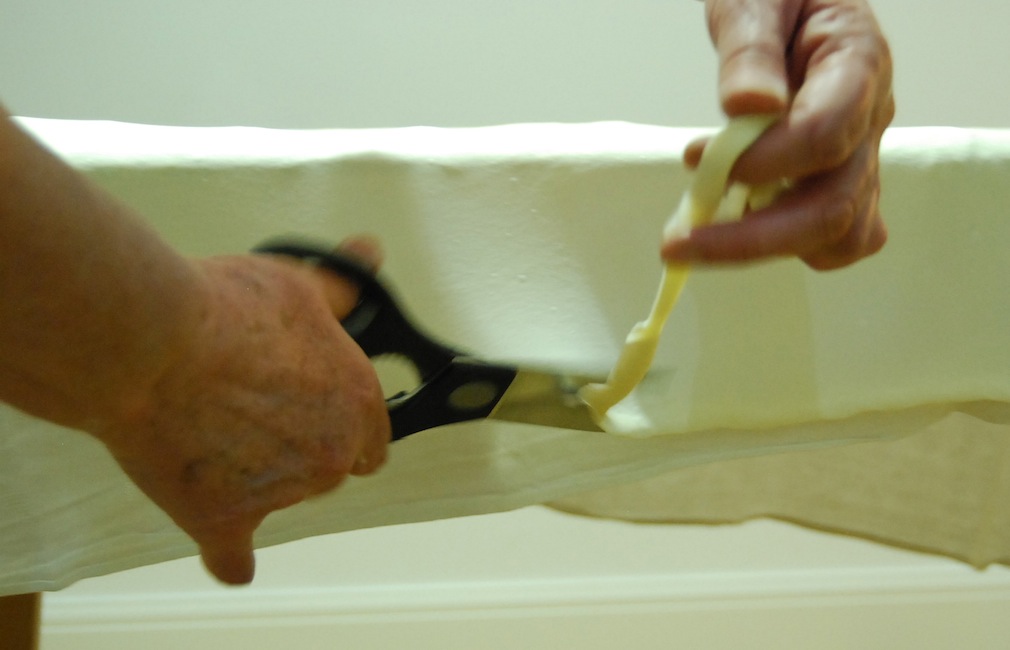
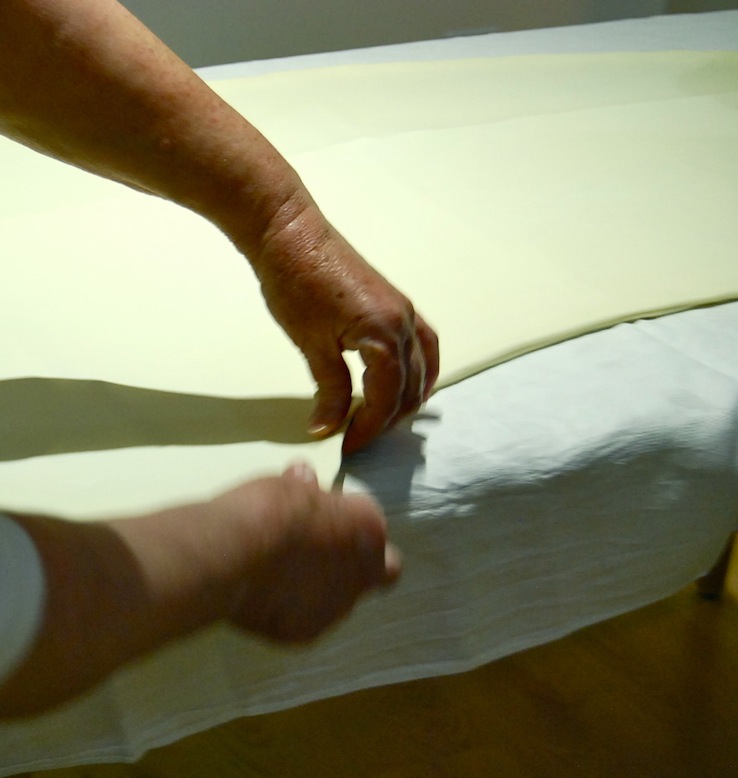 In an ideal world, you’ll end up with a sheet so thin that you’ll be able to read a newspaper placed underneath it. Cut off the remaining thick rim with a pair of scissors and get ready to fill your pie.
 Filling the Pie: Lightly sprinkle oil over the surface of the pastry (you can see the lines on the photograph below – it doesn’t need to cover the whole sheet!). To achieve the beautiful shape of the Bosnian pies, spread the filling in two lines along the length of the pastry sheet.
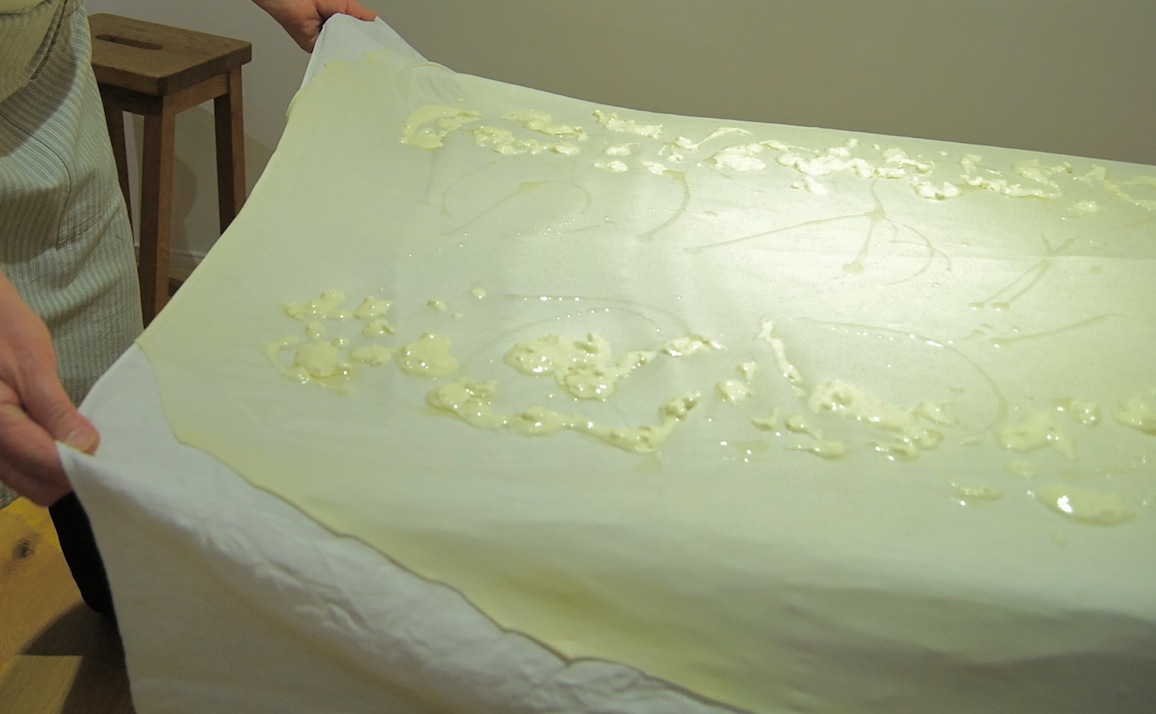
This is the filling for the vegetarian pie: a mix of eggs, cottage cheese and sour cream
Holding the seam of the cloth, lift it up in a quick movement to fold the edge of the pastry over the filling. Repeat on all sides. Brush the surface of the pastry with oil (this is to keep the sheets of pastry apart, resulting in the separate layers)
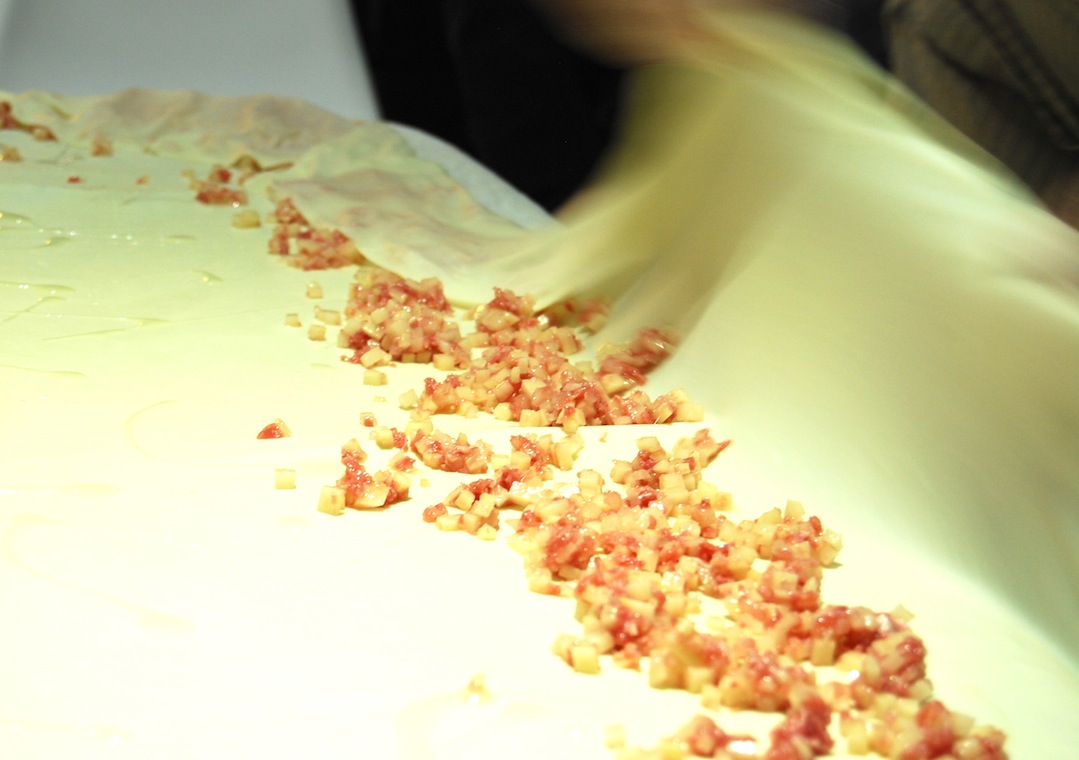
This is the meat and potato filling, in case you wondered …
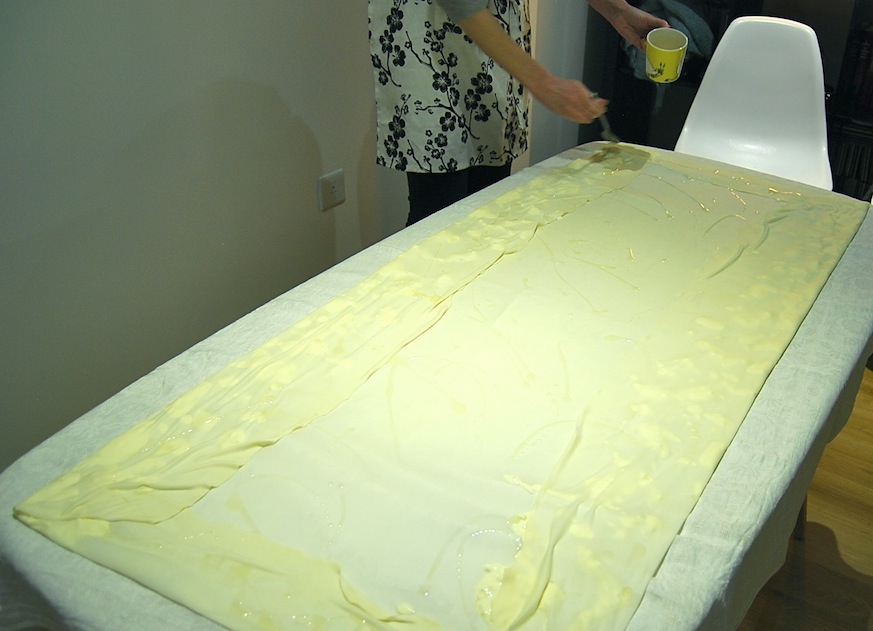 By gently lifting the seam of cloth you can now roll up the two sides until they form two parallel rolls along the centre of the table. Trim the ends if necessary.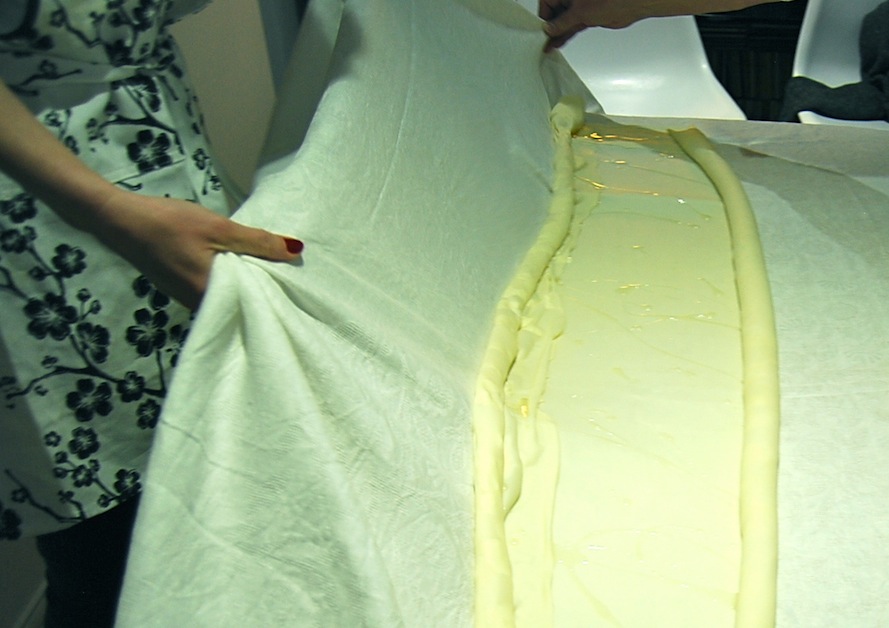
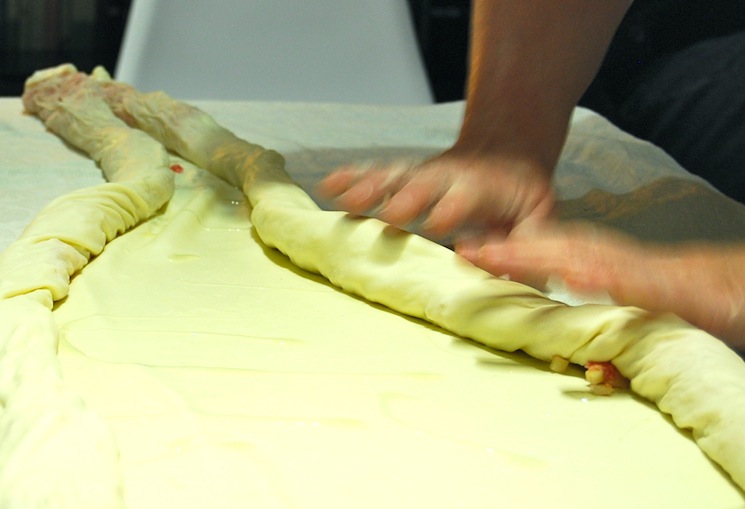 Place your prepared tin beside one end and carefully lift the rolls into the tin, rotating the tin to achieve the spiral pattern.
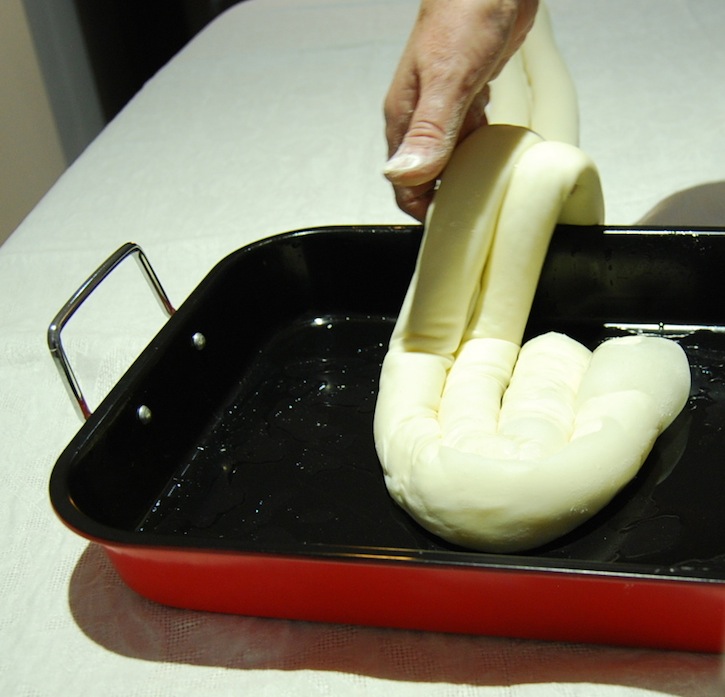 Brush with a little oil and bake for 40-45 minutes. Leave it to cool a little before you cut it into slices – just look at those amazing patterns of the filo sheets!
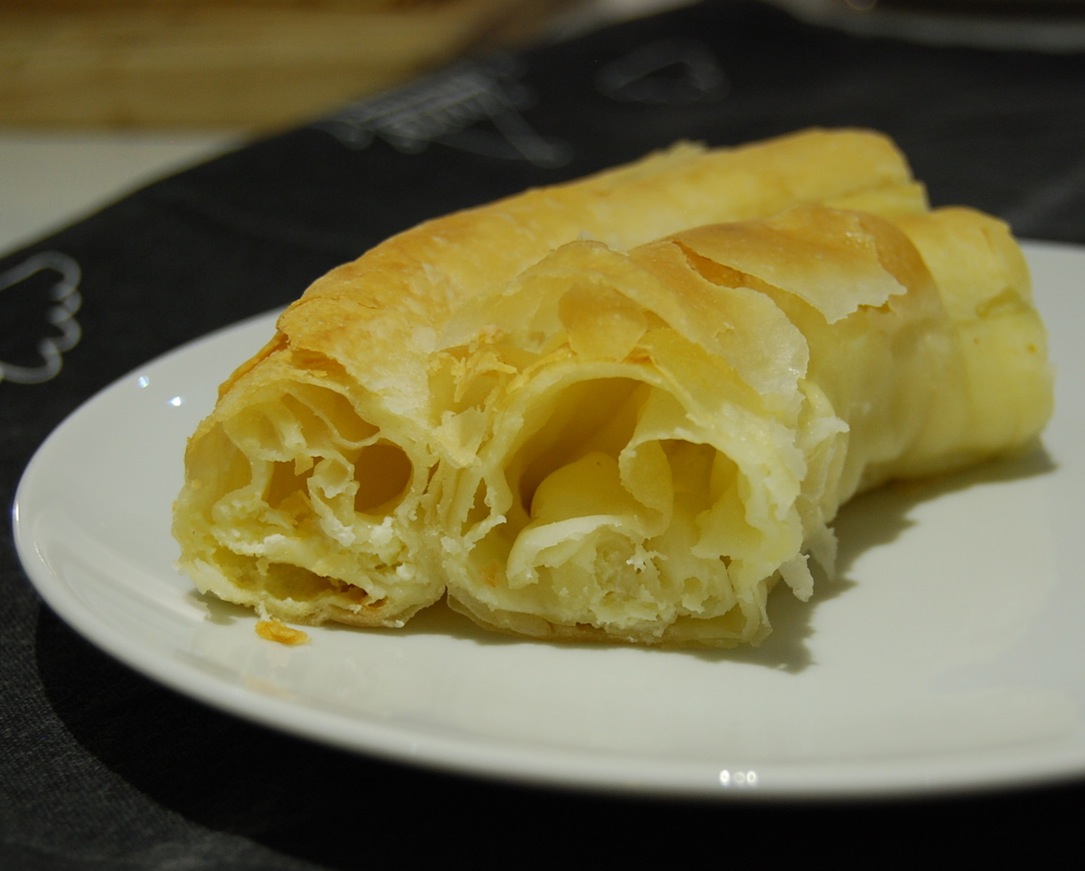 Doesn’t it look so much fun? I can assure you, it is not half as difficult as it seems to be – with good company (and a few glasses of prosecco) anybody can do it. The perfect dish for Fiesta Friday, over at Angie’s at The Novice Gardener – a traditional Bosnian snack will make the perfect finger food for the gathering there!
  This week she is being supported by Selma @Selma’s Table and Sue @birgerbird – I winder what those two lovely ladies have in store for us!
Have a look at Angie’s blog to see who else has come along, and at their delicious dishes! Perhaps you feel like partying, in that case simply add the badge to your post with the dish you are planning to bring along, link it up to The Novice Gardener following the instructions on the post, and hey presto, the party can begin! Well, we’ll better get started on a few more sirnica, to feed the crowds! 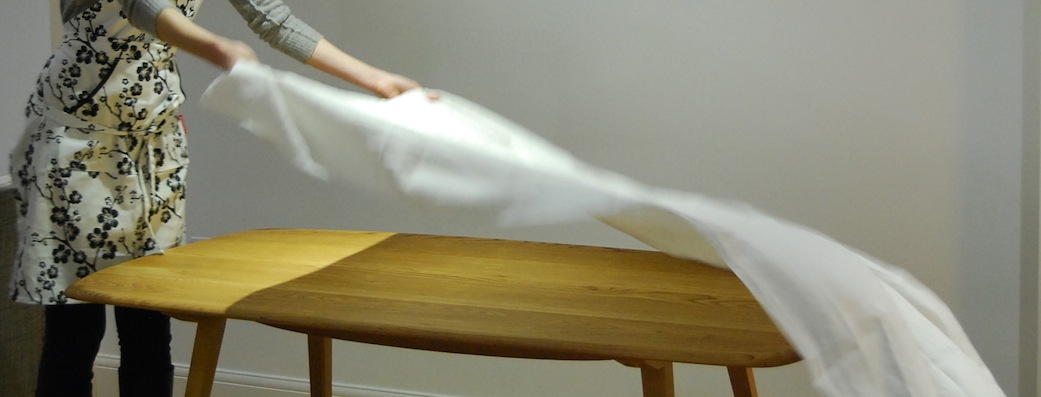


 Ginger&Bread
Pingback: Bosnia: Zeljanica – Spinach and Feta Pie | Ginger&Bread
Simply great! I love those spirals, in Croatia you can get them too-filled with spinach, sheeps cheese or apples. But maybe I will try to machine-knead he dough, as my hands do not allow tolerate such vigorous action any more.
LikeLike
I think the spinach-filled version might be the zeljanica. And yes, a kitchen machine will do the hard work! I have to say, when it gets to the size of a large kitchen table you just want to pat yourself on the shoulders with your least floury hand 😉
LikeLike
oh yes, that I believe! The few times I made apple strudel ….. proud I was!
LikeLike
Wow what a beautifully written, documented and executed post Ginger. How wonderful to see how fillo is made. I have always bought it ready to go…enjoyed learning how it is made. Thank you.
LikeLike
Trus me, I had no ideas either! When J mentioned it my first thought was that her parents would bring a little machine or something…
LikeLike
So impressive. Mastering that would be something. Getting the dough that thin but still pliable enough to work with is quite a feat. Beautifully done.
LikeLike
It was surprisingly straightforward – it helped that I could simply watch and then replicate it at home when nobody was looking 😉
LikeLike
This is great!!
Wonderful pictures…
I love Strudel so much!
LikeLike
I only ever thought of Strudel as something sweet! Now that I have made this I am tempted to try out savoury versions, too! One of the foods I miss most from Germany are Sigara Borek … Watch this space 😉
LikeLike
Thanks that was very interesting to read. I really will have to give this a try sometime!
LikeLike
Do that – it’s such fun to make it! Perfect to test drive your new kitchen 😉
Ginger x
LikeLiked by 1 person
I have one time seen some women demonstrating making strudel dough here in Minnesota. It was at a fair, and I wasn’t able to see the whole thing, as I just happened across it, and had small children with me, but I was awestruck! Seeing your cheesecake strudel and reading this gives me the same feeling of admiration.
What an incredible treat this must have been and how wonderful to be involved! You are so talented and have so much to share. 🙂 It was a lucky day that I happened across your blog. I just wish I could have even the smallest bite of the finished product!
I noticed the Fiesta instructions, too! Thanks!
LikeLike
LOL, I forgot to explain in my email 😉
Give it a try someday, it’s really easy to make and you feel great afterwards – just don’t tell anyone how easy it is and they’ll admire you forever!
LikeLiked by 1 person
LOL! Perhaps sometime…perhaps not! I have visions of complete disaster! I am quite sure something awful would happen.
I can particularly envision achieving near perfection only to have my cat jump up on the table and walk across it, for instance, even though I would have been careful to put her in a room with a closed door!
And if not the cat, my mind can conjur up a dozen other mishaps! 🙂 I fear achieving this perfection is simply rife with danger!
LikeLiked by 1 person
Speechless in awe of making filo from scratch – what a great experience!
LikeLike
It was such a wonderful afternoon, I felt really blessed! The changes between our parents’ generation and ours have been so drastic that it sometimes needs an interpreter (in this case me) to bridge the gap 😉 Making something like filo from scratch to eat on the same day seems such an extravagance to us, but it is well worth it.
LikeLiked by 1 person
You have demonstrated it so well. It looks so airy and fabulous.Is it as easy as it seems?
LikeLike
It actually is – do give it a try, it’s amazing! Now my next task is to learn to make chapattis …
LikeLiked by 1 person
OK!! Will try my hand at it soon👍🍞
When you make so many complicated and gorgeous breads, chapati should be the easiest for you.
LikeLiked by 1 person
Filo pastry making looks like fun. You must have so much experience to get it soo thin without tearing. I dont think i can do it like that ever.
LikeLike
I made my own the following weekend, using half the ingredients and still managed t pull it out over my own table – it is actually not that difficult as long as you really work it well in the first place! And then don’t pull too hard ..
LikeLiked by 1 person
Wow, what a fantastic experience and great for you to be able to both have it and share it with us. Will you be trying it again yourself at home?! It’s the sort of thing I can imagine being great in a group with someone who knows what they are doing but a bit daunting on your own, I don’t know that I’d have the patience. But lovely to see. How true that we are potentially losing some of these skills.
LikeLike
You’re not living too far from us, I think (we are near Heathrow) – anytime you fancy a pull-along 😉
I’ve made it once since and I am planning to make the meat version again as my photographs that day just didn’t do it justice. And then it’s boreks and baklava …
LikeLike
Amazing!!!!!
LikeLiked by 1 person
Thanks, Elaine! And to imagine that I stood idly by, watching the proceedings 😉
LikeLiked by 1 person
That’s what I’d be doing, with my mouth wide open in amazement!
LikeLiked by 1 person
Pingback: Fiesta Friday #50 | The Novice Gardener
Oh my Ginger – fantastic photos! Thanks for sharing – I am truly impressed 🙂
LikeLike
Thanks – that means a lot to me, coming from you!
LikeLike
Holy Moly, you’re a master for sure!
LikeLike
Not really, I am just the photographer! But I’ve made it since, so it is doable … and just think of the potential fillings, Sarah! 😉
LikeLike
That is amazing, Ginger – what a fantastic experience too. You have taken some really clear photos and described it so well too. It has actually made me feel like I could give go now. Have you tried to make it yourself yet? Thanks so much for sharing this fab experience with us – Happy Fiesta Friday!
LikeLike
I’ve used it for an apple strudel, which turned out perfect; I’m dying to make the meat version now, probably next weekend. My family enjoyed the bits I brought home from my friend’s so they’re all for it!
LikeLiked by 1 person
Wow! Awesome! I bet this is so delicious to eat. I know my mom used to make the best strudels. Usually with fruit. I would love to try it with meat.
LikeLike
There are so many possibilities … too many, almost …
LikeLiked by 1 person
Oh my goodness!! I have always wanted to make filo pastry from scratch but it always seems intimidating… it still does!! but your post just makes me want to try it even more… I wish I could see a a maestro at work and learn… Filo pastry is such a beautiful delicate dough… Definitely on my bucket list of things to learn to make!
LikeLike
Just go for it – what’s the worst that could happen? 😉
LikeLike
Unreal. Really! Thank you for sharing this special awesome creation with us on Fiesta Friday. Now, can I have another one just to take home please?
LikeLike
Thank you, Sue! It was such a wonderful afternoon I had to try and bring the experience along! It’s all gone, unfortunately, but I hope you’ll be making your own soon 😉
LikeLike
I don’t think I have the patience to make my own filo, or a big enough work surface! I really enjoyed reading this post and the step by step photos, I can imagine how much more satisfying it was to learn to make your own!
LikeLike
Do give it a try, it is so much fun! I halved the ingredients to suit my table when I tried it at home 😉
LikeLike
This is absolutely amazing! I’ve only seen it made on TV once, so the fact that you got to see it being made in person just makes it all the better. I would definitely love to try making it myself one day 😀
LikeLike
Go girl! 😉
LikeLiked by 1 person
I found your directions very encouraging. I have attempted filo before, but not as fine as yours. Maybe I should try again. Thanks for a very clever post.
LikeLike
I think the secret is the thorough kneading and sufficient rest. The rest is easy! Thanks for your lovely comment, Hilda!
LikeLiked by 1 person
The filo pastry looks fantastic! It would never occur to me to even try but it does look like fun 🙂
LikeLike
I effing love it!
I always wanted to make my own filo and I guarantee you 100% that this will make me consider it a little more for sure 🙂
LikeLiked by 1 person
This is mighty impressive, Ginger! I’m in awe… 🙂
LikeLike
This whole preparation looks simply amazing Ginger. I remember old ladies in my village making bread for the whole family, and it was the same ritual. Beautifully documented, lovely pictures! xx
LikeLike
It was one of my favourite sessions, ever! To watch people cook together, especially mothers and daughters, is such an amazing experience!
LikeLiked by 1 person
I can feel that dough between my hands! Is there a better feeling? 🙂 Not that mine comes out looking that beautiful but it’s fun to play! 🙂
LikeLike
Pingback: Apple Strudel – The last Word in Apple Cakes | Ginger&Bread
Pingback: Tuna and Red Pepper Pastry Parcels - My Dinner
Pingback: Vegetable Börek | Ginger&Bread