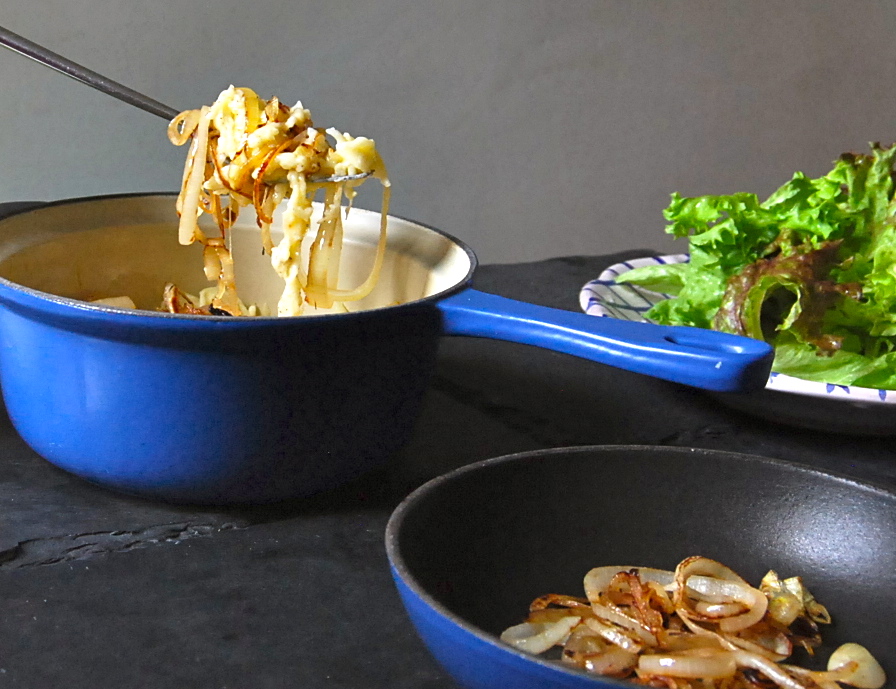
Kässpätzle, or Macaroni Cheese, the Swabian way
Spätzle are to the cuisine of my region what rice is to Indian food or chips to Britain: there is hardly a dish that cannot be served, enhanced or transformed with a generous helping of these delicate little noodles. It’s the first dish we made when I got together with other students from my region at my university, 300 miles away from home. Although I have to admit we nearly fell out over the right way to make them … only one hour into our friendship …
Despite their popularity in southern Germany and parts of Austria and Switzerland, they are not very well known outside these regions. You will therefore understand my excitement when I saw Betsy and Carly Ellen’s post on Spätzle on Crowded Earth Kitchen, they encountered them in Bavaria and serve them with mushrooms and bacon. We eat them with anything, especially with meats that come with a bit of sauce, such as casserole dishes, but on children’s menus you’ll often find them served with nothing but a spoonful of light gravy. My personal favourite is the Swabian version of macaroni cheese, which you’ll find at the bottom of this post.
Betsy and Carly Ellen call them ‘dumplings’, whereas I can only ever think of them as ‘noodles’; in fact, Spätzle are possibly both, and therefore they are a dish like no other: incredibly light, they seem to melt on your tongue, especially when they have been freshly prepared. Although the ingredients are the same as for many other dumplings or noodles – flour, eggs, water and salt – the consistency of the dough is more like a batter. But perhaps the most remarkable aspect is the way in which Spätzle are made, as the individual noodles are scraped off a board, straight into boiling water.
Traditionally we use a metal scraper and a wooden board with a handle and an angled rim, which you can see on the picture below:
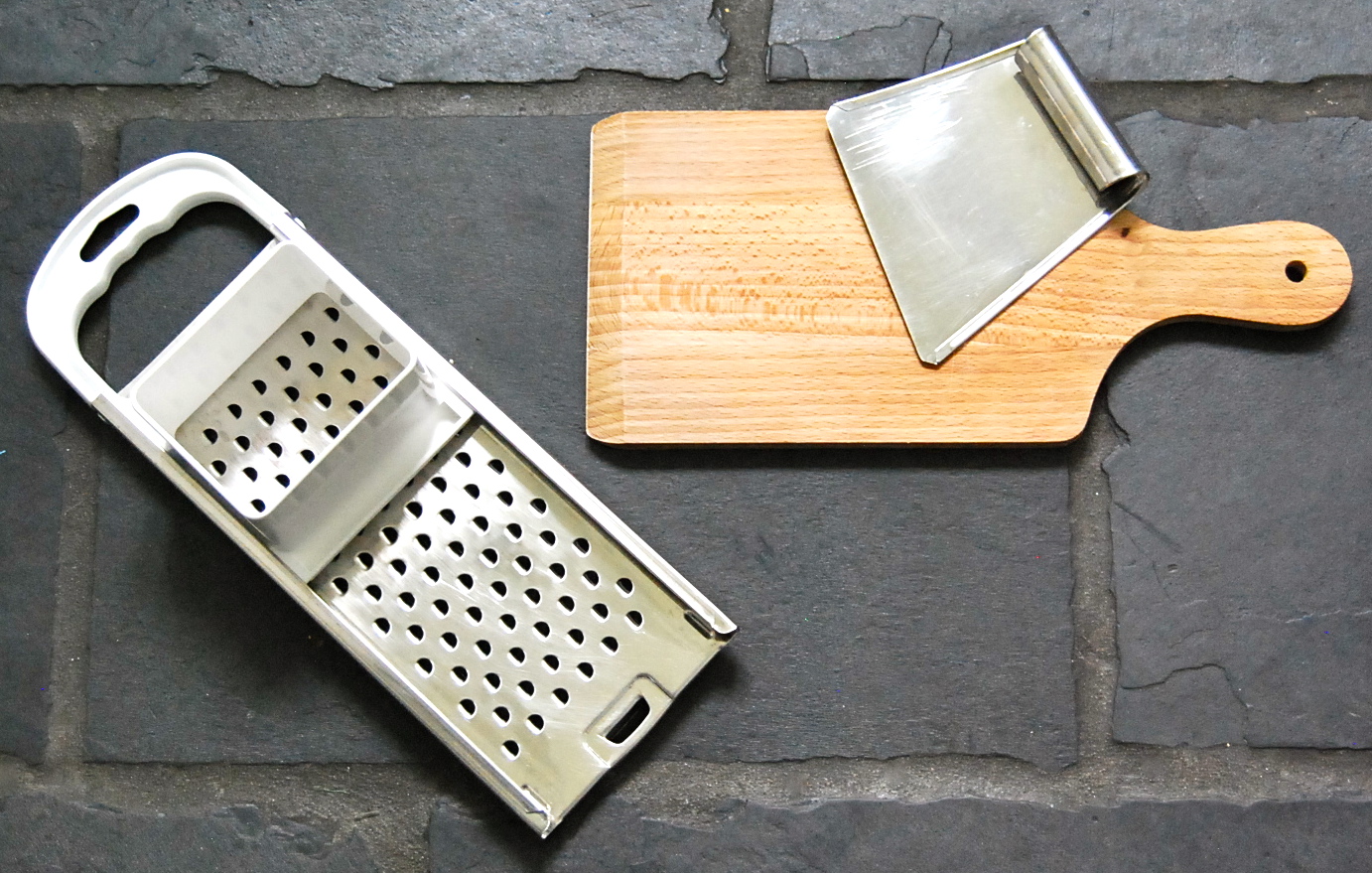 On the left I have a ‘Spätzleschwob’, the closest to a Spätzle-machine you can get: here the batter is filled into the plastic frame and then pushed through the holes in the metal ‘grater’, but more of that later. I have seen people make Spätzle using a knife, and any thin board with a handle and a pastry scraper will do the trick. All you need is some fine-motoric skills, some upper-body strength, and determination.
Spätzle (serves 2 as a side dish)
As mentioned before, the recipe for the dough – or batter – is incredibly simple: as a side dish for two people you use one egg and 100g plain flour, some salt and enough water (I use sparkling water for added lightness) for a fairly thick batter.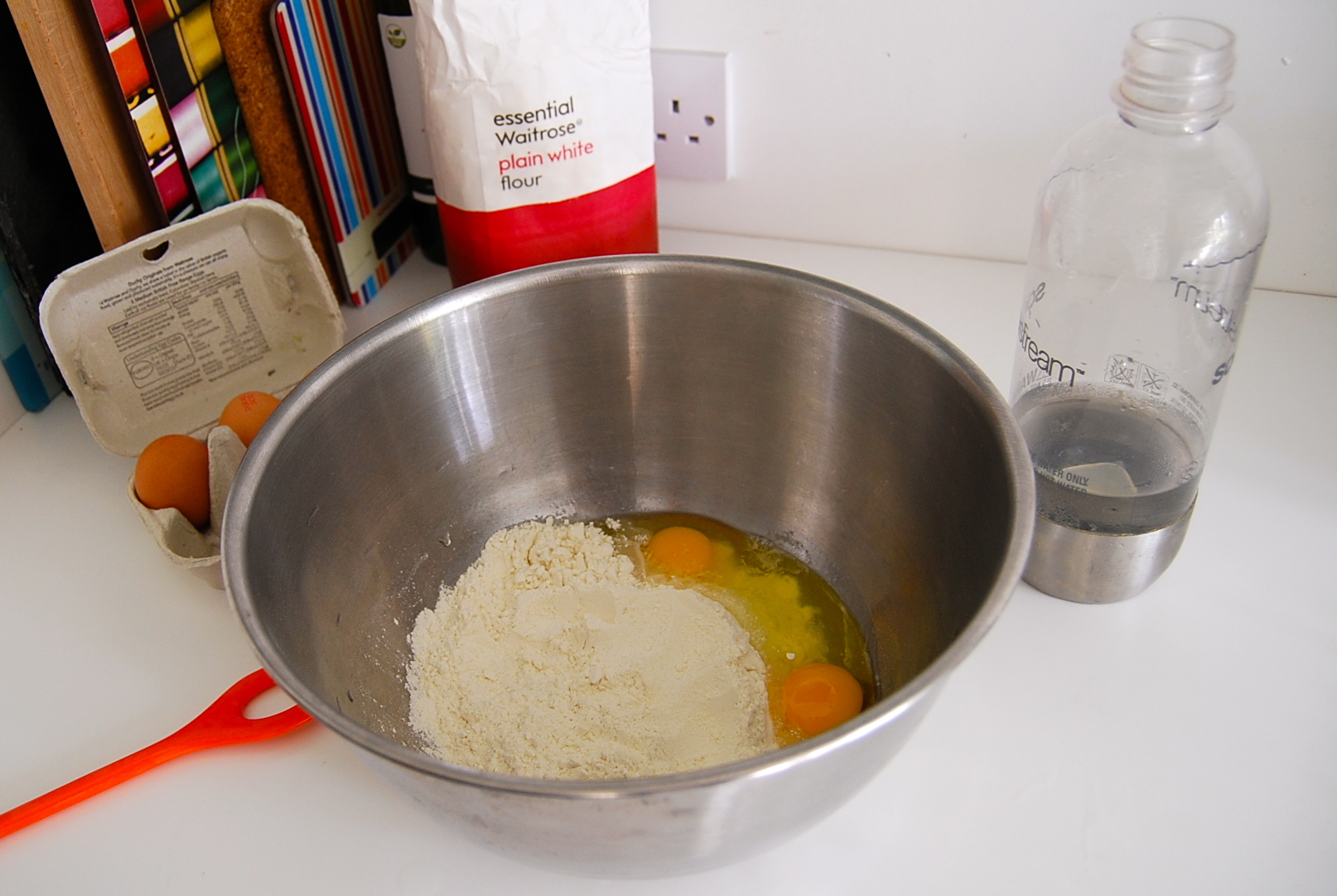
Using a wooden spoon, mix the ingredients until you get a fairly thick batter, like the one on the picture below: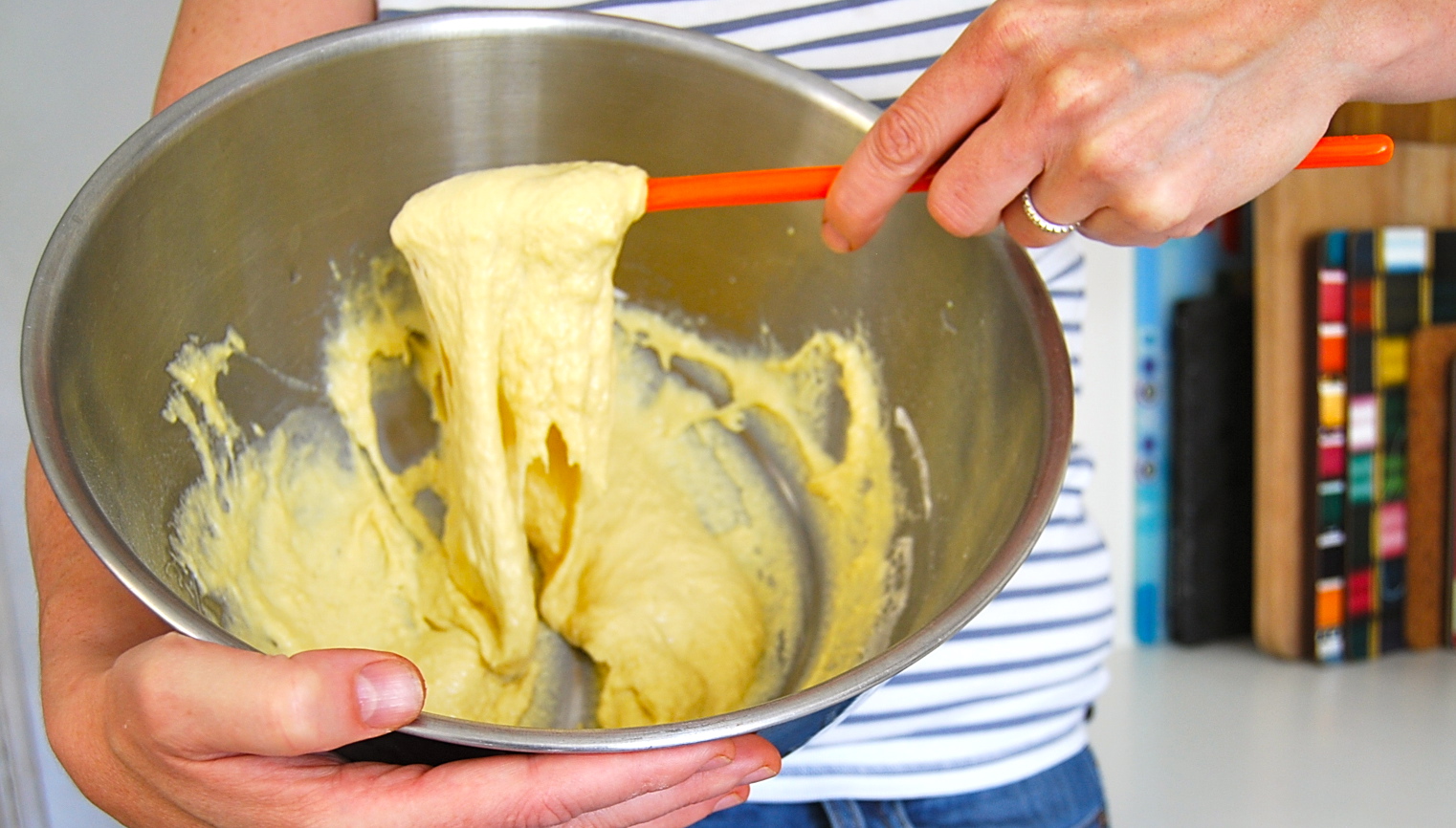
Bring a large pot of water to boil and add some salt. Have a skimming ladle and a dish ready to collect the finished Spätzle before starting to scrape. When you’re ready, get your board and scraper ready by wetting them in the boiling water, before placing a small amount of the batter onto the board. Using the scraper, flatten the blob out towards the edge:
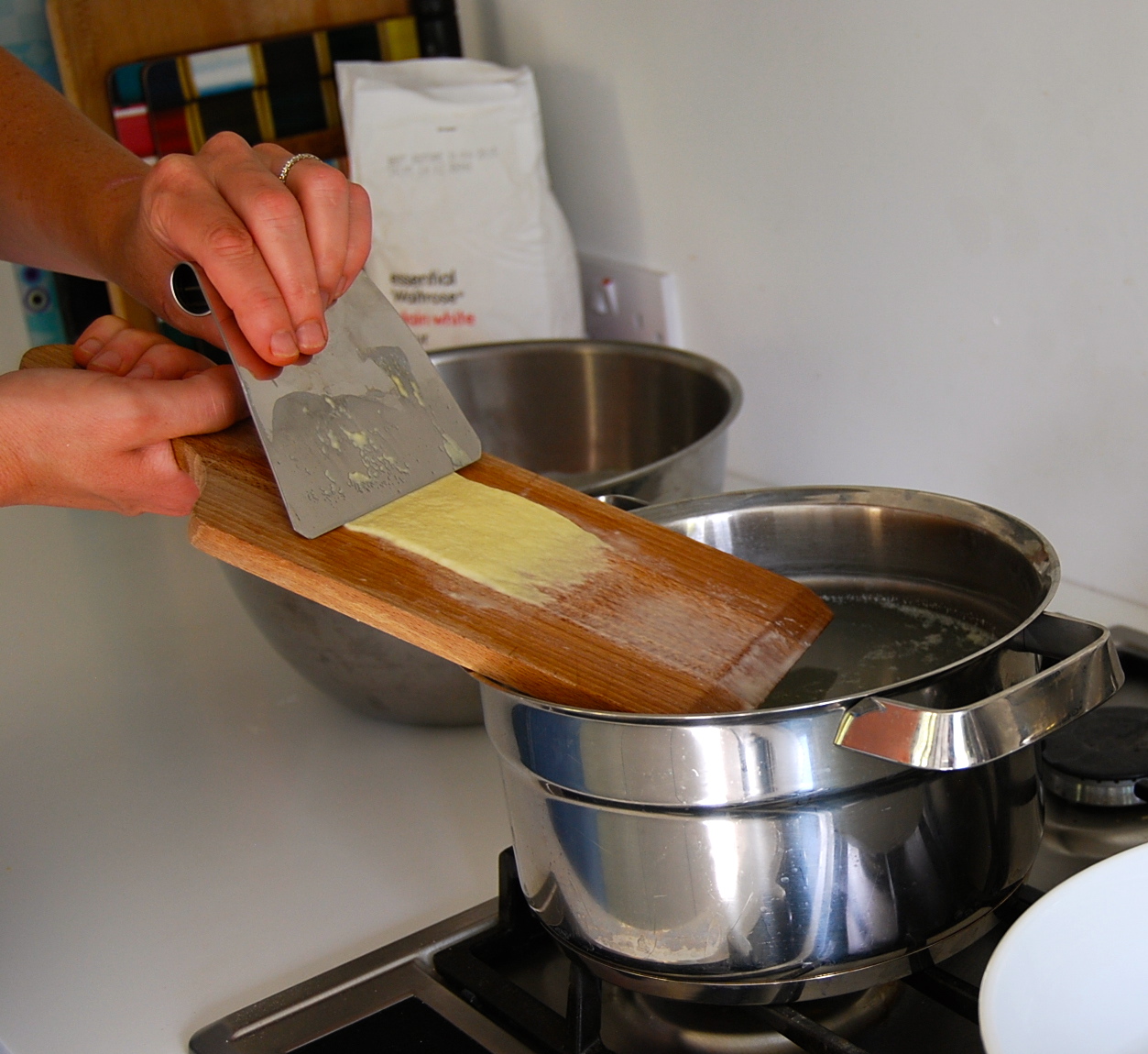
Now you can start ‘scraping’: cutting off thin strips of batter with your (wetted) scraper,
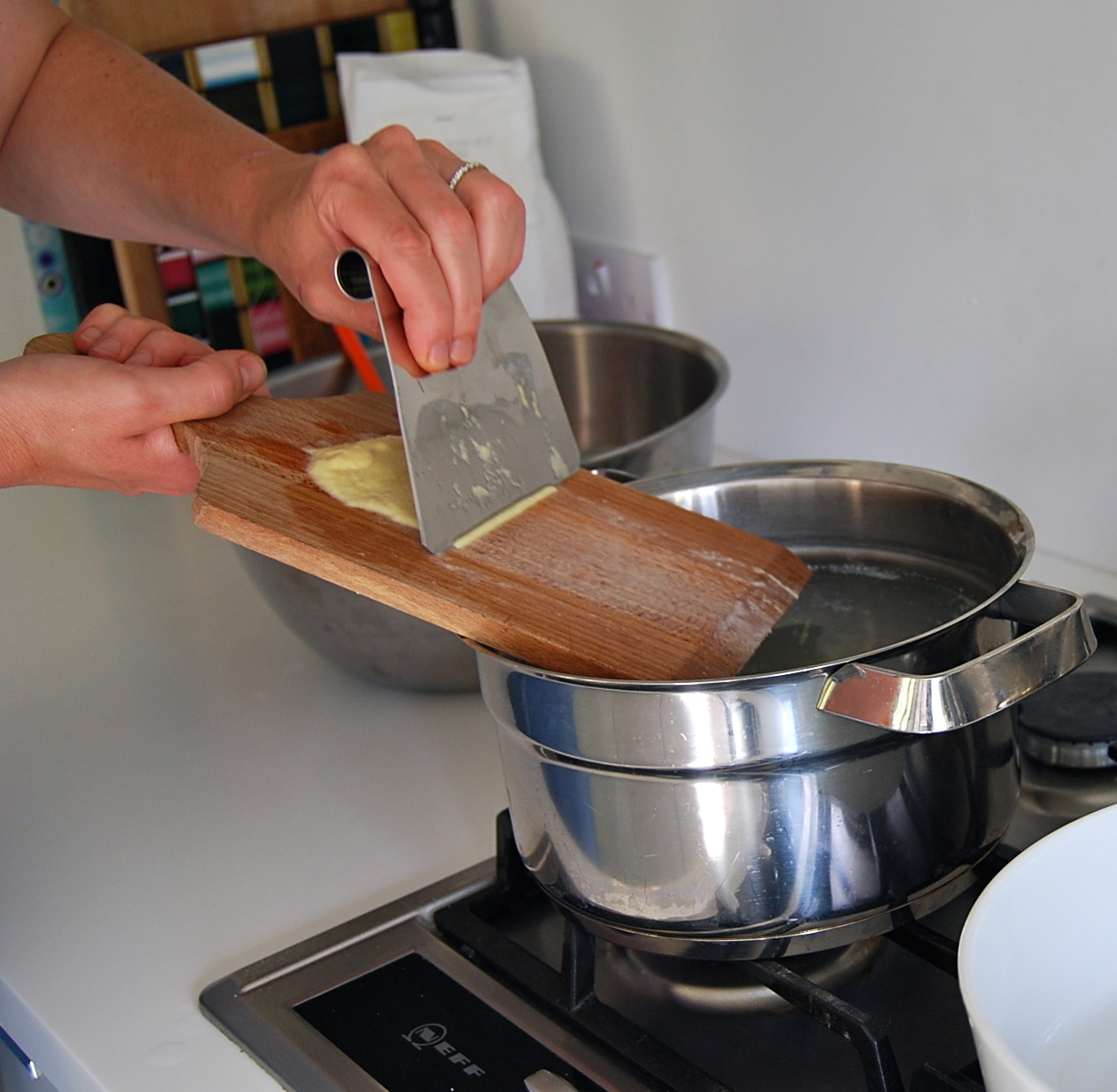
and pushing them to the edge of the board where they fall into the boiling water. Simple.
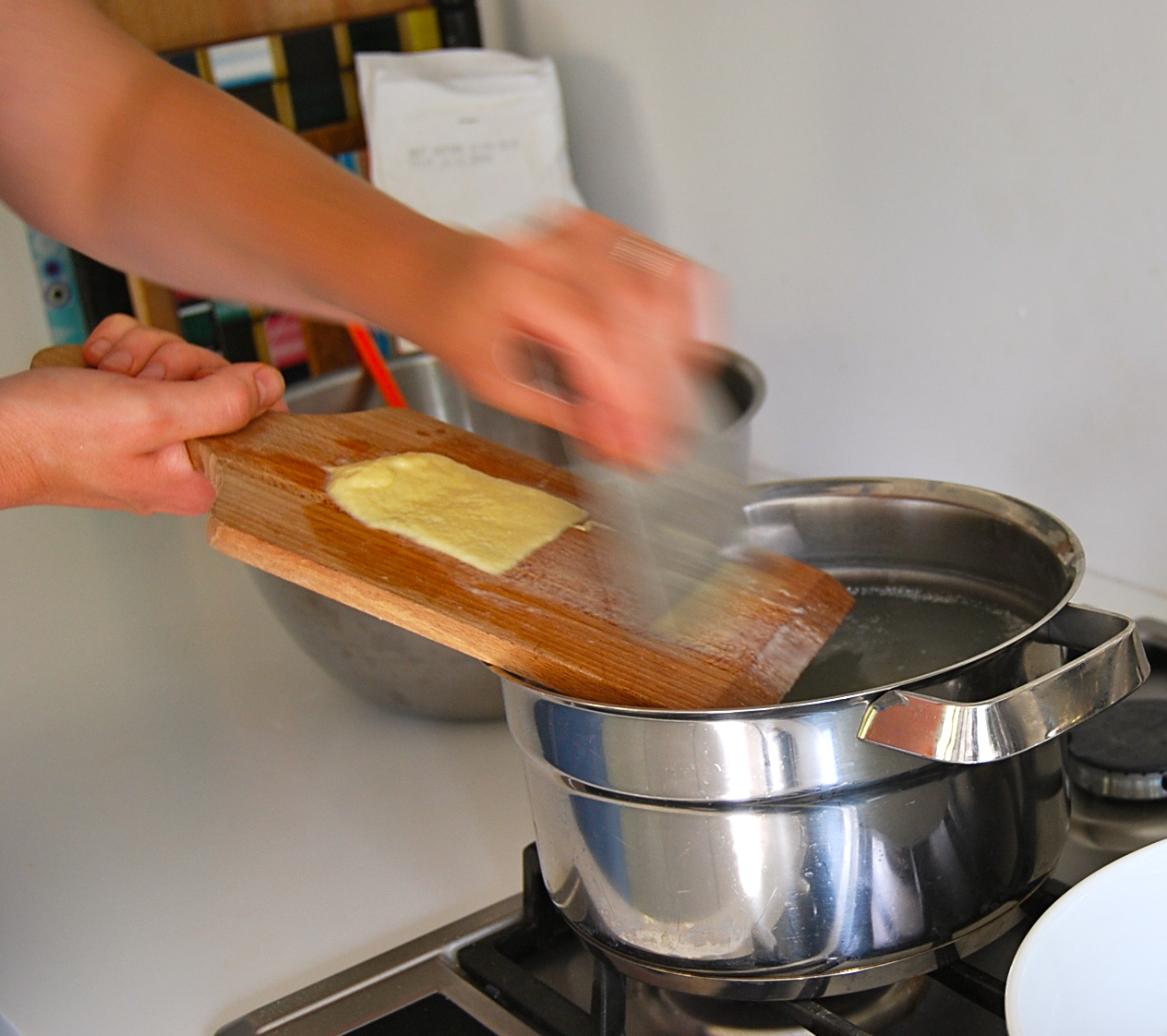
Keep cutting and pushing until you get to the thicker end of the batter, wet the board and scraper, flatten out the batter and cut and scrape again until the blob of batter is finished.
The noodles should be bobbing away in the boiling water at that stage, and once they’re all at the surface you can use your skimming ladle to scoop them into your serving dish.
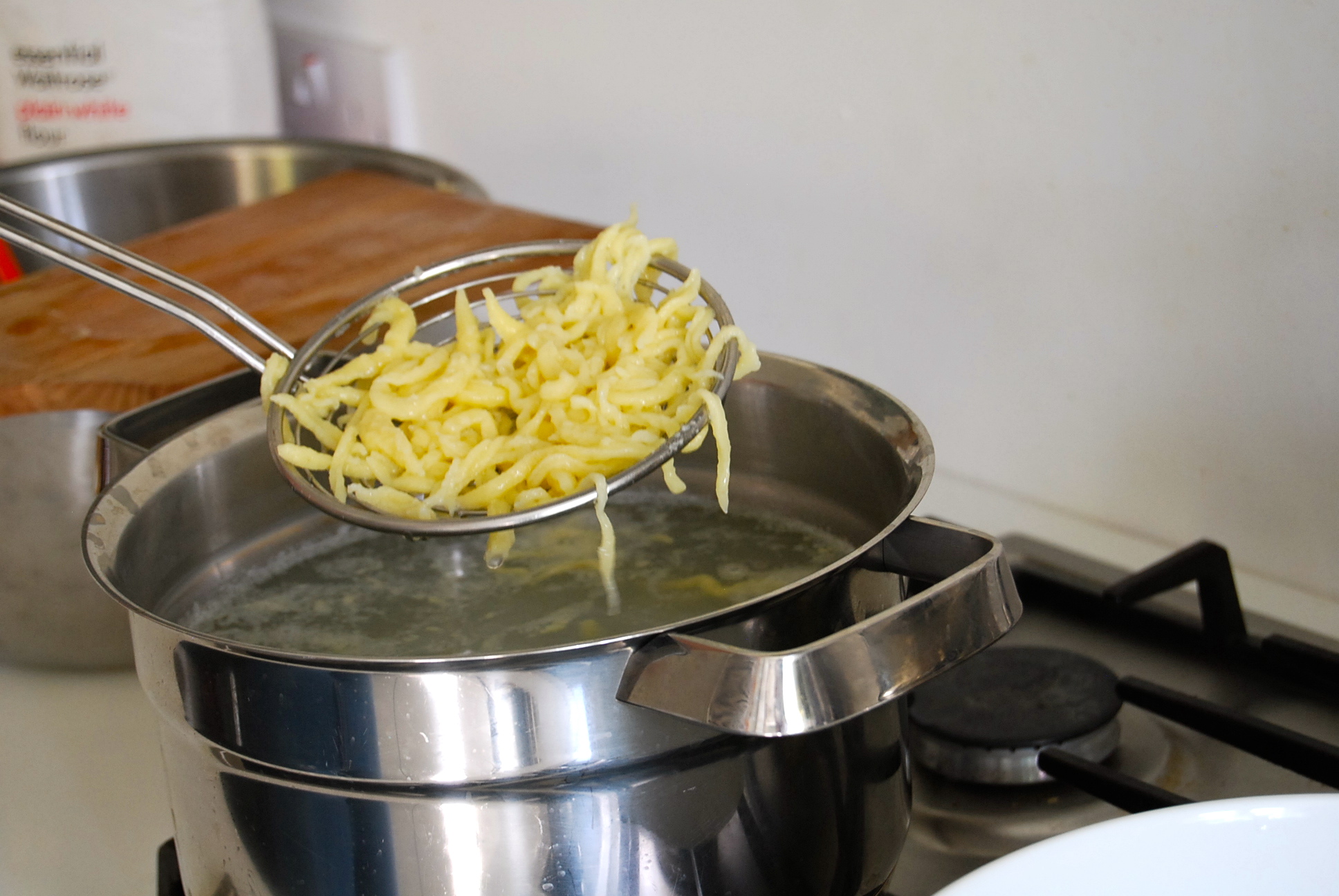
Up to here, most people will agree with me, but once the Spätzle are out of the water the big debates begin: some (like my cousin) scoop them into a pot filled with lukewarm water and don’t drain them until they serve them; others rinse them under cold water before transferring them to an ovenproof dish in the warm oven, covered with tin foil, to keep them warm. I’ve witnessed numerous arguments between followers of different techniques, and it was not a pretty sight. Think Romeo and Juliet, just without the romance.
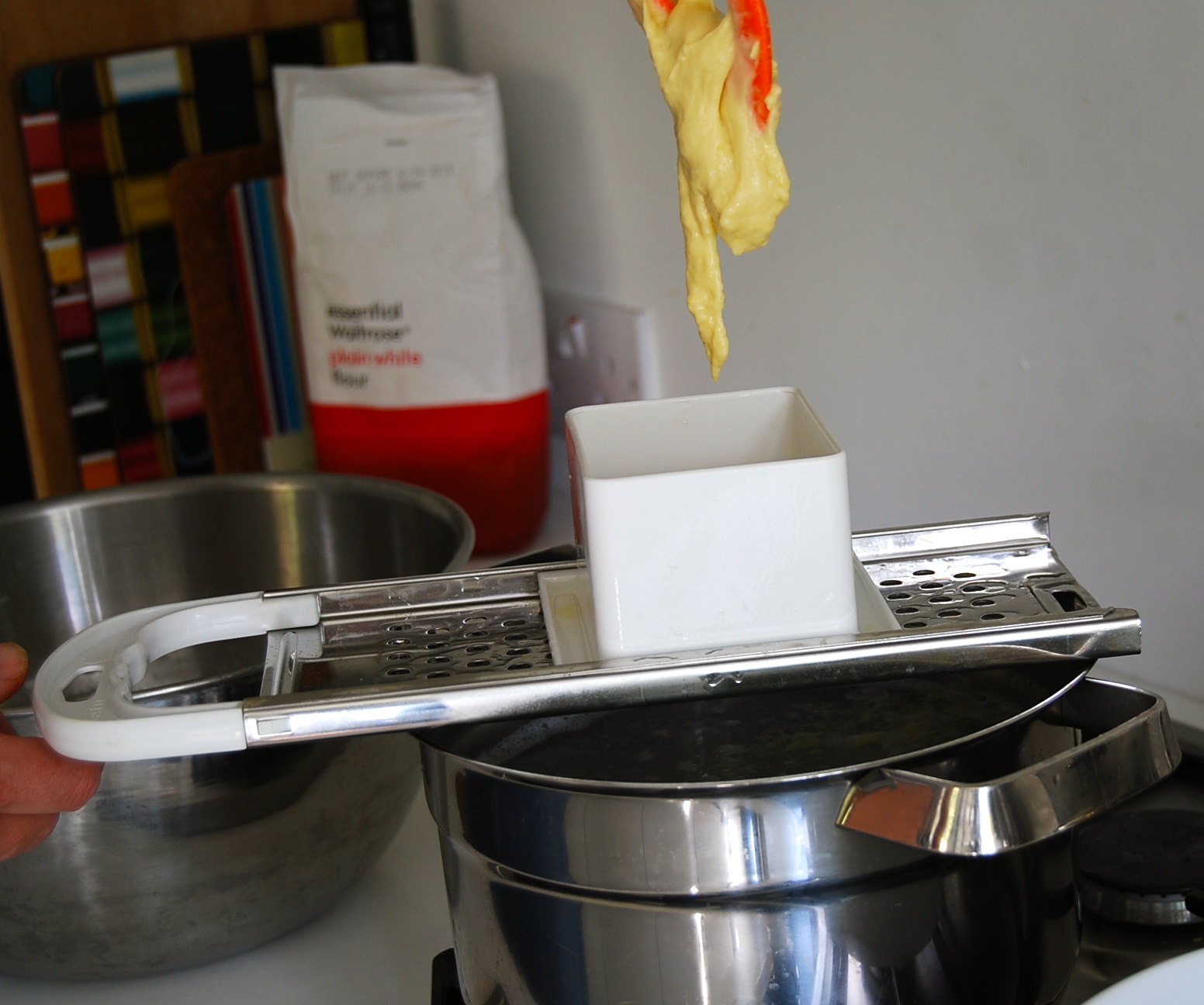
As with so many traditional recipes, they tend to take their time to prepare. Therefore modern engineering has provided us with a machine that speeds up the process, such as the ‘Spätzleschwob’: here a slightly runnier batter is filled into a plastic frame:
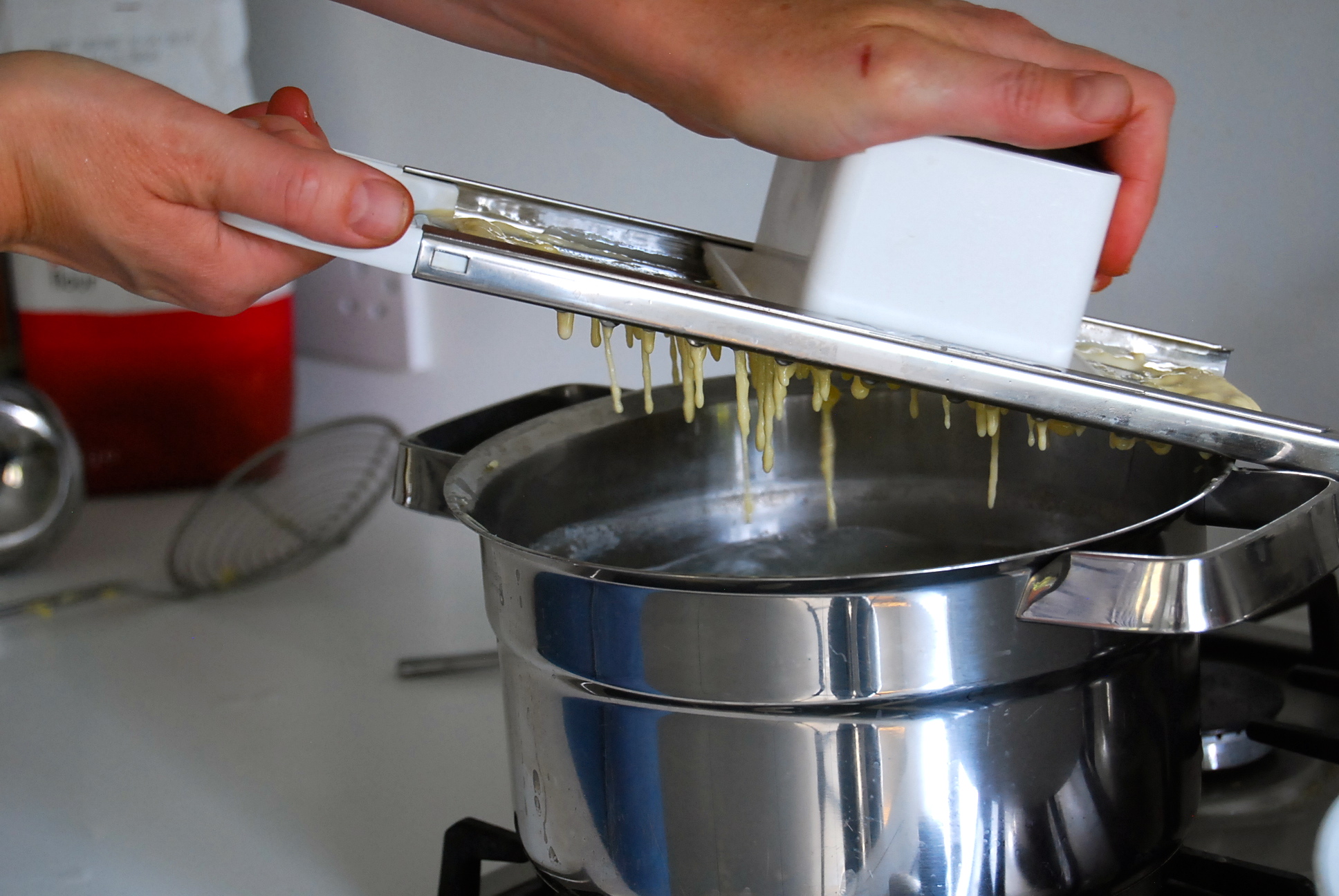
By moving the frame back and forth across a metal ‘grater’, the batter is forced through the holes and runs down in long drops:
In the end the ‘machine-made’ Spätzle (on the left) don’t taste much different, but they do look slightly stumpier than the hand-made ones (to the right).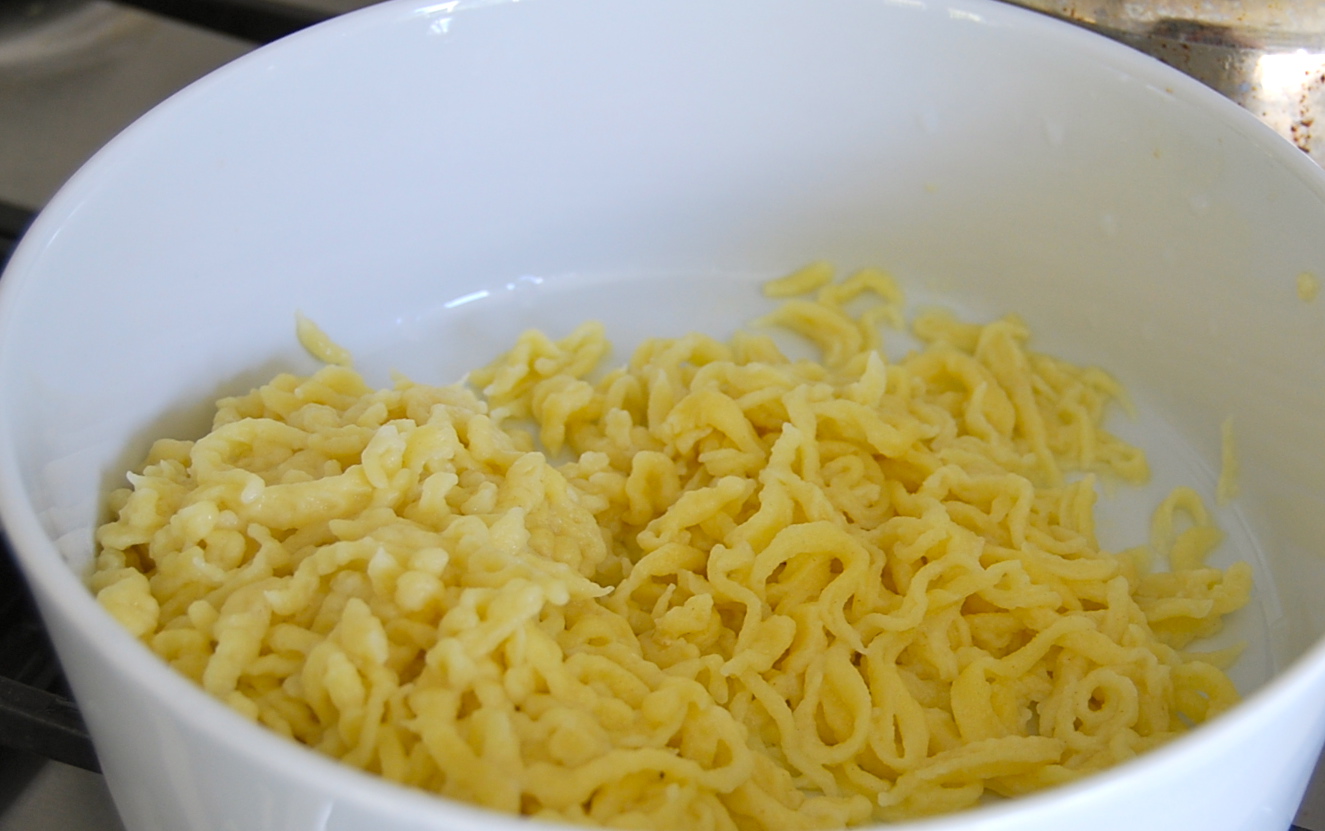
Anyway, whatever way you make them, they are incredibly delicious: light and delicate, their uneven texture allows sauces to stick to them, making them the perfect accompaniment for casseroles or meat dishes. I’ll be posting a few recipes over the next weeks, especially when I will get my hands on some venison come Autumn!
For the time being, I will offer you a version that is typical for the Allgäu region, where we spent our holidays: Kässpätzle, or ‘cheese Spätzle’, the Swabian version of macaroni cheese. This is not your light lunch option, it is a rather heavy dinner that will send you reaching for a beer and – possibly – a glass of Obstwasser, such as Slivovitz, to aid your digestion. In other words: perfect for this cold and miserable weather!
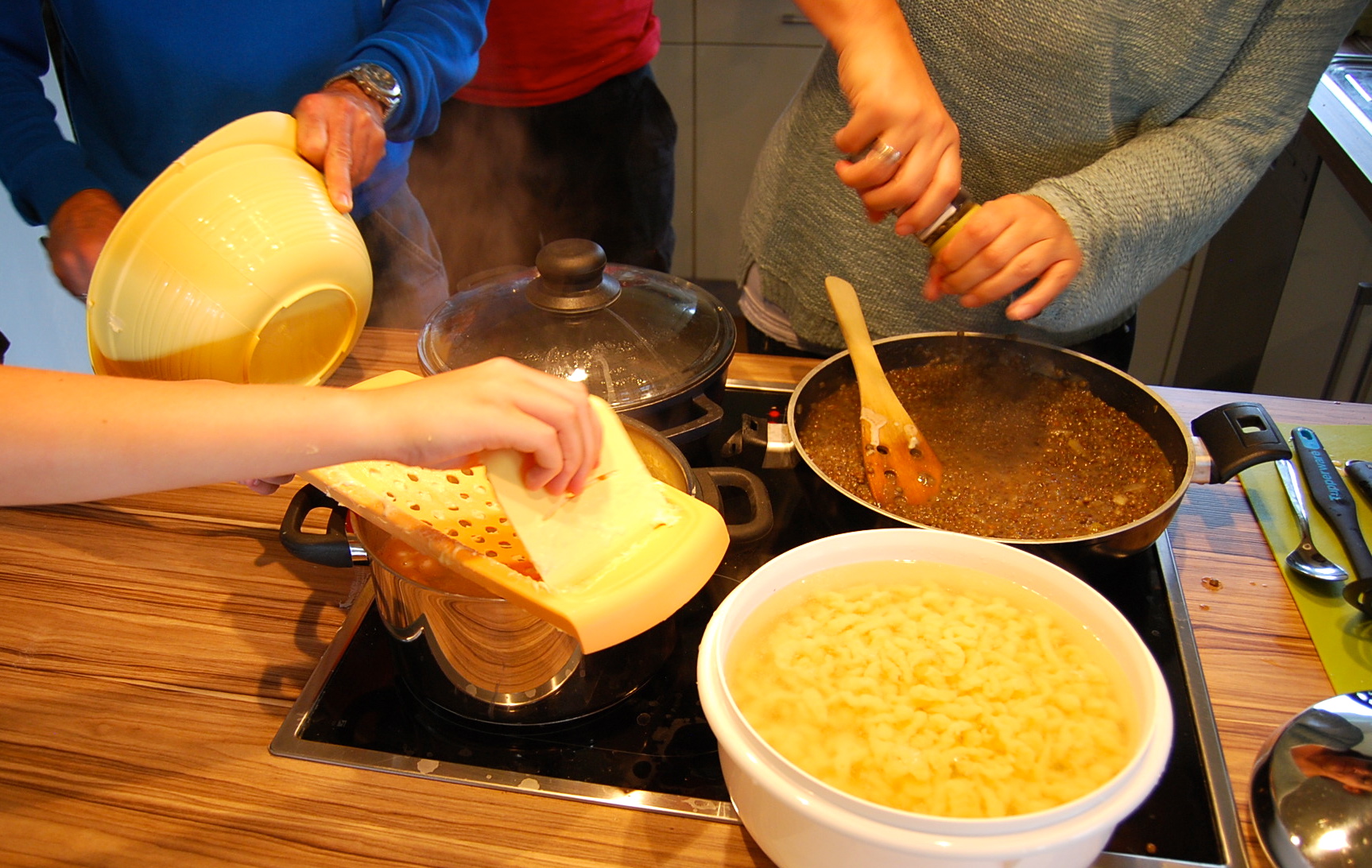
In the Allgäu, Spätzle are made slightly differently: they are pushed through a sieve with much bigger holes to create rather short little dumplings, much shorter than the Spätzle I made. You can see us at work in my cousin’s kitchen:
 If you haven’t got a contraption like this, check out Crowded Earth Kitchen‘s post, where you can see how to use a simple sieve 🙂 In some regions these are then called ‘Knöpfle’, ‘little buttons’, to distinguish them from the more laborious Spätzle I presume.
Kässpätzle (Cheese Noodles) (serves 4)
For Kässpätzle, you’ll need to make Spätzle out of 4 eggs and 400g flour (double the amount per person than for the Spätzle as a side dish), as well as 3 onions and 200g of grated cheese, such as a mature cheddar, but an Emmental cheese would be more authentic.
You simply layer the Spätzle and the cheese in an ovenproof dish, seasoning each layer with pepper and salt. Then you warm it up in your over until the cheese is beginning to melt.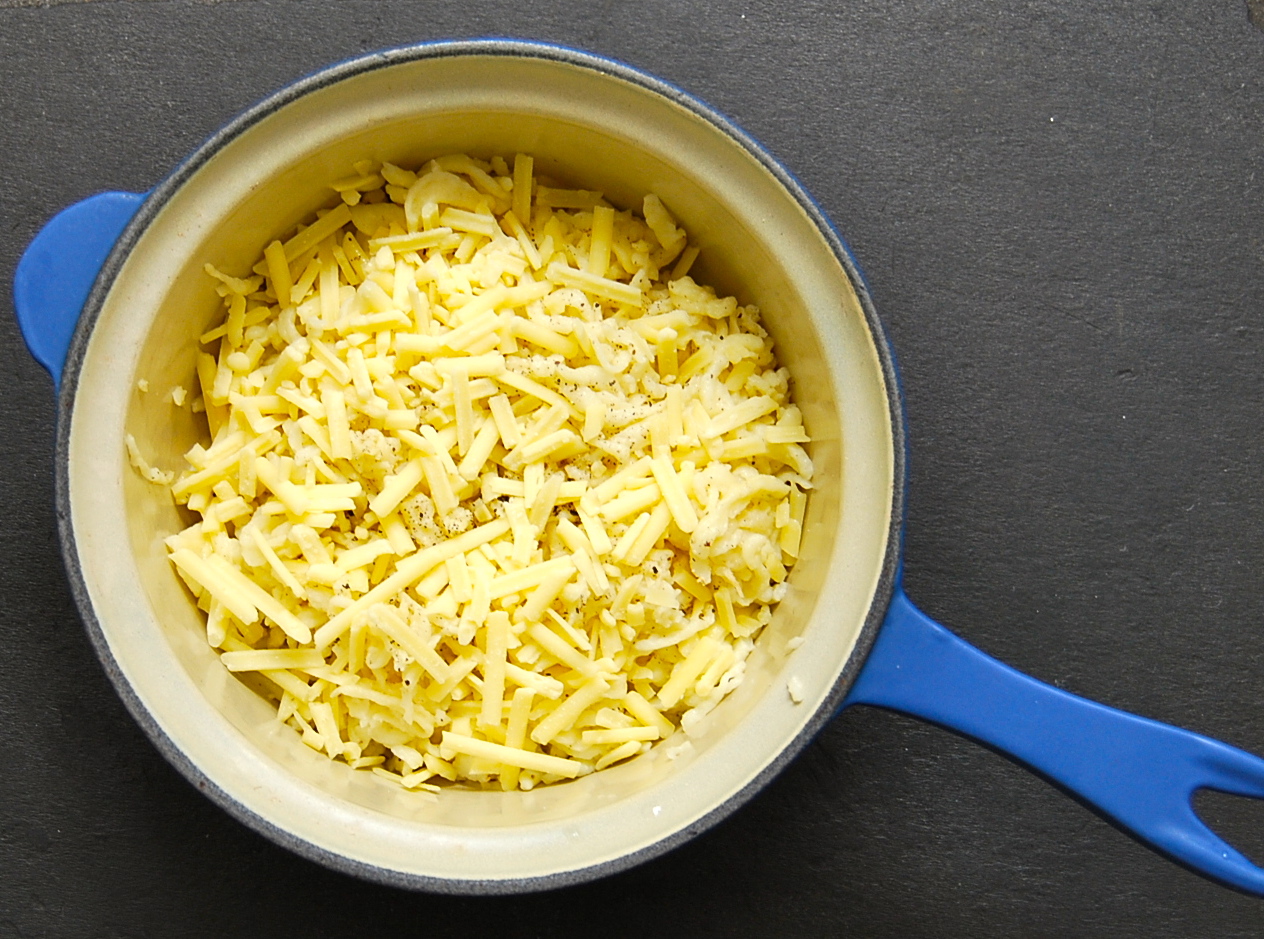
Now slice the onions into thin rings and fry them at a medium/high heat until they are nicely browned. Remove the dish from the oven, add the onion rings on the top and serve with a side salad. And beer.
By the way, the name ‘Spätzle’ can be translated as ‘small sparrow’, which happens to be a common term of endearment, like ‘darling’. Although I love them, I am not going to insist that Swabians call each other after dishes to express their love: after all ‘Spatz’, like the bird ‘sparrow’, is quite a popular name to call your lover, too 😉
Intrigued? Well, Nigel Slater and the BBC were, which is why they invited me to take part in the filming of his new series ‘Eating Together‘, which will air on BBC1. You’ll not only get a crash course on how to make Spätzle, but Nigel Slater will show you how to use them for his amazing version of macaroni cheese. Now that’s what I call fusion food!


 Ginger&Bread
Yeeesss!!
Love the photos, I felt like I was making this with you for a min there lol
LikeLike
So cool you’re making Spätzle… great instructions too, I’ve never made them myself and your photos explain the process really well. Yum!
LikeLike
Have a go – it’s not half as difficult as my clumsy explanation make you believe 😉
LikeLike
Oh…these are one of my absolute favorites! We have this place in Trier, where we go from time to time ONLY to have a nice proper German food and these!!! When I’m back from my holidays this is the must on my list of things to eat. Great I could see how you make them 🙂 xx
LikeLike
I went to Trier once, it looked beautiful! Crossed over into Luxemburg for a quick excursion, if I remember correctly, but we only visited a petrol station … Do give them a try and let me know how it went!
LikeLike
Uhmm I hope at least the gas station in Lux was fun 😀
LikeLike
I forgot to mention- both of course!!
LikeLike
Noodle! Always noodle!!
LikeLike
Looks interesting, Ginger. I think I’ll have a try making them. I can imagine that there’s a knack to making these – probably something that’s easy to do if you’ve grown up with the technique. You’ve added sparkling water, which doesn’t sound like a traditional ingredient, somehow. Do you think beer could be another option to add lightness – like beer batter in Britain?
LikeLike
Thanks – and what an interesting idea! Never thought of it before … must give that a try someday 😉
LikeLike
Du schabst aber sehr weit hinten 😉
LikeLike
Was man nicht alles für die Kamera tut 😉
LikeLike
Danke Mat, mir fiel es auch auf ☺ schönes Bild von unserem Abschiedsessen “Gaisburger Marsch.” Der ist auch einen Blog wert 😆
LikeLiked by 1 person
These look delicious! I’ve always wanted to try making spätzle, you’ve given me the perfect excuse to give them a try. Thanks!
LikeLike
I LOVE Spaetzle! (I tried them a few times before I had to give up eating wheat products) but so far have had three very failed attempts at making them – dough too wet, dough too thick, dough covering entire kitchen 😉 I haven’t tried the board method because it looks so tricky – there are so many amazing videos of grannies doing it at high speed on YouTube that I am totally intimidated by it!
LikeLike
I know – I come from a long line of those grannies but the gift must have been lost somewhere in an unfortunate mutation 😉
LikeLike
I actually had this for lunch today! Delicious! Thanks for the recipe! 🙂
LikeLike
Let me know how you get on – it takes a wee bit of practise …
LikeLike
Credit where credit’s due: my friend Nicole, who just started her own blog TooFoodToBeTrue.wordpress.com, kindly helped me with the photographs. Thanks for your great help – there’sno way I could have made those action shots myself 🙂
LikeLike
Cheese spaetzle. *Heaven*
LikeLike
Absolutely!
LikeLike
Pingback: Springerle – Aniseed Biscuits | Ginger&Bread
Pingback: Serviettenknödel, a Dumpling for Special Occasions | Ginger&Bread
Pingback: Consommé with Crêpes – Flädlesuppe | Ginger&Bread
Pingback: The Schnitzel Challenge: Viennese Schnitzel, the one and only | Ginger&Bread
Pingback: German Wine, traditional Onion Quiche, and a German Wine Giveaway | Ginger&Bread
Pingback: Say Cheese: My 15 Seconds of Fame | Ginger&Bread
Pingback: Hugo: elderflower+prosecco=cocktail | Ginger&Bread
I am so happy I found your blog, I love it! I want to keep reading. I can’t wait to make spaetzle.
LikeLike
Pingback: Nigel Slater’s Spätzle and Cheese | Ginger&Bread
Pingback: Steak and Stout with Spätzle: Schwenglish in 3 Courses | Ginger&Bread