After last night’s rather comprehensive victory, the second semi-final tonight will decide which team is going to teach Germany a lesson or two about winning a match. Argentina will need some support, and I think a slice or two of this cake might just do the trick. Torta Rogel, or Alfajor Rogel, is a uniquely decadent concoction of thin, crispy layers of pastry, filled with the ubiquitous caramelized condensed milk duce de leche, and topped with Italian meringue. You can’t go wrong with that.
Alfajores are layered cakes, popular snacks all over South America as well as Spain. The word is of Arabic origins: الفاخر means ‘luxurious’ and links the origins of these type of sweets to Moorish Spain, al-Andalus, the period from the 700s to 1492 when large parts of Spain were governed by Muslim rulers.
‘Moorish’ adequately describes this dish, which is not easy to make but worth the effort. In Argentina it is often served as a wedding cake, but you need to ensure that your dress gives you a little room to expand. I found detailed instructions on Flor’s website, Recetas y Tortas YA!, and I used Flor’s recipe, especially the video of her making the cake which was very helpful. When she reminds you – repeatedly! – to roll out the dough as thin as you can, you need to heed that advice. Despite trying my best, my Rogel could have done with slightly thinner layers… but without anyone noticing, soon I will try and make another one to hide the photographic evidence of my impatience. First I have to loose the weight I gained trying this one…
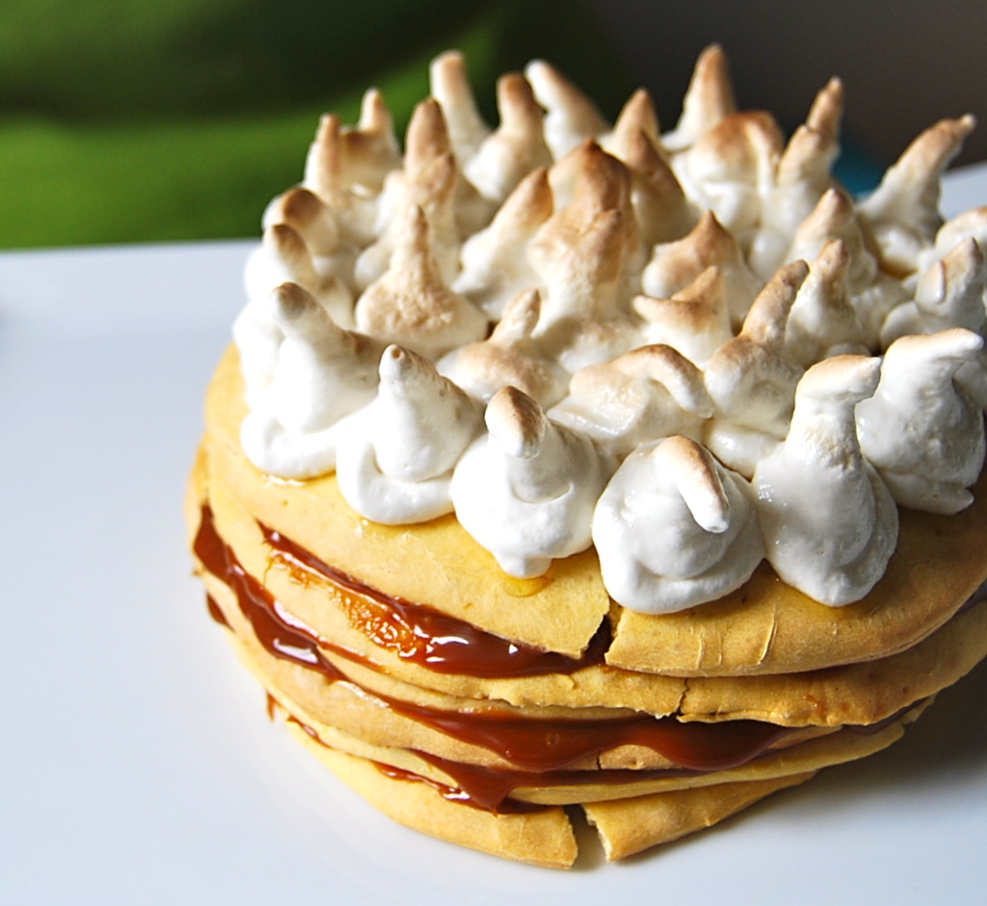
Alfajor Rogel or Torta Rogel
Alfajor Rogel (for 5 discs of 21 cm diameter)
Pastry:
- 3 egg yolks
- 1 egg
- 1 tbs strong alcohol (Vodka etc.)
- 160 gr flour ‘00’
- 1 tsp salt
Filling:
- 400 gr. dulce de leche
Italian Meringue:
- 1 egg white
- 60 gr caster sugar
- 2 tbs water
For the pastry:
Sift the flour onto your work surface and make a hollow in the middle, in which you put the remaining ingredients. Make sure to keep one egg white for the meringue!
Knead until you have a smooth and uniform dough. Add water if necessary. Let the dough rest, covered with plastic wrap, for at least 30 minutes at room temperature.
Preheat your oven to 180-200 ° C. Flor wants you to keep it at that temperature for at least ten minutes before putting in the pastry. Cut the dough into 5 equal sized pieces. Roll out each piece until it is very thin and cut out circles. I used a cake tin and rolled out the dough on a sheet of parchment paper, to help me lift it onto the tray in one piece! Remember to roll it our very thinly …
Put the discs onto an ungreased baking sheet and use a fork to prick the dough in several places so it does not curl. Bake for 10 minutes or until they are golden brown on the edges.
I assembled the cake as the disks came out of the oven – they were still quite hot, which made it easier for me to spread the dulce de leche on them, layer after layer.
For the Italian meringue:
Beat your egg white with a hand mixer until it forms very stiff peaks. In a small pan, measure out the water and pour in the sugar right into the middle of the pan – you want to avoid any sugar crystals sticking to the sides of the pan!
Over a medium heat, and without touching or mixing, bring the water to boil. Once you can see no sugar crystals, turn up the heat and watch it bubbling away. This will take a few minutes – if you have a sugar thermometer, wait until it reaches 120C. Otherwise, just watch it bubble up for a bit and hope that the sugar has dissolved …
As soon as you think it is ready, start whisking your egg white again and pour in the syrup, trying not to pour it onto the whisks as your don’t want to be splashed with boiling hot sugar syrup. Continue until the mix has cooled down completely and has a lovely silky texture.
Pipe it onto the assembled cake and brown it for a few minutes under a hot grill.
Enjoy! And if this alfajor is not sweet enough, try your hands – or, your sweet tooth – at an Argentiniana chocotorta. I bet you can’t get any more decadent than that!
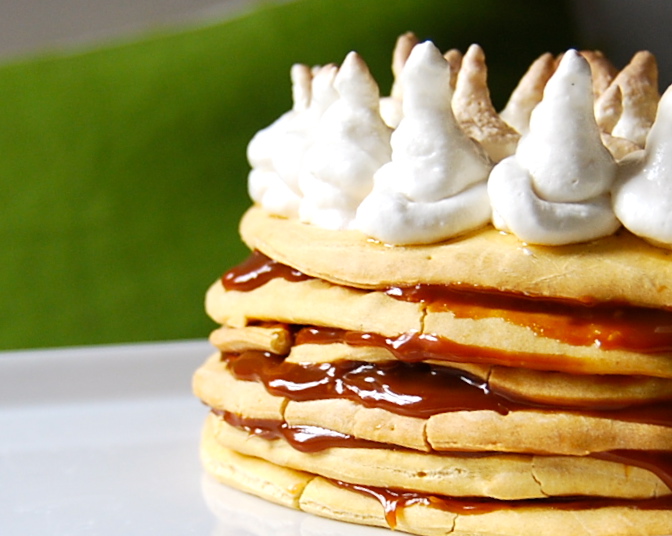
Torta Rogel


 Ginger&Bread
That’s amazing – it looks like a crown.
LikeLike
Apparently it’s quite popular as a wedding cake – it does make for an impressive centrepiece!
LikeLike
It’s very popular in Uruguay, as well. If I remember correctly, my mum’s recipe doesn’t use any eggs for the pastry, which might be why they’re really thin and crispy (she also cooks them on a cardboard disc in the microwave, but best not to talk about that!).
LikeLike
Oh please speak to your mum about the recipe! I’d love to see if not using eggs will give you a much crispier pastry, which would be great. So far the chajá is still our favourite …
LikeLike
I asked my mum. Her recipe calls for only flour and double cream, plus a few drops of some sort of alcoholic beverage (spirits, rather than wine or beer. She says she uses whatever is at hand: whiskey, brandy, whatever). She doesn’t do exact measurements, but she says she basically adds flour to the double cream until it’s at a point where you can barely touch it without flouring your hands. Says that makes it really easy to roll out, and you can even do it just with your hands.
I must say, having been in the kitchen while she makes it, making a nuisance of myself by trying everything, the pastry on its own doesn’t really taste like anything. The thing is, when it’s that think and crispy, all it’s doing in the cake is adding texture and keeping you from eating the dulce de leche by the spoonful, so it doesn’t really matter!
By the way, she also says she finds making Italian meringue a faff, so she makes hers au bain marie, and instead of adding the melted sugar to the beaten egg whites just adds sugar and a spoonful of water to that. I can vouch for that tasting really nice, but I do like Italian meringue better!
Finally, if you have any dulce de leche left over from the Rogel, this is my favourite, very scaleable recipe. Make basic shortcrust pastry for the base and blind-bake it (I’ve even used the storebought pastry cases instead -gasp!- and they’re not too bad). Spread a layer of dulce de leche on top (half to 1 cm thick, to taste). In a bowl, mix with a fork egg whites, icing sugar and chopped nuts (walnuts work well, and so do hazelnuts, or some sort of mix). How many egg whites will depend on the size of the cake, but for a 20-25 cm round one I use 1 egg white. You use 100 g of icing sugar per egg white. Spread the mix over the dulce de leche and stick in a medium oven until the top is crisp and starting to brown. Let it cool a bit before serving, otherwise the dulce de leche will be much too runny. It tastes best slightly lukewarm!
LikeLike
You are an absolute star! I will give these a try over the summer holidays and report back 😉
Thanks to your mum, too!!
LikeLike
Pingback: Countdown to the Worldcup in Brazil | Ginger&Bread
Pingback: Pastel Tres Leche | Ginger&Bread
Pingback: Macmillan Coffee Morning – Vote for your Cake! | Ginger&Bread