This Russian salad – or Salade Olivier, comes with a lot of history: first invented in the 1860s in Moscow by a chef named Lucien Olivier, who guarded the recipe jealously. His sous-chef – apparently – stole the recipe and opened up his own restaurant to sell his version – needless to say, it simply wasn’t the same. Check out the history on the SRAS website, which also discusses the different versions.
Despite its criminal origins, the salad was such a success that it took Russia and the world by storm, which is how I have come across it: in its disguise as an ensaladilla rusa, one of the most popular salads in Spain.
The historical version probably included all sorts of delicacies, from game birds via veal tongues to caviar, which are hard to come by if you don’t have the spending money of an oligarch. The basic version of this popular dish includes potatoes, carrots, peas, hard-boiled eggs and mayonnaise, with chicken, mince meat, apples and gherkins as regional (or personal) variations. I stuck to the basics in order to placate fussy eaters; I’m fine without the meat but would have loved to add gherkins and even half an apple. The following quantities, therefore, are just to give you a rough idea of what you need to get to the version on the picture – ideally you adjust quantities – as well as ingredients – to suit your tastes!
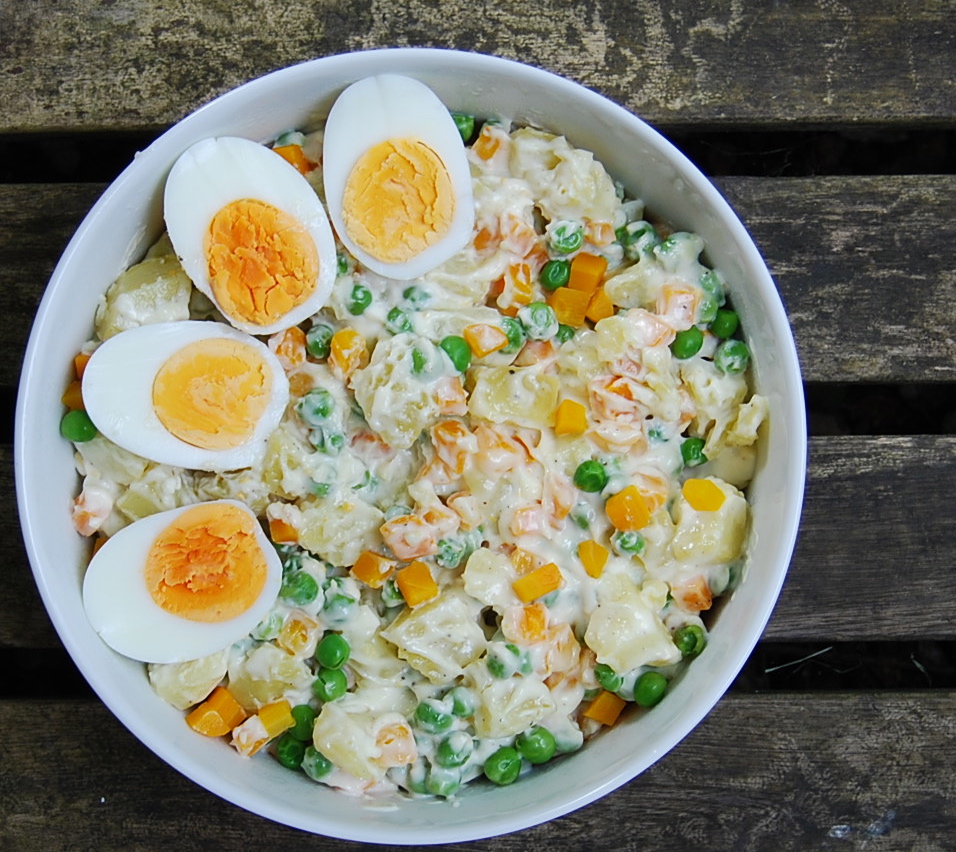
Russian Salad or ensaladilla rusa – perfect for picnics or barbecues
Russian Salad – Salade Olivier (served 6)
- 500g salad potatoes
- 1-2 carrots
- a handful of peas (frozen or canned)
- 2 hardboiled eggs
- 200g mayonnaise
- salt and pepper to taste
Boil the potatoes until they are not too soft – you need to dice them into small cubes. The same with the carrots and one of the two eggs.
Carefully mix the veg (and other ingredients) with the mayonnaise until you get a consistency you like – some people will be happy with just a dollop or two, others want to see the stuff drown in a sea of mayonnaise. It’s your call, really.
Season with salt and pepper and decorate with the second egg. For a traditionally Russian arrangement, place an olive in the centre of a round bowl and arrange the sliced eggs in a circle around it. That’s the way you’d want to serve it for a traditional Russian New Year’s dinner!


 Ginger&Bread
Looks good!
LikeLike
It is 😉 I was trying to stick to the basics to make it ‘authentic’ but I think it’s a dish that cries out to be altered!
LikeLike
Yum looks great!
LikeLike
These look amazing. Really nice recipe and great presentation 🙂
LikeLike
Thank you! Some dishes, however delicious they are, are difficult to ‘present’, and this is one of them, especially if you like it smothered in the white stuff 😉
LikeLike
Very beautiful. The pictures are so vibrant! Nice!
LikeLike
Ta! It’s not easy, so I am kinda quietly pleased with the result. It tastes even better, you know!
LikeLike
Oh I bet!!
And it is a great relief and an inner pleasure when something tricky to make come out excellent 🙌
LikeLike
Pingback: Countdown to the Worldcup in Brazil | Ginger&Bread